When "Low-Key" Was Fear in Neutral Colors: Sending the Birthday Text

The PATH Food Court and the Birthday Invite Spiral
If you’re a late-20s hybrid worker in Toronto who can send a client follow-up in 30 seconds but has been rewriting a birthday text in Notes all week, this is birthday invite anxiety—not you being chill. When Casey (name changed for privacy) sat down with me, that was the exact kind of panic she brought in: polished on the outside, privately wrecked by the send button.
As she talked, I could practically hear the scene around her: 12:18 p.m. in the PATH under King Station, Slack pinging, cutlery clattering, HVAC humming overhead, a too-salty salad going ignored while her phone grew warm in her hand. She kept changing one line from ‘birthday drinks next Friday’ to ‘might do something low-key if you’re around,’ rereading it, locking the screen, then opening Instagram instead. She wanted to send the invite and feel chosen. She also expected a letdown if the replies came back vague, slow, or thin.
Her apprehension had that specific bodily shape I know well—a chest pulled tight like a drawstring bag, a stomach dropping half a floor like an elevator that missed its stop. She looked at me and said, very evenly, ‘I would rather act like I do not care than find out I cared more than they did.’
I nodded. ‘You call it low-key, but your body knows it isn’t.’ Then I told her something I wish more people heard before their birthday week turned into group chat anxiety and private heartbreak: a lot of adult birthday hurt happens before anyone even replies. ‘So let’s not make this a verdict machine,’ I said. ‘Let’s make it a map. We’re going to find where the fear enters, where the longing is still alive, and what clarity looks like when your worth is no longer on trial.’

Choosing the Compass: The Decision Cross · Context Edition
I asked Casey to set her phone face-down, place one hand over the tight place in her chest, and say the question once, without cushioning it: should I send the birthday invite, or am I just setting myself up to feel bad? Then I shuffled slowly. For me, that small ritual is never about theatre. It is a nervous-system handoff—from spiraling alone to looking at the pattern in daylight.
For this kind of send-or-don’t-send question, I use a five-card decision spread called the Decision Cross · Context Edition. It fits because the surface choice looks binary, but the real leverage is deeper: what does Casey’s mind make a slow RSVP mean? This is how tarot works at its best. Not as fortune-telling, but as card meanings in context. The spread separates the visible stall, the belonging wound underneath it, the two coping paths branching from it, and the most grounded next step.
I explained the structure to her as I laid the cards into a cross. The center card would show the concrete knot: the drafted invite, the hesitation, the freeze between reaching out and bracing for disappointment. The card below it would expose the hidden driver making the choice feel dangerous. The left and right cards would show what the ‘send it’ path and the ‘hold back’ path were really doing emotionally. The top card would give us the antidote: how to act without turning other people’s response energy into the measure of self-worth.
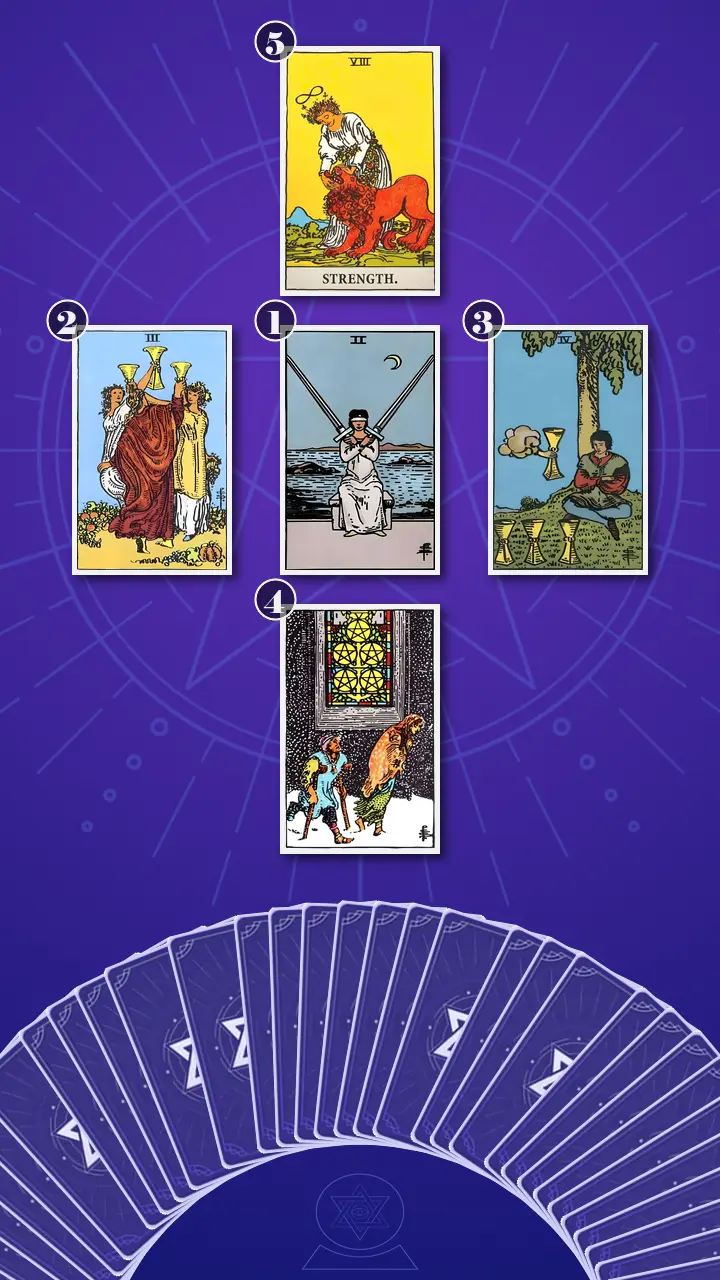
Reading the Map: The Cards on the Table
Position 1: The Draft That Never Leaves Notes
I turned the center card first and named the position clearly: this was the concrete symptom knot—the drafted birthday invite, the hesitation to send, and the freeze between reaching out and bracing for disappointment.
Two of Swords, upright.
The image told the truth instantly. Casey was back on that lunch break in the PATH, editing the invite so it sounded casual enough to protect her, then closing the app instead of sending it. It was the social equivalent of A/B testing campaign copy forever and never hitting publish. The blindfold on the card felt exactly like social mind-reading without evidence; the crossed swords over the chest looked like protective wording blocking the real ask. Low-pressure wording is sometimes just fear in neutral colors. Energetically, this was blocked Air: analysis over-functioning because feeling the exposure seemed riskier than staying stuck.
I asked her, ‘What are you trying not to feel in the first thirty minutes after you send it?’ Casey let out one short, bitter laugh and dropped her gaze to the table. ‘Stupid,’ she said. Her thumb started rubbing the edge of her phone case. ‘Like I made it weird by caring.’ That was the moment the stalemate stopped looking vague and started looking precise.
Position 4: The Lit Room at the Edge of the Chat
Next I turned the card below the center—the deeper factor shaping both options, the wound running the decision from underneath.
Five of Pentacles, upright.
This card never shouts. It just makes the emotional temperature drop. I saw the whole modern scene immediately: a pasted invite sitting in a group chat, the phone being flipped face-up every few minutes, office coffee going stale, shoulders creeping toward ears while the silence grows teeth. The stained-glass window in the card became the birthday table, the photo dump, the friend cluster, the chat thread that feels close enough to touch and somehow still not quite yours. It was the social version of realizing you’re not on someone’s Close Friends and deciding that tells you everything.
Here the energy was Earth in scarcity mode. Not facts—story. Ordinary delay was being translated into exclusion. I said it as gently and directly as I could: ‘This is the part of you that hears silence and instantly thinks, “Okay, now I know where I rank.”’ I watched the reaction move through her in three quick beats. First, her breathing paused. Then her eyes went unfocused, as if half a dozen quiet chats were replaying behind them. Then her shoulders dropped a fraction and she said, almost under her breath, ‘This one hurt because it’s true.’
‘Yes,’ I said. ‘And it matters that we name it correctly. Because you can want company without putting your worth on trial.’
Position 2: The Table You Actually Want
Then I moved left, to the position showing what the ‘send it’ path was really about in this case: the genuine desire for celebration, connection, and being allowed to want company.
Three of Cups, upright.
The reading warmed the instant this card appeared. This was not a fantasy montage or a desperate grab for reassurance. It was a real table at a low-key Toronto spot, maybe near Ossington, maybe one friend from work and one old friend finally clicking, maybe shared fries, maybe cocktails, maybe the kind of laughter that makes people lean in. The raised cups were visible mutual yeses. The circle of dancers was the relief of shared momentum instead of endless social guessing. Energetically, this was balanced Water: healthy longing, not neediness.
I told her, ‘This card does not say you need a packed room. It says your desire is clean.’ Casey exhaled and nodded before I finished. ‘I don’t need perfect,’ she said. ‘I want real.’ Her face softened around the eyes for the first time, and I could almost see actual names starting to come to mind.
Position 3: The Cost of Acting Unbothered
On the right side, I turned the card that shows what the ‘hold back’ path protects and what it quietly costs.
Four of Cups, upright.
This one was exact. It was Casey saying, ‘Honestly, maybe nothing, super low-key,’ before anybody had asked for that disclaimer. It was putting her emotional phone on Do Not Disturb before anyone had even texted. The offered cup in the image was possible connection itself, but her posture on the card had already folded closed. Energetically, this was Water in withdrawal: not an absence of feeling, but defended feeling.
I said, ‘Keeping the invite unsent may feel like control, but it also blocks the clean chance to receive what you say you want.’ She pressed her lips together, nodded once, and gave me that half-smile people use when a truth is both relieving and a little offensive. ‘So I make the plan vague enough that nobody can clearly say yes,’ she said, ‘and then I act like that told me something.’
‘Exactly,’ I said. ‘It protects you in the short term and recreates the loneliness in the long term.’
When Strength Put a Hand on the Lion
Position 5: The Antidote Above the Cross
When I reached for the final card—the guidance, the antidote, the posture that could reorient the whole reading—the room changed. The rain at the window thinned to a soft tapping, and even Casey stopped fidgeting. This was the card everything beneath it had been lifting toward.
Strength, upright.
I began with the setup she already knew in her body. ‘You know that lunch-break moment,’ I said, ‘when you swap “birthday drinks” for “if you’re around,” lock your phone, and pretend scrolling counts as deciding? That tiny moment is the whole loop. You want warmth, and then you hide the part of you that wants it.’
The invite is not a referendum on whether you matter. It is a clear doorway.
Not the blindfold of perfect protection, but the lion-hearted act of honest outreach—Strength asks you to lead with self-respect, not fear of a letdown.
I let that sit between us. On old cruise bridges, long before I was doing sessions like this, I watched captains make docking calls in moving water. You do not wait for the sea to become emotionless. You approach the harbor with a clear line, steady hands, and respect for the swell. My old Port Decision Model still lives in my bones because of that. Strength is a harbor card. It does not ask for bravado. It asks for leadership of your own nervous system.
Then I brought in what I call my Choice X-Ray, the Venetian habit I use whenever a decision feels emotionally expensive. Send the invite: the cost is temporary exposure, a tight chest, maybe a slow reply, maybe a maybe. The benefit is real data, honest outreach, and a night that actually has a chance to exist. Hold it back: the benefit is short-term relief. The hidden cost is guaranteed ambiguity, self-erasure, and one more story about how nobody chose you when no clear door was ever opened. That is why Strength is the antidote. It is not telling you which outcome is certain. It is showing you which action keeps your dignity intact.
Casey reacted in a sequence I know well. First she went very still, fingers suspended above the edge of the table as if her body had hit pause. Then her eyes lost focus—not blank, just busy, replaying the edits, the softened wording, the little ‘no pressure’ tucked into the text like emotional bubble wrap. Then the feeling arrived. Her jaw loosened. One shoulder dropped, then the other. Her eyes glossed, just enough to catch the light. ‘But if I send it clearly,’ she said, and now there was a flash of anger under the tenderness, ‘doesn’t that mean I’ve been making myself smaller for no reason?’
‘Not for no reason,’ I said. ‘For protection. But protection can outlive the moment it was built for. The issue was never that you wanted too much connection. The issue was that disappointment taught you to mistrust your own longing.’
She let out a breath that sounded like it had been waiting behind her ribs all week. There was relief in it, and also that odd, brief dizziness that can come after a heavy bag is set down and you realize your hands are empty now. I asked her, ‘With this new lens, was there a moment last week this would have changed?’ She nodded immediately. ‘The PATH,’ she said. ‘When I changed it to “if you’re around.” That was the exact second I disappeared.’
That was the real shift. Not from fear to fearlessness, but from guarded anticipation and rejection pre-loading to warm, clear, self-respecting outreach. Strength was showing her that she could feel exposed without making herself smaller.
From Insight to Action: The Warm Clear Ask
Once all five cards were on the table, the story became clean. Casey had been standing outside her own party with the lights off so nobody could disappoint her. At the center was the Two of Swords freeze: turning a vulnerable social ask into a wording problem. Beneath it sat the Five of Pentacles wound: the fear that slow or mixed RSVP energy would prove she was socially adjacent rather than truly included. On one side, the Three of Cups kept telling the truth—she wanted warmth, reciprocity, and a small, real celebration. On the other, the Four of Cups showed the defensive move: lower the stakes, blur the plan, act indifferent first, and then feel the loneliness anyway.
I told her the blind spot as plainly as I could: ‘You are treating other people’s timing as privileged evidence about your worth.’ Then I gave her the direction of change: ‘We’re moving this from a test of who cares to a clear act of self-honoring outreach.’ A clear invite is self-respect, not neediness. So I gave her a plan small enough for a real nervous system, not an idealized one.
- Build the harbor, not the fantasy castTonight, choose one plan you would genuinely enjoy even if only three or four people come: one venue near a subway stop, one date, one start time, and one spend that fits your real budget. Then send one clean script to two or three anchor people you actually want there: ‘Hey, I’m doing birthday drinks at [place] on [day] around [time] if you’d like to come.’If the full group chat feels too exposing, stop at the anchor texts first. Small and clear beats vague and overwhelming.
- Use the No-Verdict RSVP RuleBefore checking replies, open a Note with two headings: ‘What happened’ and ‘What I’m making it mean.’ Log only the data—‘2 yeses, 1 maybe, 3 pending’—and give the plan a real response window, like until Thursday night, so every hour does not become a referendum.This is my Reality Testing method in miniature: facts first, story second. Mixed RSVP energy can be information without becoming a verdict.
- Do the 10-minute face-down resetAfter sending, put your phone face-down for ten minutes and do one ordinary grounding task: make tea, shower, walk around the block, fold laundry, or refill your water bottle before you look again.If ten minutes feels impossible during a work block, make it one TTC stop or the length of a kettle boil. The point is to interrupt the spiral, not perform perfect self-control.
Casey gave me the most reasonable objection possible. ‘I can’t exactly disappear for ten minutes in the middle of a workday,’ she said. ‘Slack exists.’
I smiled. ‘Then we scale it. This is not a monastery. Make it one streetcar stop, one washroom break, one lap around the office kitchen. Strength is steady, not dramatic.’

A Week Later: The Quiet Proof
A week later, Casey sent me a screenshot. The text was simple and direct: a real place, a real day, a real time. Under it she wrote, ‘Sent it to three people first. Two yeses, one maybe. I did not rewrite myself into corporate copy.’ I laughed out loud when I read that, because it was exactly the kind of line that tells me someone has found their footing again.
She also told me something smaller, which is usually how I know the change is real. She slept a full night after sending it. The first thought when she woke was still, what if the turnout is thin?—and then she smiled, opened her facts note instead of the chat, and booked the table anyway.
That is what clarity looked like here. Not certainty. Not a cinematic Instagram birthday photo dump. Just a woman letting the invitation be honest, letting the data stay data, and keeping ownership of her own warmth. That is what this Decision Cross · Context Edition was built to reveal, and it is why I trust tarot most when it hands the power back where it belongs: not to the cards, but to the person willing to act with self-respect.
When a simple birthday text makes your chest go tight, it is often not about one night out at all—it is the split between wanting to be chosen and bracing for proof that you might not be.
If that split is alive in you tonight, what would the warmest, clearest version of your own doorway sound like in words you would not need to apologize for?
Every reading at AceTarot is a Journey to connect with inner wisdom and empower next step.
Learn more about our Journey to Clarity.