A Full Sink, Three Unread Texts, and the Night Work Stopped Working

The Empty Inbox, the Full Sink, and the Moment the Room Got Loud
If you live alone in a city apartment and the second your laptop closes the place feels louder, the sink looks accusatory, and the unread badges suddenly hit like unread text anxiety, you are probably in this loop already. In plain language, this is high-functioning avoidance in plain clothes — productive procrastination after work, with better branding.
That was exactly how Alex (name changed for privacy) met me on screen from her one-bedroom near St. Clair West in Toronto. It was 7:43 p.m. on a Tuesday. Her work laptop had just snapped shut, the mug beside it smelled faintly burnt and gone cold, and through her half-open window I could hear a streetcar bell drift up between passing tires. Over her shoulder, cloudy water sat in a full sink; three message previews glowed on her lock screen like tiny alarms she could not make herself touch.
‘I can answer a 4:58 client email instantly,’ she said, rubbing the back of her neck, ‘but I still can’t open a text from my friend asking how I’ve been. And then I feel ridiculous about it, so I do one more work thing instead.’
I could see the contradiction clearly: she wanted the certainty of clearing work tasks, and she was scared of facing the emotional and everyday mess waiting outside work. The guilt in the room felt like a second gravity field — invisible, but strong enough to pull her shoulders up toward her ears and make her chest drop every time she looked toward the sink or those unread messages.
I told her gently, ‘This is not laziness. It is competence doing hiding duty. We are not here to shame the pattern. We are here to map it, so you can choose what happens next with more clarity.’
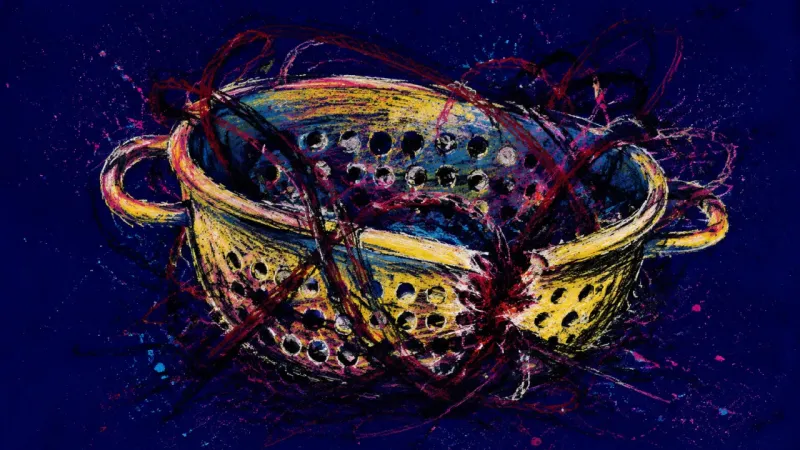
Choosing the Bridge: A Four-Card Map for High-Functioning Avoidance
I asked her to put both feet on the floor, take one slow breath, and hold the question in plain language: Work inbox cleared, sink full, texts unopened — am I hiding in work? Then I shuffled slowly, not as theater, but as a way to narrow the beam of attention. That is how tarot works at its most useful for me: not as a verdict from outside you, but as card meanings in context, arranged so the hidden logic becomes easier to see.
For her, I chose the Situation-Obstacle-Advice-Outcome · Context Edition. I use this simple four-card tarot spread for work-as-avoidance and unread text anxiety when the issue is not about predicting an external result, but about understanding a tight psychological loop with the fewest cards necessary. It moves cleanly from symptom, to blockage, to reframe, to lived next step.
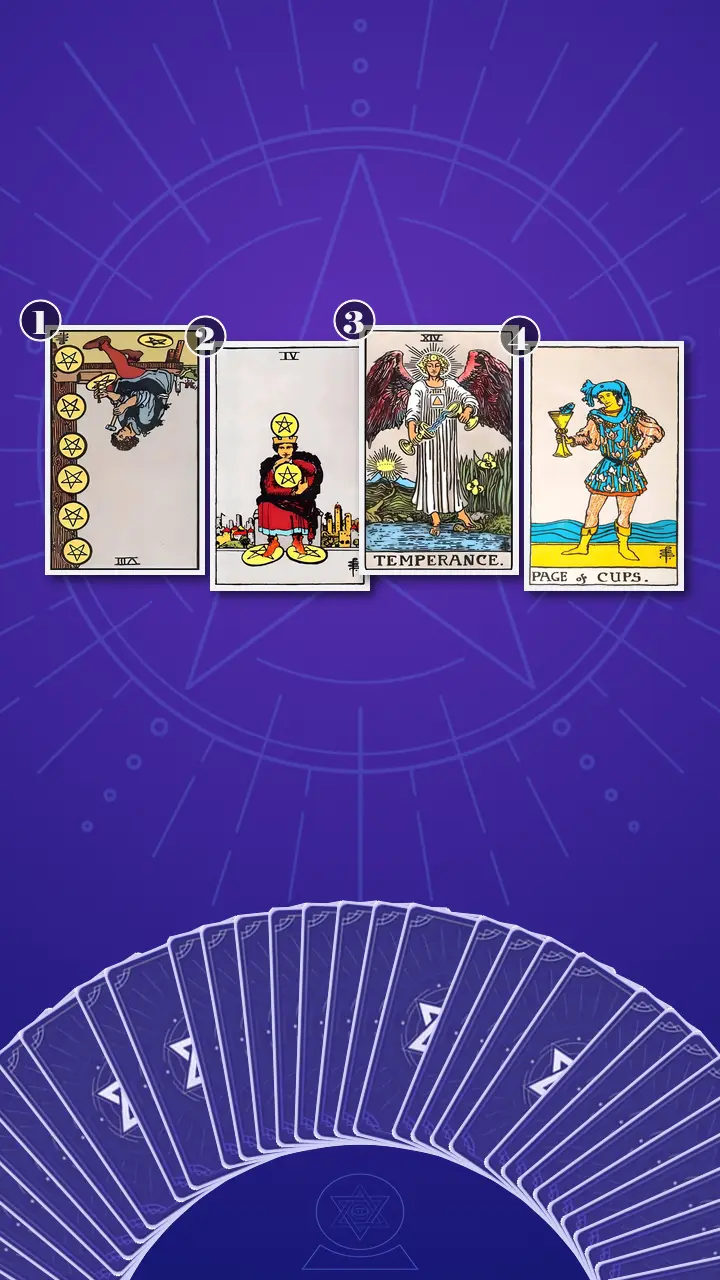
I laid the cards in a straight horizontal line, like a short bridge. The first card would show the visible pattern keeping the inbox tidy while home care and personal contact drift. The second would reveal why work feels safer than personal life right now. The third — the hinge of the whole reading — would identify the inner shift that could rebalance the system. The fourth would narrow the usual outcome slot into integration: not fortune-telling, but the first real-world expression of change.
Reading the Tight Orbit
Position 1: The Loop That Called Itself Wrapping Up
Now I turned the first card. This position shows the presenting pattern: the visible behavior loop in which work stays tidy while home care and personal contact are delayed.
Eight of Pentacles, reversed.
I told her what I saw immediately. This was 7:38 p.m. energy in her Toronto apartment: still cleaning up tiny client follow-ups, rewording a low-stakes email, checking sent items so the day could end feeling exact. The sink stays in peripheral vision. Three text previews sit on the lock screen. She keeps choosing the task with a definition of done.
In tarot language, this is earth energy gone narrow and overworked — not balance, but blockage. The craftsperson in this card is so bent over one lane of effort that the rest of life falls out of frame. It is like refreshing the same safe browser tab because the other tabs ask something personal. Very Inbox Zero brain. And this was the first clean reframe I gave her: an empty inbox is not the same thing as a settled life.
I asked, ‘What has your version of one last work thing been this week?’ She let out a short laugh that carried more recognition than humor. ‘Reformatting a follow-up nobody needed till tomorrow,’ she said. Her thumb kept rubbing the edge of her phone case. That half-laugh was the sound of the loop being named.
Position 2: The Grip Beneath the Good Habits
Then I turned the second card. This position reveals the underlying blockage: the fear-based reason work feels safer and more controllable than personal life right now.
Four of Pentacles, upright.
This card always shows me a grip before it shows me a problem. The moment Alex logs off, she does not feel free; she braces. She reopens Slack ‘just to check one thing,’ because standing in a quiet apartment with dishes, silence, and messages from people she loves feels more exposing than answering coworkers. The longer you wait, the more basic care starts feeling like a confession.
Here the energy is excessive and defended. Not deficiency — overconcentration. Work mode has become noise-cancelling headphones for the rest of her life. The pentacle clutched to the chest in this card is that held-breath feeling: if I stop moving, all the unfinished parts of me will catch up. So this was never really about discipline versus laziness. It was about safety versus exposure.
As I said it, the overhead light in her kitchen gave a faint electrical buzz, and she went still in that particular way people do when a sentence has landed exactly where it hurts. Seeing the Four of Pentacles, I had a quick inner flash of the planetarium dome: a small craft in a solar storm locking every stabilizer at once. It survives the pressure, yes — but it cannot change course while gripping that hard.
I asked, ‘When you look at the sink or see those unread texts, what is the first feared thought under the guilt?’ Her jaw tightened first. Then her eyes dropped to the counter behind her. Then she said, very quietly, ‘That it proves something. Like… if I can’t manage my own dishes and my own messages, maybe I’m only competent when somebody else gives me the rules.’
When Temperance Let the Cups Mix
Position 3: The Bridge Card
When I turned the third card, the room seemed to soften around the edges. This position identifies the key inner shift: the rebalancing principle that can loosen the productivity-as-protection pattern. In this spread, it was also the bridge.
Temperance, upright.
I told her this was the card of integration, measured pacing, and emotional regulation. One foot on land and one in water. Practical life and feeling life in the same body, on the same evening. The stream moving between the cups was the whole lesson: not reject work, not drown in feeling, but let attention circulate.
You know that moment when the laptop finally closes, the apartment gets louder, and your whole body drops the second you see the sink and the unread texts? That is not random. That is the transition where the hiding place stops working.
The trap is not that work matters too much. It is that work became the only room where you let yourself feel capable.
You do not need to live in sealed-off compartments anymore; start letting the cups mix, because balance grows from what you integrate, not from what you keep avoiding.
Outside her window, the streetcar bell had already passed; all I could hear now was the low fridge hum from her kitchen. I let the sentence sit there. Alex’s reaction came in three small waves. First, a physical freeze: her breath paused and her fingers stopped at the hem of her sweater. Then the thought sank deeper; her gaze went slightly unfocused, as if she were replaying a dozen nights at once — the Slack check, the cold mug, the bright little text bubble she could not bear to open. Then the feeling broke through, not as instant relief but as resistance. She let out a sharp breath and said, ‘But if that’s true, doesn’t that mean I’ve been doing this all wrong?’
‘No,’ I said. ‘It means one part of you became overtrained because it kept you safe. That is different from wrong.’ At the planetarium, I call this Orbital Resonance: two bodies do not stabilize by pretending they are separate universes. They stabilize through repeatable relationship. Your work self has been pulling all the gravity, and your home life has been left in eclipse. Temperance is not asking you to become less capable. It is asking you to let capability circulate. It is basically the opposite of Severance — not two incompatible operating systems, but one life that can finally sync.
I watched her shoulders lower by a fraction. Even that small release mattered. It was the first move from productivity-based self-protection toward integrated responsibility and calmer wholeness. I asked her, ‘With this new lens, think back to last week. Was there a moment when one tiny personal action could have changed the feeling of the night?’
She nodded slowly. ‘If I had washed even three dishes before picking up my phone,’ she said, ‘I think I wouldn’t have disappeared into scrolling. I think the whole night would’ve felt less like evidence against me.’
‘Exactly,’ I told her. ‘Count one human thing as done today. That is not extra credit. That is the medicine.’
I gave her the practical version right there, while the card was still warm between us. ‘Tonight, before you reopen Slack or start scrolling, set a 10-minute timer. Choose one personal action only: wash three dishes, open one thread and send one honest sentence, or wipe one section of the counter. Stop when the timer ends. If shame spikes or the task starts snowballing into fix everything, that is your cue to pause, not push.’
Position 4: The First Soft Re-Entry
Then I turned the fourth card. This position reframes outcome into integration: the kind of small, real-world action that begins reconnecting work competence with emotional and domestic life.
Page of Cups, upright.
This card did not ask for a life reset. It asked for an awkward first draft. Integration looked small and slightly unpolished: a text that says, ‘Hey, I’ve been in my head and slow to reply, but I was thinking of you,’ or washing the mug and the plate instead of waiting for a full kitchen reset. More voice-note energy than perfectly crafted Notes app paragraph.
Here the energy becomes balanced and gently moving. Water is back in the system, but in a size the body can tolerate. The fish rising from the cup is that oddly tender moment when a feeling finally surfaces and turns out not to be catastrophic. You do not need the perfect reply. You need a real one.
Alex looked back at her phone, then at the card, and this time her mouth softened instead of tightening. ‘That I can do,’ she said. The sentence was small, but it had room in it.
Done for Today Across Life
When I stitched the spread together for her, the story was clean. The reversed Eight of Pentacles showed the functional mask: work competence turned into a bunker. The Four of Pentacles showed the fear under it: not mess, but exposure. Temperance offered the balancing principle: stop treating productivity as the only place self-trust can live. And the Page of Cups showed the first embodied proof: one honest, slightly awkward act of care or contact.
The blind spot was not subtle once the cards were speaking to each other. Alex had been using a scoring system in which responsibility only counted if it was visible, paid, measured, or urgent. Under that rule, dishes, texts, and emotional upkeep became extra — and then shame made them feel enormous. Her transformation direction was the exact opposite: home care and personal connection had to start counting as equally valid forms of responsibility.
Because I spend so much of my life explaining celestial motion, I offered her one of my own grounding tools: the Earth-rotation perspective. Day does not become night by snapping a switch, and dusk is not failure. So I did not ask her for a dramatic reset. I asked for a small twilight period between work mode and life mode — a deliberate turn of the planet.
When I named the first exercise, she frowned. ‘Ten minutes sounds weirdly small,’ she said. ‘Like it won’t fix anything.’ I smiled. ‘Good. We are not trying to fix everything. We are trying to transfer competence into personal life without turning it into another performance review. That is also my Solar Sail Principle: I do not wait for resistance to disappear. I use a little friction to move the smallest useful distance.’
- The 10-Minute Re-EntryThe moment you close the laptop on the next five workdays, set a 10-minute phone timer and do one non-work action before opening TikTok, Instagram, Slack, or email again. In your apartment, that can be washing three dishes, clearing standing sink water, or wiping one section of the counter.If 10 minutes feels too big, make it 3. The win is not catching up; the win is teaching your nervous system that you can survive the transition without fleeing back into work.
- Done-for-Today Across LifeWrite a two-box shutdown note at logoff: one box labeled work closed and one labeled life closed. Example: sent final client email + washed three dishes. Keep it on paper, in Notes, or in the first line of an Apple Reminders list called whatever you already use — Adulting, Life Stuff, anything.Say out loud, ‘This counts as responsibility too.’ If your inner critic rolls its eyes, treat that as data, not a stop sign.
- One Honest TextChoose the least emotionally complicated delayed thread and send one plain opener tonight: ‘I’ve been in my head and slow to reply, but I was thinking of you.’ If typing feels too loaded, send a 15-second voice note instead.Do less than you want to explain. Short is allowed. Sincere is enough. You are reopening the channel, not writing an apology essay.
That was the whole point of the reading for me: actionable advice, not guilt in prettier language. In this Situation-Obstacle-Advice-Outcome · Context Edition tarot spread for work-as-avoidance and unread text anxiety, the cards were not asking her to become flawlessly balanced. They were asking her to stop outsourcing her sense of capability to work alone.

A Week Later, the Room Had Different Gravity
Six days later, Alex sent me a message at 8:01 p.m.: a photo of one clean mug on the drying rack, a half-cleared sink, and a screenshot of a text thread reopened. ‘Still felt the stomach drop,’ she wrote. ‘Sent the voice note anyway.’ The apartment was not transformed. Neither was her whole life. But the room no longer felt like evidence.
I loved that because it was real. No prophecy had solved her evening. She had. The cards simply gave language to the loop and a bridge out of it. That is what finding clarity often looks like when work feels safer than life: not a grand reset, but competence returning to the rest of your own world.
If tonight the laptop closes and your chest drops at the sight of the sink and unread texts, remember this: the hardest part is not the mess itself. It is the fear that outside work, with no deadline and no gold star, you might not feel in control of yourself at all. Noticing that fear is already a form of movement.
So if responsibility did not have to look polished for the next ten minutes, what one small act would let your two cups mix — a rinsed mug, an honest voice note, or a single text that sounds like you?
Every reading at AceTarot is a Journey to connect with inner wisdom and empower next step.
Learn more about our Journey to Clarity.