Decoding the Layoff Email Wasn’t Closure: How I Built It Through Action

Finding Clarity in the Subject Line
If you’ve ever searched your inbox for the layoff subject line just to reread one sentence and see if it hits differently today, you’re not alone—and you’re not “being dramatic.”
When Alex (28, non-binary, Toronto) joined my video call, I could tell they’d already been awake inside the story for hours. Their camera showed a kitchen table, winter-gray light, a mug that had clearly gone cold. Their hands kept drifting off-frame the way hands do when they’re hovering over a trackpad—like their body was still half inside Gmail.
“It’s so stupid,” they said, voice low. “I know rereading it won’t change anything, but I can’t stop.”
I asked what the moment looked like, not as therapy homework—just as data. They described it like a scene they’d watched too many times: the TTC ride into downtown, the smell of winter coats and coffee, one hand on the pole, the other thumb hovering over the search bar. The second the company name autocompleted, their chest tightened. The subject line appeared. Their stomach did that sinking drop like a small elevator lurch.
“And then I open it anyway,” they said. “Like I’m checking a bruise to see if it still hurts. I tell myself I’m ‘just getting clarity,’ but then I spiral into job tabs and resume edits and… nothing gets submitted.”
The feeling in their words had a texture: shame that moved like thick syrup—slow, sticky, making every forward step feel like wading. Not loud shame. Quiet, private shame. The kind that makes you stare at a screen as if you could out-think your own nervous system.
“I hear the goal,” I said, keeping my tone steady. “You want to move forward into a new career chapter. And there’s another part of you that’s afraid the email proves you’re not employable. Today, let’s not try to ‘win’ against that fear. Let’s map it. We’re going to use tarot the way I use star charts at the Tokyo planetarium—less fortune-telling, more orientation. A Journey to Clarity.”

Choosing the Compass: The Celtic Cross · Context Edition
I invited Alex to take one slow breath with me—nothing mystical, just a clean transition from doomscrolling brain to observing brain. On my desk, the deck made a soft, papery hush as I shuffled. Behind me, the planetarium’s star projector was off, but the room still had that faint ozone-and-metal scent I associate with calibrating constellations: precision, not drama.
“Today we’ll use the Celtic Cross · Context Edition,” I told them.
For anyone reading who’s wondered how tarot works in real life: I chose this spread because Alex’s problem isn’t vague. It has a chain. There’s a present symptom (the compulsive rereading loop), an emotional root (the layoff shock and grief), and a practical pivot point (rebuilding self-trust through real-world steps). The Celtic Cross is basically a structured map for that chain: it moves from what’s happening now → what blocks you → what’s underneath → what you’re aiming for → and the next workable door.
In this version, I treat the last card less like a fixed “outcome” and more like an integration direction—because the point isn’t to predict your career. It’s to give you actionable advice and next steps that create new evidence.
“We’ll start at the center,” I said, “with the current pattern and what’s crossing it. Then we’ll go down to the root driver. And when we climb the final ‘staff’ of cards, we’ll see what your environment is mirroring—and what kind of inner strength actually closes the inbox.”
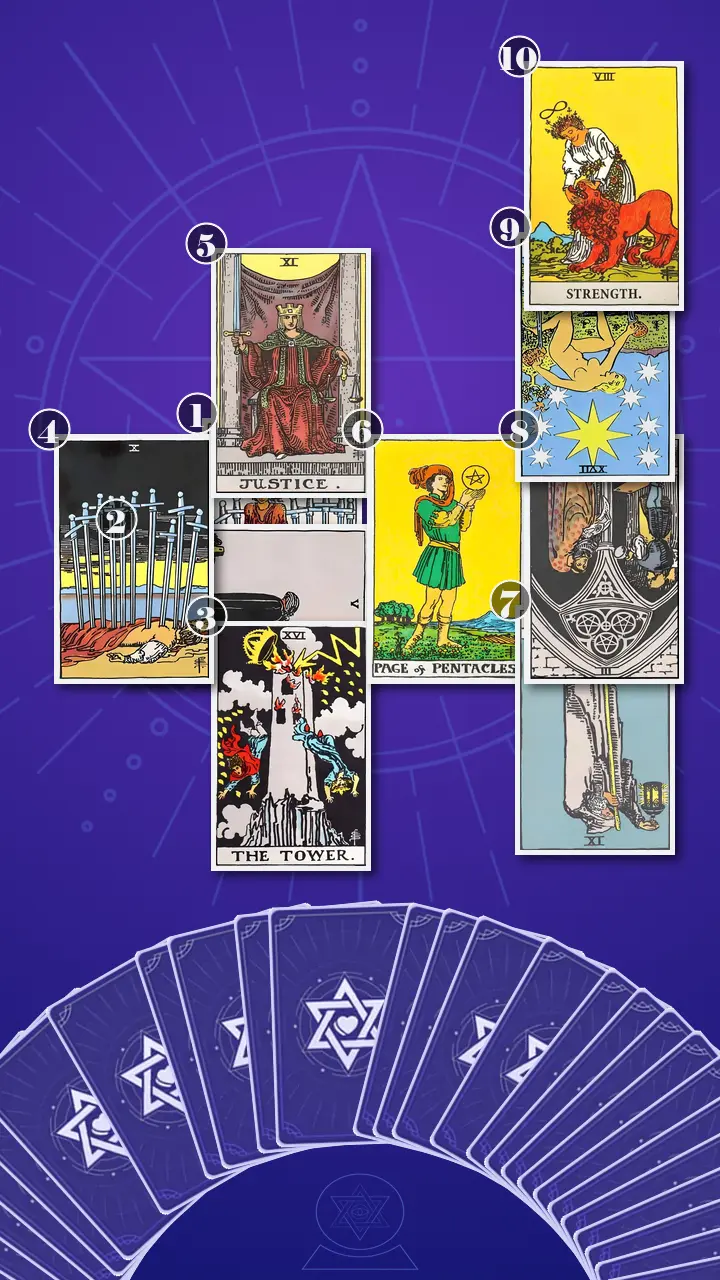
Reading the Map: Card Meanings in Context at a Career Crossroads
Position 1: Current pattern in motion
“Now we turn over the card representing your current pattern in motion: what you’re doing now that keeps bringing you back to the layoff moment.”
Eight of Swords, upright.
I didn’t have to reach for symbolism; Alex had already been living the image. “This is ‘review-mode’ on autopilot,” I said. “Reopening the layoff email, zooming in on wording and timestamps, then bouncing into job boards and resume edits. It feels like you’re doing something, but you’re actually staying inside a mental safety cage—lots of motion, no contact with the real market.”
In energy terms, Eight of Swords is Air in excess: thinking as containment. Like a browser with 27 tabs open—your CPU is screaming, but nothing is actually running.
“You’re not stuck because you’re lazy—you’re stuck because ‘review-mode’ feels safer than ‘feedback-mode.’”
Alex made a sound that was almost a laugh, but it had edges. “Okay,” they said, a little bitter. “That’s… painfully accurate. Like, it’s rude.” Their shoulders lifted, then dropped, as if their body had been bracing for me to scold them and couldn’t find the attack.
“The bindings are loose in this card,” I added. “Meaning: the trap looks absolute, but there’s a small, real exit. Not a life overhaul. A ‘submit’ button. A single message.”
Position 2: The immediate challenge
“Now we turn over the card representing the immediate challenge: what makes it hard to stop looping and take the next career step.”
Five of Cups, upright.
“The hardest part isn’t motivation,” I said. “It’s the grief underneath. You’re trying to job-search while also mourning the loss of routine, status, and belonging. So the email becomes a pain-anchor—you revisit it because it keeps the loss ‘explainable,’ even when it keeps you stuck.”
Water here is in blockage: emotion that can’t quite move, so it coagulates around a single object—one corporate email—as if that’s the container for everything.
Alex’s eyes flicked away from the camera toward something on their screen. I knew the motion: LinkedIn, probably. “It’s the ‘excited to announce’ posts,” they admitted. “I can feel happy for people and also feel… punched. And then I’m back in my inbox.”
“That’s the spilled cups,” I said gently. “And the two cups still standing in the background are real too—your skills, your people, your options. Not as a silver lining. Just as inventory. The pivot isn’t ‘be over it.’ It’s: allow the loss to be true and turn your head enough to see what remains.”
Their jaw unclenched like a tiny muscle finally got permission to stop performing.
Position 3: The root driver
“Now we turn over the card representing the root driver: the deeper fear or belief the layoff activated.”
The Tower, upright.
The Tower is not subtle. And layoffs rarely are. “This tells me the layoff landed as a nervous-system shock,” I said. “Not just a calendar change. Even now, your body reacts like the ground could disappear again, so your mind keeps returning to the impact site—the email—to prevent another sudden fall.”
In energy terms, this is a surge—a lightning strike that reorganizes everything. It’s why logic alone can’t talk you out of the loop. Your system is trying to guarantee safety in a market that can’t guarantee anything.
Alex swallowed. Their throat moved like they were trying not to cry, or not to be seen crying. “I don’t want sympathy,” they said. “I want a reason.”
“Of course,” I replied. “Your brain is doing what brains do after a shock: it tries to build a model that predicts the future. But the growth question isn’t ‘How do I make it never happen?’ It’s ‘What foundation do I build so I’m resilient if change happens?’”
In my own head, I flashed to a night at the planetarium when a school group asked why planets don’t just fall into the Sun. The answer wasn’t ‘because they’re good enough.’ It was physics: velocity, orbit, balance. Safety isn’t a moral verdict. It’s a structure.
Position 4: The recent imprint
“Now we turn over the card representing the recent imprint: how the layoff still shapes your nervous system and decisions.”
Ten of Swords, upright.
“This is the brutal ending story,” I said. “The day your brain filed it as: ‘It proved something about me.’ So you keep checking the email to see if the worst-case narrative is still true.”
Ten of Swords is Air in collapse—a mind that narrates an ending as total personal failure. But the card also shows dawn on the horizon: time moving forward even if your inner voice hasn’t updated.
Alex’s fingers worried the edge of their sleeve. “I still talk about it like it just happened,” they admitted. “Even though it was months ago.”
“Exactly,” I said. “You’re not still in that ending. Your mind is.”
Position 5: Your conscious aim
“Now we turn over the card representing your conscious aim: what you think you need—closure, fairness, proof, a clean narrative.”
Justice, upright.
“This is the inner courtroom,” I said. “You’re trying to make the layoff morally legible—fair, explainable, clean. You draft the perfect explanation for networking, weigh every detail like evidence, and you want a verdict that says you’re still employable.”
Justice is clarity in excess when it becomes prosecution. Balanced evaluation turns into self-cross-examination: running your own performance review in your head with no manager, no rubric, and no appeal process.
Alex let out a sharp breath. “I rewrite the same line in networking messages,” they said. “Like if I get the tone right, nobody can question my value.”
“That email is a document,” I said, letting the words land. “Your worth isn’t.”
Position 6: The next opening
“Now we turn over the card representing the next opening: the most workable near-term direction for rebuilding momentum.”
Page of Pentacles, upright.
The whole reading shifted temperature here—less screen-glare, more daylight. “This is the apprentice,” I said. “A grounded new beginning. Learning, building, shipping tangible proof. It’s a one-week product sprint energy—small deliverables, real feedback, momentum you can measure.”
Earth energy arrives as balance: not grand inspiration, but steady output. Hands on something real: a short case study, a campaign teardown, a mock strategy deck. Something you can literally link.
“I hate how… boring that sounds,” Alex said, and then, almost relieved, “but also I feel my chest loosen a bit?”
“That’s the point,” I said. “Your nervous system trusts what it can hold. Page of Pentacles doesn’t argue with shame. It builds receipts.”
Position 7: Your stance
“Now we turn over the card representing your stance: how you’re relating to this situation, including self-talk and isolation vs support.”
The Hermit, reversed.
“This is solitude tipping into isolation,” I said. “Like using airplane mode as a lifestyle: it’s calm, but you also don’t get any new information.”
In energy terms, this is guidance in deficiency: the lantern turned inward too tightly, illuminating only the fear story. “You keep telling yourself you’ll reach out once you feel confident,” I said. “But confidence doesn’t arrive in a sealed room.”
Alex nodded, then winced like the nod hurt. “I’ve been declining coffee chats,” they admitted. “I don’t want to show up as ‘the laid-off one.’”
“I get it,” I said. “But your career can’t be rebuilt solely in drafts.”
Position 8: Your field
“Now we turn over the card representing your field: what the environment, job market, and other people’s responses are mirroring back.”
Three of Pentacles, reversed.
“This is a feedback gap,” I said. “Not being seen for your craft. Working in a silo. It can reflect how modern hiring feels opaque—so you assume you’ll be misunderstood, and you keep revising privately instead of testing your story with a real human.”
Here the Earth element is in blockage: collaboration disrupted. The cathedral in the image becomes an empty building—no echoes, no responses, just you and your thoughts.
I watched Alex’s eyes go distant, like they were replaying a week of silence from recruiters. “When they don’t reply,” they said, “my brain goes, ‘See? Unhireable.’”
“That’s not data,” I said. “That’s a verdict your shame is trying to issue in an environment that’s noisy and inconsistent.”
Position 9: Hope and fear
“Now we turn over the card representing hope and fear: what you want to believe vs what you’re bracing for.”
The Star, reversed.
“This is hope being temporarily blocked,” I said. “You want renewal. And you’re terrified that optimism will make you naive—and hurt again.”
The Star reversed often shows up when someone has been living under comparison fatigue: doomscrolling success stories, saving job posts without applying, then thinking, what’s the point after one small non-response.
In energy terms, it’s Water in interruption: steadiness breaks, and guidance feels distant—like the sky is there, but you can’t find one star to navigate by.
Alex’s voice got smaller. “Everyone else looks like they bounced back instantly.”
“Social feeds compress time,” I said. “They don’t show the private draft folder named ‘Resume_FINAL_final_v7.’ They don’t show the nights someone stared at a screen and felt their chest tighten.”
When Strength Closed the Inbox
I let a brief silence happen. In my work, silence is often where the real interpretation arrives—like when the planetarium goes dark and, for half a second, people can feel how big the sky is.
Position 10: Integration direction
“Now we turn over the card representing the integration direction: the mindset and strength to practice so the layoff becomes a chapter, not an identity label.”
Strength, upright.
The image is calm on purpose: gentle hands, a lion, an infinity loop. Not domination—relationship. “This is emotional regulation that turns intensity into consistency,” I said. “Gentle courage. Self-respect. The ability to work with fear without letting it drive.”
And then I slowed down, because this was the bridge card—the one that turns a reading into a plan.
Setup: I pictured what Alex had already described: it’s 11:40 PM, the screen is too bright, and they’re back in the inbox—again—searching for the same subject line like it might finally tell them how to be safe in the job market. Their mind is trying to get emotional closure by rereading old text, because action risks new pain.
Delivery:
Stop treating the email as a verdict and start treating yourself as someone you can lead—Strength is the quiet hand that closes the inbox and opens the next step.
For a second, Alex didn’t move. Their breath paused—like their lungs had been waiting for permission.
Then the reaction came in a chain I’ve seen a hundred times, but it’s never less human:
First, the freeze: their eyes widened a fraction, pupils catching the screen light; their shoulders locked high, as if bracing for impact.
Second, the seep: their gaze unfocused, drifting past the camera—like their brain was rewinding to the moment the layoff email first arrived. I watched their throat work, that tiny swallow that means, this is hitting somewhere deeper than words.
Third, the release: a long exhale that sounded like air finally finding an exit. Their shoulders dropped, not dramatically—just enough to change the silhouette of their body. And then, unexpectedly, a flash of irritation crossed their face.
“But if that’s true,” they said, sharper now, “doesn’t that mean I’ve been wasting months? Like I’ve been doing it wrong?”
“It means you’ve been protecting yourself,” I said. “You built a safety ritual that looks like productivity. That’s not ‘wrong.’ It’s adaptive. But it’s not getting you what you want.”
This is where I bring in my own framework—my Orbital Resonance lens. “In celestial mechanics,” I said, “resonance is when two bodies keep pulling each other into the same repeating pattern. It’s not because either body is ‘bad.’ It’s because the timing locks in.”
“Right now, your system is in resonance with that email. Trigger hits—LinkedIn post, recruiter subject line, Sunday Scaries—and the orbit snaps back to the inbox. Strength isn’t about muscling out of orbit. It’s about changing the parameters: one small thrust, consistently, until the loop can’t capture you the same way.”
I leaned in a little. “Now, with that perspective: can you remember one moment last week when the urge to reread hit, and if you’d had this sentence—quiet hand, closes the inbox—you might have chosen a different next step?”
Alex blinked fast. “Yesterday,” they said. “A recruiter emailed. I saw the subject line and I went straight to the layoff email. If I’d closed the inbox… I could’ve replied. Even if it was imperfect.”
“That’s the shift,” I said. “From shame and tight control toward evidence-based confidence. Not certainty—just a steadier self-respect that isn’t dependent on one employer’s decision.”
From Insight to Action: A Small Flight Plan for New Data
I summarized the story the spread had told, because integration is where tarot becomes practical.
“Here’s the arc,” I said. “At the center, Eight of Swords shows the mental cage: thinking feels like progress. Five of Cups explains the fuel: real grief you haven’t been allowed to metabolize, so the email becomes a pain-anchor. The Tower at the root is the shock that trained your body to scan for danger. Ten of Swords is the harsh ending narrative your mind keeps checking for updates. Justice shows your conscious aim—fairness and clarity—turning into self-prosecution. Page of Pentacles opens a door: small, tangible proof. The Hermit reversed and Three of Pentacles reversed show the closed circuit: isolation means no feedback, so the fear story becomes the only story. Star reversed shows why hope feels distant. Strength is the integration: you don’t need to re-litigate the layoff to regain control; you practice self-trust by creating new evidence.”
Then I named the blind spot plainly: “Your cognitive blind spot is believing closure comes from understanding the email perfectly. Your transformation direction is the opposite: closure through measurable next steps and feedback.”
Alex nodded—and then immediately did the real-world thing. “Okay,” they said, “but I swear I don’t even have time. I’ll sit down to apply and suddenly it’s… dishes, errands, and then it’s midnight.”
“Perfect,” I said. “That’s not a character flaw. That’s environmental resistance. And this is where I use my Solar Sail Principle: you don’t wait for resistance to vanish. You harness it. You set your ‘sail’ so the pressure moves you.”
“Let’s make the next steps small enough to be consent-based,” I continued, “but real enough to generate data.”
- Space Debris Clearing: The 10-minute inbox boundaryMove the layoff email into an archive label like “Old Job — Admin” and remove it from your main search habits. If you truly need it for paperwork, bookmark the label—not the email thread. Do this once, in a single 10-minute block.If your hand reaches for Gmail later, pause for three slow breaths first. You’re not “banning” it—you’re changing the orbit.
- The 70% Apply Sprint (45 minutes, one submission)Choose two roles you meet about 70% of. Set a 45-minute timer. Submit one application before you’re allowed to tweak your resume again.Seventy percent qualified is qualified enough to try. Define “done” before you start: one submitted form is a win.
- Elevator Visualization: Make forward motion physicalOnce a day, ride an elevator (or imagine it if you’re at home). On the way up, name one micro-action you’ll do in the next hour: reply to one recruiter, send one DM, or draft the first two lines of an outreach email. When the doors open, do it immediately—before any scrolling.If dread spikes, you’re allowed to do the “2-line version.” The goal is contact with reality, not perfection.
“Gentle bravery looks like one submit, one message, or one ask—then stop,” I told them. “You’re teaching your nervous system that forward motion doesn’t equal danger.”

A Week Later: The Quiet Proof
Eight days later, I got a message from Alex. Just two lines.
“I archived the email. I still wanted to open it—like, physically wanted to. But I did the 45-minute sprint instead and submitted one application before my brain could negotiate.”
They added, almost as an afterthought: “I slept through the night. This morning my first thought was still ‘What if I’m wrong?’—but it didn’t swallow me. I made coffee and replied to a recruiter anyway.”
That’s what I mean when I say finding clarity isn’t a lightning bolt. It’s a rhythm. Like Earth’s rotation—steady enough that even after a dark stretch, morning still shows up.
And if I leave you with one thing from this Journey to Clarity, it’s this: When you keep rereading the layoff email, it’s not because you’re dramatic—it’s because part of you is still trying to prove you’re safe to move forward without getting hurt again.
If you treated the layoff email as a data point—not a verdict—what’s one tiny, real-world career move you’d be willing to try this week just to generate new evidence?