From Over-Editing to One Simple Ask: Finding Your Voice in a Skip-Level

The 4:52 PM Invite That Hijacked the Night
If you saw a calendar invite labeled “skip-level” land at 4:52 PM and your entire nervous system treated it like an emergency, this is for you (hello, skip-level scaries).
When Taylor popped onto my screen, it was Monday night in New York and early morning in Tokyo. I could tell she’d been living inside that invite all evening. The AC in her apartment kept rattling like it had beef with her, and the light from her laptop had that cold, surgical glow—the kind that makes everything feel more serious than it is. She kept toggling between Google Calendar (“Skip-Level (30 mins)”) and a Notes doc literally titled “Skip-level,” fingers hovering, typing, deleting, typing again. Her phone looked warm from constant Slack scrolling.
“I don’t want to throw anyone under the bus,” she said, voice low, like she was already in the meeting. “But I can’t keep absorbing this. If I say it wrong, it’s going to become about my tone instead of the problem.”
I watched her jaw tighten in that specific way—like she was holding a sentence behind her teeth so hard it could crack. Apprehension wasn’t an abstract feeling here; it was a tight chest, a tense jaw, and a brain running restless loops like a subway car that wouldn’t reach the last stop.
“You’re not ‘too sensitive’—you’re doing risk math in a system that rewards polish over honesty,” I told her. “Tonight, we’re not trying to manufacture bravery. We’re trying to find clarity. We’re going to make your message simple enough to hold onto tomorrow—even if your body is loud.”
Choosing the Compass: The Celtic Cross · Context Edition
I asked Taylor to take one slow breath and put both feet on the floor—just for a moment, not to be “zen,” but to signal her nervous system that we were moving from spiraling to planning. While she breathed, I shuffled slowly, listening for the moment her attention stopped scattering.
“For this,” I said, “I’m using a spread called the Celtic Cross · Context Edition.”
If you’ve ever wondered how tarot works in real life—especially for something concrete like a skip-level meeting—the most honest answer is: tarot gives us a structured way to map pressure. Not a prediction that traps you, but a diagnostic layout that shows: what’s happening, what’s blocking you, what belief is driving the block, what the environment rewards, and what next steps keep you protected.
This is why the Celtic Cross fits a moment like “tomorrow I have to raise concerns about my manager.” Taylor doesn’t need a yes/no. She needs the full chain: present bind → core fear about authority → workable stance → integration and follow-up. In this edition, position 6 is tightened to the next 48 hours (because this is immediate), and position 10 isn’t “your fate.” It’s your integration posture—the part that keeps the reading ethical and still gives actionable advice.
“Here’s what we’re going to look at,” I told her. “The first card shows the communication bind you’re walking into. The second shows what’s crossing you—what makes speaking up feel risky. And the last card—position ten—is how you stay clear and protected after the meeting.”
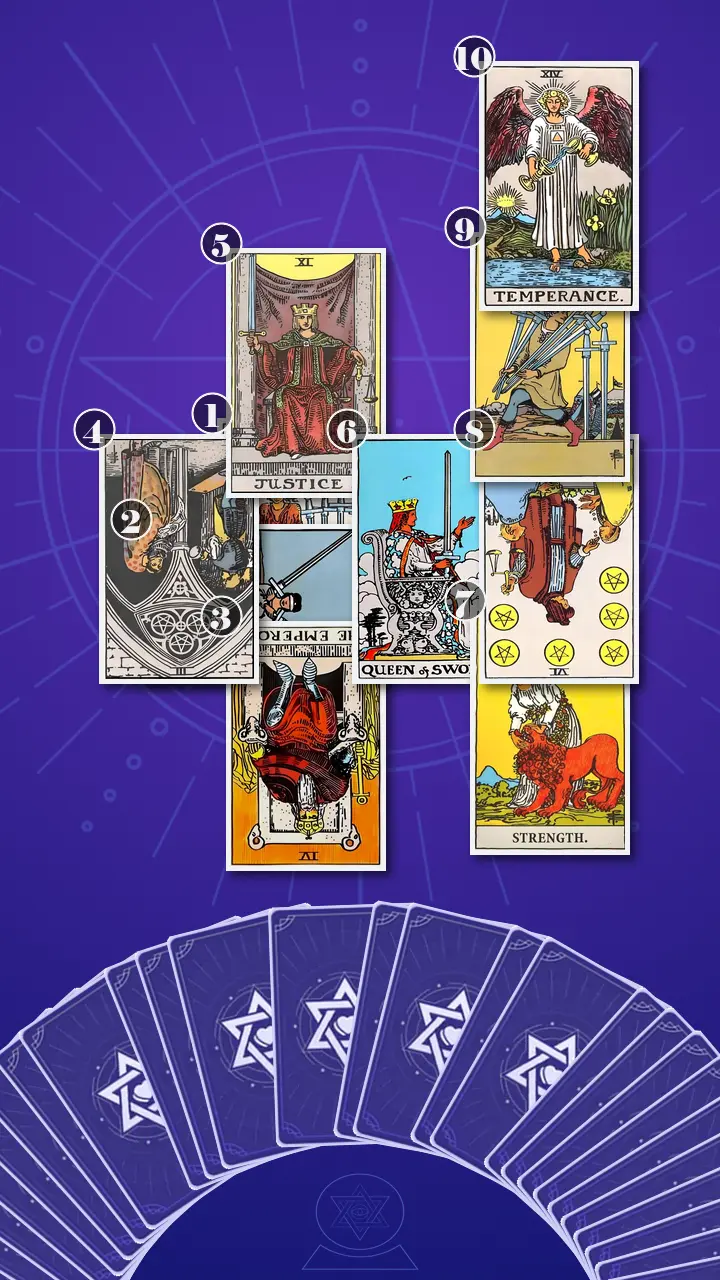
Reading the Map in a Career Crossroads Moment
Taylor’s question lived in a very modern career crossroads: wanting psychological safety and truth, while knowing workplace incentives can punish the person who names the problem. That’s not paranoia. That’s pattern recognition. I turned over the first card.
Position 1: What you’re walking into—the current communication bind
Now flipped open is the card that represents what you’re walking into: the current communication bind around raising concerns.
Eight of Swords, upright.
“This is painfully literal,” I said gently. “You’re staring at a Notes doc titled ‘Skip-level,’ convinced every sentence is a career risk. You keep rewording the same point to be ‘safe,’ and the more you edit, the more trapped you feel—like the only options are silence or self-sabotage.”
In the Eight of Swords, the blindfold matters: it’s not that there are no exits. It’s that fear makes you distrust your own read of what happened. The ropes are loose—your options exist—but your mind is treating imagined consequences like physical walls.
Taylor let out a small laugh—thin, bitter, almost embarrassed. “That’s… accurate,” she said. “It’s almost rude.”
“I know,” I said. “It’s not judging you. It’s showing you the mechanism. Your brain is trying to keep you safe by controlling wording.”
Position 2: The main obstacle—what makes speaking up feel risky
Now flipped open is the card that represents the main obstacle: what makes speaking up feel risky or impossible.
Two of Swords, upright.
“This is the freeze response dressed up as diplomacy,” I said. “You’re holding two competing scripts in your head—one honest, one perfectly neutral—and you keep trying to merge them until you end up with a sentence that says nothing.”
In my mind I pictured a split-screen, because this is how the Two of Swords behaves in a modern body:
Left screen: “There have been a few moments where alignment has been challenging, and I’m probably overthinking this…”
Right screen: “My manager dismisses me in front of others, and it’s causing rework and hesitation in decisions.”
“And then,” I said, “you keep alt-tabbing between them like you’re trying to find the ‘safe blend’—until nothing gets said.”
Energetically, this is a blockage. Not because you lack information, but because self-protection has become self-blocking. Neutrality feels like safety—yet neutrality is also paralysis.
Taylor’s eyes dropped to her hands. She rubbed her thumb over her knuckle, then stopped, like she caught herself. The exhale she gave wasn’t dramatic. It was the sound of someone realizing, quietly, “Oh. That’s what I’m doing.”
Position 3: The root driver—the deeper authority story underneath
Now flipped open is the card that represents the root driver: the deeper belief about authority and consequences that fuels the bind.
The Emperor, reversed.
“In your mind,” I said, “the skip-level isn’t a conversation—it’s a gatekeeping checkpoint. You imagine hierarchy snapping shut the second you sound ‘insubordinate,’ so you over-explain and over-defer, hoping permission will be granted instead of asking for accountability.”
Reversed, The Emperor becomes authority as threat: performance reviews, resourcing, credibility—systems that can feel personal. It’s the part of you that thinks: If I don’t get this exactly right, I’ll be punished for the disruption.
“That’s why you keep sanding your sentences,” I told her. “Your nervous system thinks the meeting is a courtroom.”
Taylor swallowed. Her shoulders rose half an inch, then settled. “I hate that it’s true,” she said. “Because I don’t even know if leadership would retaliate. I just… can’t risk finding out.”
“Exactly,” I said. “We’re going to build a structure that reduces that risk—not by being invisible, but by being clean.”
Position 4: Recent backdrop—what made this meeting feel loaded
Now flipped open is the card that represents the recent backdrop: what has been happening that led to this meeting feeling loaded.
Three of Pentacles, reversed.
“You’ve been doing solid work,” I said, “but collaboration feels off: unclear standards, shifting feedback, and moments where your contributions get minimized or reframed through your manager. So you compensate by over-delivering—and quietly resent that you have to.”
This card’s blueprint matters. It suggests you can frame your concern as a workflow and expectations issue, not a personality attack. That’s not corporate niceness. It’s strategic clarity: leaders can act on structure.
Taylor nodded once—small, controlled. “It’s like I’m always guessing what ‘good’ even means week to week,” she said.
“That uncertainty is exhausting,” I said. “And it feeds the feeling stuck loop.”
Position 5: Your conscious aim—what you want to protect
Now flipped open is the card that represents your conscious aim: what you most want to achieve or protect in the skip-level.
Justice, upright.
“This is important,” I said. “Your real goal isn’t revenge or drama—it’s a fair process. You want to bring one or two verifiable examples, name the impact on work, and ask for a standard that makes this predictable and accountable.”
Justice is balance. In modern terms: evidence that’s repeatable, and a request that’s reasonable. It’s the opposite of rambling. It’s also the opposite of swallowing it.
My own mind flickered—an internal flashback from my research days, when I learned how much a system changes when you define what you’re measuring. In astronomy outreach, I tell people: stars don’t move faster because you panic; your map just gets shakier. Justice is a steadier map.
“This card is you wanting to be taken seriously,” I told her, “and doing it through structure instead of performance.”
Position 6: The next 48 hours—the most available tone for tomorrow
Now flipped open is the card that represents the next 48 hours: the tone and momentum most available for tomorrow’s conversation.
Queen of Swords, upright.
“Tomorrow’s best version of you is calm and direct,” I said. “You state the headline, give one concrete example, make one request, then stop talking. You don’t manage everyone’s feelings—you invite problem-solving with clarity.”
This is clean Air energy—no longer trapped like the Eight of Swords. It’s usable. The Queen’s open hand matters: it’s not aggression. It’s an invitation to respond to reality.
I offered Taylor a 20-second template and made her say it once, not ten times:
“Headline: I want to raise a concern about how feedback and decisions are being delivered, because it’s causing rework and delays.”
“Example: On Friday’s launch review, I shared the launch doc, it was reframed as a rough draft, and the next steps were reassigned—after we had already aligned. That resulted in extra cycles and confusion on priorities.”
“Ask: What process can we use going forward for feedback and decision-making so we don’t keep getting last-minute reversals?”
When she finished, I didn’t rush to fill the air. I let the silence do some work. On camera, I saw her feet press into the floor—subtle, but real—like she’d found something solid to stand on.
Position 7: You in the room—what needs to lead
Now flipped open is the card that represents you in the room: your stance, strengths, and the part of you that needs to lead.
Strength, upright.
“Your power is regulation,” I said. “Your heart may race, but you keep your voice even, your words simple, and your posture grounded. You hold discomfort without turning it into an apology tour or a verbal sprint.”
Strength is balance too—just internal. It’s the gentle hands on the lion. Not suppressing anger. Not letting it drive the whole meeting. Guiding it into one clear sentence.
Taylor’s shoulders lowered a fraction, like her body recognized that “steady” is an option.
Position 8: The workplace context—the power dynamics shaping what gets heard
Now flipped open is the card that represents the workplace context: the power dynamics and incentives shaping how concerns are heard.
Six of Pentacles, reversed.
“This environment can treat support like a discretionary favor,” I said carefully. “Like opportunities, airtime, and ‘being believed’ are distributed unevenly.”
Reversed, this card often shows imbalance—gatekeeping, conditional exchange. It validates why Taylor’s system is doing risk math. It also tells us what works here: not pleading, not proving your worth, but asking for process.
“This isn’t about you being ‘good enough’ to deserve respect,” I added. “It’s about setting standards that don’t depend on someone’s mood.”
Position 9: Hopes and fears—information anxiety and reputational risk
Now flipped open is the card that represents hopes and fears: what you most want to avoid and what you secretly wish will happen.
Seven of Swords, upright.
“This is the ‘how will my words travel’ card,” I said. “You’re worried about being misquoted, dismissed, or pulled into politics. You want protection—and you also want to finally tell the truth.”
Energetically, this is not pure avoidance; it’s strategy. The healthy version is discretion: facts, observed patterns, measurable impact. The unhealthy version is contorting yourself until you vanish.
“Discretion isn’t dishonesty,” I told her. “It’s boundaries.”
Taylor’s mouth tightened again. “I’m scared they’ll just… tell my manager,” she admitted.
“That fear belongs in the room with us,” I said. “But it doesn’t get to write your whole script.”
When Temperance Poured Between Two Cups
When I reached for the final card, the air in my little office felt strangely still—like the moment in the planetarium right before the stars appear, when the dome is dark and everyone stops whispering.
Position 10: Integration—your grounded follow-up posture and protection after
Now flipped open is the card that represents integration: a grounded follow-up posture and next-step that keeps you clear and protected after the meeting.
Temperance, upright.
“This is like mixing a cocktail,” I said, because sometimes the fastest path to clarity is a practical metaphor. “Facts are the base spirit, impact is the citrus, the ask is the garnish. Too much of any one ingredient and it doesn’t land.”
Taylor blinked, and I saw an unexpected flash of resistance—like she wanted to argue with the idea of ‘mixing’ anything. Her breath caught, shoulders stiffening, then she frowned. “But if it’s about mixing it right… doesn’t that mean I’ve been doing it wrong? Like I’ve wasted all this time trying to be careful?”
I kept my voice even. “No. It means your system was trying to protect you with the only tool it had: perfection. Temperance is a different kind of protection—consistency. You don’t need to win the room. You need to stay clear enough to follow through.”
And this is where I used one of my own frameworks—the one I lean on when people are stuck between fear and action.
“I call it Solar Sail Principle,” I said. “A solar sail moves because of pressure. It doesn’t pretend the pressure isn’t there. It uses it. Tomorrow’s pressure—the time limit, the power dynamics, the fear of tone policing—can become your sail if your message is light enough and structured enough to catch it.”
Her eyes widened slightly, then softened. I could almost see the idea landing: not fighting reality, not surrendering to it—using it.
In her setup—the night before, the Slack receipts, the clenched jaw—Taylor was still trying to be uncriticizable. Still treating wording like a forcefield.
Not a dramatic confrontation, but a carefully mixed truth—Temperance turns raw frustration into a message your skip-level can actually act on.
I let that sit. No rushing. Just the hum of her apartment and the quiet of my office, like two time zones holding the same breath.
Then her reaction came in layers—three small waves I’ve learned to watch for:
First, a tiny freeze: her mouth parted, but no words came out, like her brain had paused the playback. Then her gaze went unfocused—like she was rewinding a specific memory: the Friday Zoom meeting, the interruption, the way her manager’s framing became “the truth” in the room. Finally, a release: her shoulders dropped, and her jaw unclenched on purpose, as if she realized she’d been biting down on her own voice.
“Okay,” she said, and her voice sounded different—less tight. “So I don’t have to make it bulletproof. I have to make it… usable.”
“Exactly,” I said. “And Temperance also shows the long path to the horizon—the follow-up posture. Your safety comes from pacing, recap, and boundaries. Not from rewriting yourself into fog.”
I asked her, as I always do at this point: “Now—using this lens—think back to last week. Was there a moment where you almost said something, then backed down because you were scared it would sound ‘difficult’? What would it have been like to offer the mixed version instead of the erased version?”
Taylor swallowed, eyes shining but not spilling. “In our 1:1,” she said. “When I got cut off. I could’ve said, ‘When feedback changes late, I have to redo work, and it slows launches.’ But I said, ‘No worries.’”
“That right there,” I told her, “is the shift. This isn’t just about tomorrow. It’s a move from self-doubt and over-editing to grounded confidence and clean boundaries. From decision fatigue to a repeatable stance.”
The One-Page Temperance Mix: Actionable Advice for Tomorrow
Here’s the story the whole spread told, in plain language: You’re walking into a conversation feeling trapped (Eight of Swords), and your main obstacle is a protective stalemate that freezes you into neutrality (Two of Swords). Under that is a harsh authority story—an internal Emperor that says, “Say it wrong and you’ll pay” (Emperor reversed). The recent backdrop is real misalignment and visibility gaps that make the stakes feel loaded (Three of Pentacles reversed). Consciously, you’re aiming for fairness and credibility, not drama (Justice). In the next 48 hours, your best tool is clean, direct language plus a pause (Queen of Swords), held by regulation (Strength). The environment has some imbalanced incentives (Six of Pentacles reversed), and your fear is information travel—being quoted, reframed, or punished for tone (Seven of Swords). The integration is Temperance: mix facts, impact, and ask; follow up with a neutral recap; protect yourself with consistency, not perfection.
The cognitive blind spot I want you to notice is this: you’ve been treating “uncriticizable” as the same thing as “safe.” But “uncriticizable” often turns into vague—and vague doesn’t protect you; it erases you. The transformation direction is clear: from polishing yourself into neutrality → to being fact-based, concise, and boundaried about impact and requests.
I looked at Taylor and said it the way I’d say it to a friend who’s smart enough to overthink herself into a corner: “The goal isn’t a perfect script. The goal is a repeatable headline.”
Then I gave her next steps—small enough to do tonight, structured enough to hold tomorrow.
- The 20-Second HeadlineIn your Notes app, write one line: “I want to raise a concern about [specific behavior] because it’s causing [specific impact].” Read it out loud once. Under 20 seconds, spoken.When you feel the urge to add disclaimers (“maybe,” “just,” “to be fair”), pause and delete one hedge word. Being specific isn’t being cruel.
- One Example, No MotivesPick ONE example and format it like meeting notes: “On [day/meeting], [observable action], which resulted in [impact on work].” No adjectives, no mind-reading, no character judgments.If you catch yourself building a courtroom (screenshots, twelve threads, a full narrative), set an 8-minute timer. When it ends, you’re done.
- The Sponsorable AskDraft ONE request a skip-level can actually sponsor: “What process can we use going forward for [feedback / priorities / decision-making] so I’m not getting last-minute reversals?”If the conversation becomes about your tone, bring it back to the work: “I’m trying to stay concrete—can we focus on the impact and the process?”
- The Temperance Mix + Private RecapTonight, do a 2-minute “Temperance mix”: split a page into three columns—Facts / Impact / Ask—with 1–2 short lines each. After the meeting, hold a private 10-minute calendar block to write what you said, what they said, and the next step.If sending a follow-up email feels risky, keep the recap strictly for you. Your clarity still counts—and it helps you follow through.
And because her meeting was in the morning, I added one of my favorite grounding tools—simple, physical, and slightly cosmic.
“Before you walk in,” I said, “use my Earth-rotation perspective. Put your feet flat. Feel the floor. Remember: the Earth is literally rotating under you at roughly a thousand miles an hour and you’re still standing. That’s what stability looks like—motion happening, and you staying grounded anyway.”
She laughed—this time with a little warmth.
“Facts, impact, ask,” I reminded her. “No motives. No courtroom. No apology tour.”

A Week Later: The Quiet Proof
Five days later, I got a message from Taylor while I was prepping a new planetarium show—calibrating the projection so the stars would move at the right pace. Her text was short, like a person who finally trusts brevity.
“I did the Facts/Impact/Ask page. I read my headline off my phone. I paused. It was uncomfortable, but it didn’t spiral. I booked a follow-up checkpoint and wrote my private recap right after.”
Then she added: “I slept through the night. This morning I still thought, ‘What if I messed it up?’—but I didn’t rewrite anything. I just… got coffee.”
That’s the kind of clarity I trust. Not fireworks. A small looseness. A jaw unclenching. A message that exists in the world without being sanded into dust.
When a skip-level is tomorrow, it can feel like your whole career is balanced on one sentence—so your chest tightens, your jaw locks, and you keep sanding your truth down until it’s smooth enough to survive but too vague to change anything.
If you let go of being “uncriticizable” for just one minute tomorrow, what’s the one fact + impact + ask you’d be willing to say—simply enough that you can repeat it without rewriting yourself?