She Almost Texted "Are You Going?"—Then Planned the First Ten Minutes
Outsourced Social Safety in the 7:18 p.m. Scroll
If you're a late-20s hybrid office worker in Toronto who can answer a client email in two minutes but somehow can't RSVP to dinner until one specific friend replies, this is that very particular kind of friend group anxiety. When Jordan (name changed for privacy) sat across from me, she didn't bring a dramatic crisis. She brought one of those painfully searchable questions: why do I wait for one friend to reply before making plans?
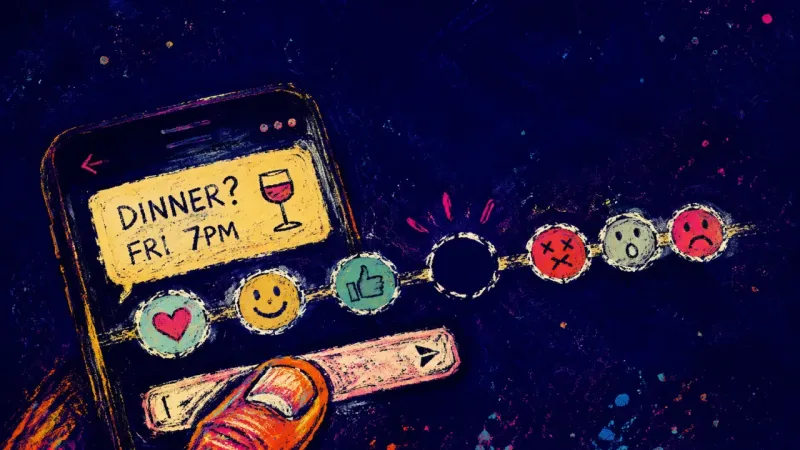
She described a Thursday at 7:18 p.m. in her apartment so clearly I could almost see it: Slack still open on her laptop, socks on the rug, iMessage glowing in her hand. The laptop fan kept up its soft mechanical hum. The phone lit her fingers blue-white as she tapped through the reactions on a dinner invite, not reading the plan so much as reading the room through who had reacted and in what order.
She wanted to go. That was the maddening part. But the second she couldn't find one familiar name, the question changed. It stopped being, 'Do I want this?' and became, 'Will I have somewhere to land if she's not there?' The feeling sat in her body like a subway brake screech trapped under the ribs: tight stomach, held breath, shoulders quietly preparing for impact.
I nodded and said what she needed to hear without shame wrapped around it. 'This isn't indecision. It's outsourced social safety.' Then I leaned in a little and softened my voice. 'Let's make a map for it. Not so we can force a yes to every plan, but so you can find clarity about what is yours to decide and what fear has been deciding for you.'

Choosing the Compass for Group Chat Anxiety
I asked Jordan to place both feet on the floor and take one slower breath before she touched the deck. I shuffled slowly, the way I do when I want the ritual to function as a threshold rather than theater: less mystery, more focus. A faint cedar note rose from my wrist as the cards moved, dry and steady.
I told her I was using a Situation-Obstacle-Advice-Outcome spread. For a question like this, how tarot works best is not through prediction, but through pattern recognition. She didn't need fortune-telling about whether a dinner would be fun. She needed card meanings in context: the visible RSVP habit, the deeper belonging wound beneath it, the inner shift that could interrupt the loop, and the practical way that shift might look in real life.
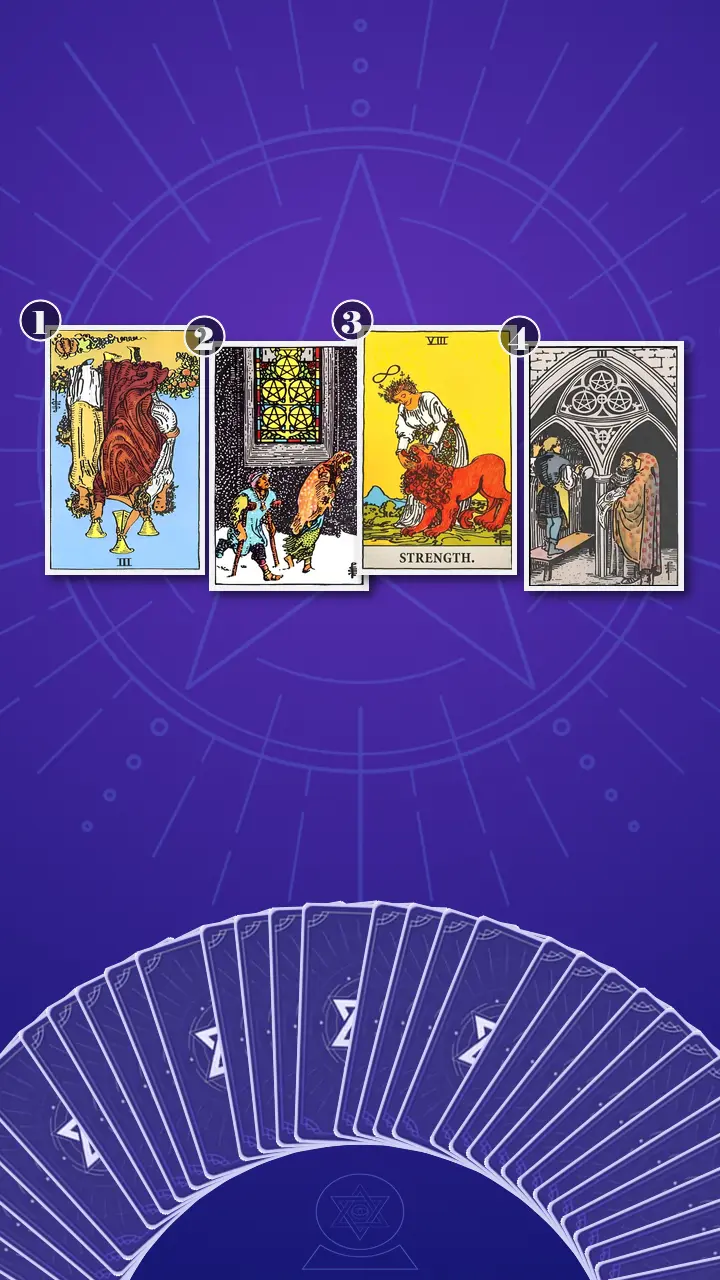
I laid the four cards left to right in a straight line, a short bridge from hesitation to self-led participation. The first card would name the surface pattern. The second would show the fear that made the delay feel necessary. The third would point to the medicine. The fourth would show what finding clarity could look like when it became behavior, not just insight.
Reading the Reactions Like Weather Radar
Position 1: The Circle That Breaks When One Name Is Missing
I turned over the first card. 'This position presents the visible social pattern: checking whether one specific friend is attending before deciding how to respond.' The card was the Three of Cups, reversed.
I told Jordan this was the exact shape of her habit. A casual dinner invite lands in the group chat after work, and instead of answering from actual interest, she starts scanning the participant list like a social forecast. The three raised cups on the card should feel like easy friendship, easy circulation, the kind of night where you just show up and fold into the energy. Reversed, that ease is blocked. One missing person mentally breaks the circle, and suddenly the whole plan feels socially unstable.
'It's like you're using one person as your emotional Wi-Fi hotspot before you let yourself connect to the room,' I said. 'That's the blockage here. The energy isn't absent; it's conditional. You want to RSVP based on your own interest, but your nervous system has been trained to wait for external clearance first.'
Jordan gave a short laugh that had a bruise under it. 'That is... annoyingly accurate.' Her fingers tightened once around her phone, then loosened. I smiled. 'Annoying, yes. Weird, no. Protective, absolutely.'
Position 2: The Restaurant Doorway
I turned to the second card. 'This position reveals the deeper fear or blind spot that makes the RSVP delay feel necessary.' The card was the Five of Pentacles, upright.
This one always lands in the body before it lands in the mind. I asked Jordan to picture the exact scene she fears most: walking into a restaurant where the coats are already off, everyone is mid-conversation, chairs have found their owners, and before her personality can even show up, her body has to solve the immediate geometry of belonging. Where do I stand? Who do I slide next to? Is there a space that looks like mine?
'You're not asking whether the plan is good,' I told her. 'You're asking whether you'll have a place in the room.' That's Five of Pentacles. Not social failure, exactly. Social scarcity. The card shows warmth nearby but not yet felt as available. In perfumery, it reminds me of smelling something beautiful through a shop door on a freezing street: the warmth is visible, real, and still somehow not yours. Here the energy is deficiency. The room may be fine, but uncertainty gets translated into proof that you may not belong.
Jordan went very still. First her breath paused. Then her eyes unfocused as if she were replaying a dozen entrances at once. Then came the chest-drop, a long exhale that seemed to leave from somewhere lower than her lungs. 'Yes,' she said quietly. 'That is exactly what I'm trying to avoid.' I nodded. 'Needing reassurance makes sense. Letting it make every decision for you is the part that costs you.'
When Strength Put a Hand on the Panic Tab
Position 3: The Card That Asked Her to Be Her Own Safe Person
When I flipped the third card, the room changed in that small way it sometimes does during a reading. Even the traffic outside seemed to step back for a second. 'This position identifies the inner quality or perspective shift that can loosen dependence on one external social anchor.' The card was Strength, upright.
I asked Jordan to picture that Thursday-night moment again: Slack still open, dinner invite glowing, thumb hovering over the private 'Are you going?' text because one familiar reply would instantly make the whole decision easier. Then I used my Social Pattern Analysis lens, the one I trust most when a social problem is pretending to be a scheduling problem. 'The hidden barrier isn't the whole night,' I said. 'It isn't even the group. It's the unstructured threshold between arriving and landing. Your alarm spikes in the first ten minutes, and then you let those ten minutes speak for your belonging.'
You do not need a social bodyguard to cross the threshold; you need Strength's open hand and steady spine to meet the lion of discomfort without backing away.
I let that sit between us.
Jordan didn't melt into agreement. First she frowned. Then her thumb hovered over the dark screen in her lap as if an invisible message were still waiting to be sent. Then a flash of resistance came through. 'But if I stop checking,' she said, 'I could still walk in and feel awful.' Her voice wasn't defensive so much as tired. Tired of the possibility.
'Yes,' I said. 'And Strength is not pretending that away. This card is not telling you to become louder, cooler, or suddenly effortless. It's asking for soft steadiness. A hand on the chest. Feet on the floor. One slower exhale. One honest sentence: I am afraid I'll feel peripheral. Then a smaller question: can I handle the first ten minutes?' The cedar on my wrist seemed sharper then, and I thought what I often think when Strength appears: real courage has almost no fragrance throw. It stays close to the skin and changes the wearer first.
Something in her face gave way in layers. Her jaw unclenched. Her shoulders dropped half an inch. Then there was that odd little blankness that sometimes follows relief, when a person realizes the new path is simpler but also more their own responsibility. 'So the point isn't to feel safe first,' she said slowly. 'It's to stop making her answer do all the work of safety for me.' I nodded. 'Exactly. A safe friend can soothe you, but she can't be your only proof that you belong.' Then I asked, 'Now, with this new lens, think back to last week. Was there a moment when this would have changed the feeling?' She stared at the card, then gave a tiny nod. 'The work happy hour. I didn't need the whole night solved. I needed a plan for the first ten minutes.'
That was the hinge. Not from fear to confidence. From cue-scanning and borrowed safety to self-trust and active belonging.
Position 4: The Structure You Help Build
I turned over the final card. 'This position shows what practical integration looks like when you respond from self-trust rather than borrowed safety.' The card was the Three of Pentacles, upright.
I loved the symmetry immediately: the reading had opened with one kind of three and closed with another. First a circle she didn't trust. Now a structure she could help build. In real life, this card looks like replying promptly, showing up, and bringing one small way to participate: asking how people know each other, helping choose the table, offering to make the reservation, saying hi first when someone new arrives. The energy here is balanced earth. Not performance. Not sparkle. Structure.
'Belonging gets stronger when you bring one small way to participate,' I told her. 'You're not a guest waiting to be escorted into the doc. You're one line in the group project. Small, visible, useful.' Jordan smiled at that, this time without the bitterness. I could almost feel the practical click in her. She didn't need a total personality transplant. She needed one contribution entry move.
From Borrowed Certainty to an Own-Anchor RSVP
When I stitched the whole spread together for her, the story was clean. The reversed Three of Cups showed the surface habit: group belonging that only feels stable if one trusted person completes the circle. The Five of Pentacles showed the deeper wound: the outsider forecast, the fear that walking in alone will expose some lack of belonging. Strength interrupted that equation by moving the center of safety back inside her body. And the Three of Pentacles grounded the lesson in behavior: place is often built through participation, not granted in advance by perfect comfort.
I told Jordan her blind spot was subtle but expensive. She had been treating the first awkward five to ten minutes as a verdict on the whole evening. In fragrance terms, she had been mistaking the top note for the entire composition. The sharp first hit of discomfort is real, but it is not the full story. The transformation direction was clear: move from using one friend's attendance as proof of safety to using her own interest and self-regulation as the basis for deciding.
- The Own-Anchor RSVP For the next low-stakes invite, open your Notes app before you open the reactions and rate two things from 0 to 10: 'Do I actually want to go?' and 'Do I have the energy?' If both numbers are above 5, send a simple reply like 'I'm in' or 'I can make it for a bit' before checking whether your safe friend answered. Keep it small and use it on an easy-to-leave plan. If your body braces, I often suggest one dab of cedar or vetiver on the wrists — my professional presence enhancement trick with woody accords. Not magic; just a repeatable cue for steadier posture and a calmer reply.
- The First Ten Minutes Method Before you text 'Are you going?' to anyone, place a hand on your chest or upper ribs, keep your feet on the floor, and take three slower, exhale-heavy breaths. Name the fear in one sentence: 'I'm afraid I'll walk in and feel peripheral.' Then answer only the next question: 'Can I handle the first ten minutes?' If body cues feel awkward, hold a cold glass or lean into a wall instead. A quick cleansing citrus spray by the door can also mark the shift from analysis mode to social mode.
- One Small Contribution Practice If you go, choose one tiny participation move before you leave home: ask one real question, help choose the table, offer to book, or be the first to say hi when someone new arrives. Save one conversational bridge in your phone, like 'How do you know everyone here?' so you are not improvising from pure adrenaline. Contribution does not need to be impressive. One warm or practical move counts. Keep your boundary: you do not owe anyone a sparkling version of yourself, and you can leave after 45 minutes if that matches your actual capacity.

A Week Later, the Quiet Proof
A week later, Jordan messaged me after a work patio plan. 'Did the Notes app thing,' she wrote. 'Interest 7. Capacity 6. She still hadn't replied. I went anyway.' Then another message came in: 'Asked someone about their weirdest client note of the week. It was normal. I was normal. The first ten minutes were the whole battle.'
She added one more line that I loved because it was honest: the walk from the streetcar to the patio had still been the hardest part, and her first thought at the door was, 'What if this is a mistake?' But she laughed at herself and went in anyway. That is the kind of proof I trust most — not a transformed life, just a changed entrance.
This is why I trust a Situation-Obstacle-Advice-Outcome tarot spread for group RSVP anxiety and belonging patterns. It can take a habit that feels embarrassing and make it legible, actionable, and kinder. Jordan did not become fearless. She became more available to her own interest, which is often the first real form of clarity.
Sometimes the longest part of going out is not getting ready or getting there — it's sitting with your phone in your hand, waiting for one familiar name to make the room feel safe enough to enter. So the next time a casual invite lands and the group chat starts pulling you into borrowed certainty, what tiny own-anchor move — a slower exhale, an interest score, a question saved in your phone — might help you answer from your real interest instead?
Every reading at AceTarot is designed to connect you with your inner wisdom and empower your next step.
Learn more about our Journey to Clarity.