From iCloud-Album Self-Consciousness to Sharing with Family on Your Terms

Feeling Watched in a Family iCloud Shared Album: The Warm Phone, the Tight Jaw
If you open the shared album and your jaw tightens before you even see a comment, that’s not drama—it’s your nervous system clocking an invisible audience.
Casey (name changed for privacy) sat across from me in my little Toronto studio space—half tarot table, half radio booth. It was 8:47 p.m. on a Tuesday, the streetcar bell faint through the window like a distant notification. The mini-fridge hummed. Casey’s phone was warm in their palm, iCloud Shared Albums open, thumb hovering the way it hovers over a risky text.
They scrolled, and I watched their body answer before their words did: jaw braced, shoulders slightly up, the tiniest drop in the stomach like stepping off a curb you didn’t see.
“I got added to the family album,” they said, staring at the screen the way you stare at a work dashboard when you already know what you’ll find. “And now I… curate. I zoom in, crop, rewrite captions. I don’t want to disappear, but I also don’t want to be discussed.”
Their self-consciousness wasn’t an idea—it was a physical contraction, like their whole chest was trying to become a smaller target. Included… and put on display at the same time.
I nodded, gentle but direct. “We can work with that. Let’s treat tonight like a Journey to Clarity—not to make your family different, but to make your next move feel like it belongs to you.”
And because I’ve spent ten years studying how sound changes a nervous system in real time—on-air, off-air, in families, in fights—I added, “Also: your body is giving us data. We’ll use it.”

Choosing the Compass: The Energy Diagnostic Map (7) for Boundaries Online
I asked Casey to take one slow breath—not as a ritual, just as a gear shift. Then I shuffled, letting the cards make that soft, papery whisper that always reminds me of cueing up vinyl: you can’t rush it without scratching something important.
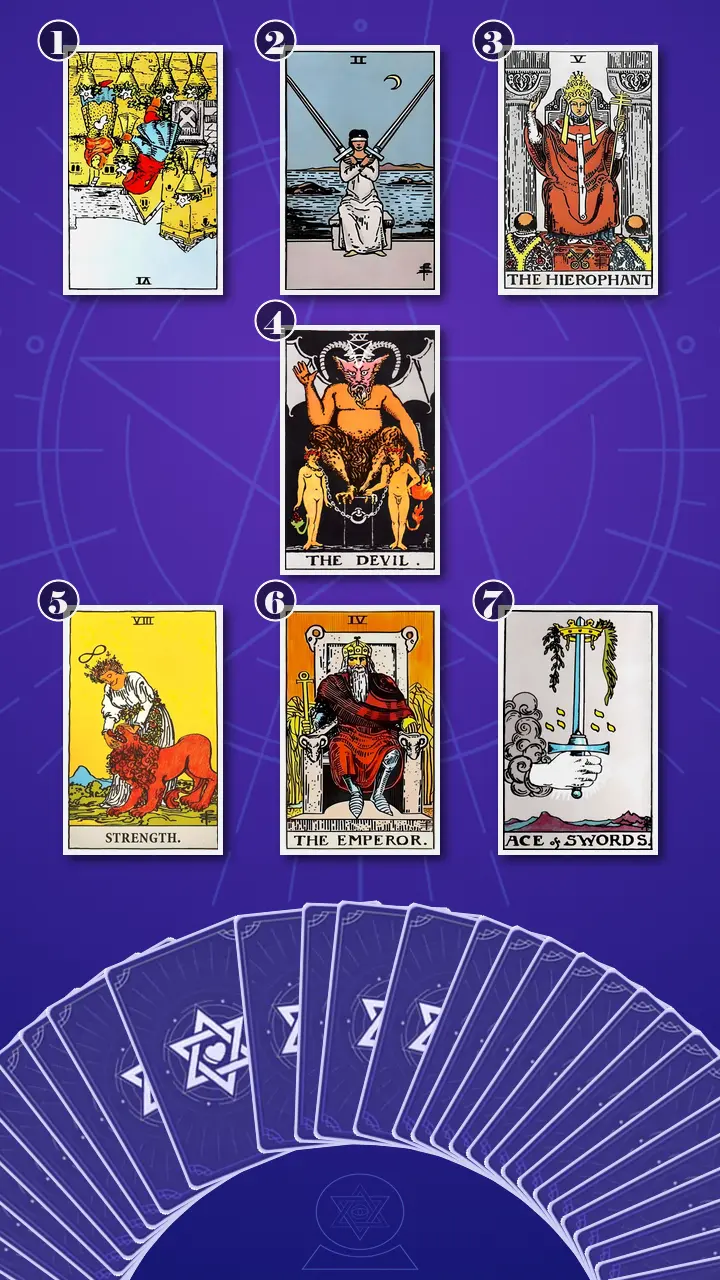
“Today we’ll use a spread I call the Energy Diagnostic Map (7) · Context Edition,” I said. “It’s a 7-card tarot spread for boundaries with family online—especially in shared digital spaces like a family iCloud or Google Photos album.”
For you reading along: this layout works because this problem isn’t a single decision like ‘Do I post or not?’ It’s a system. There’s the trigger (shared visibility), the inner tug-of-war, the external rulebook, and then the real knot: the compulsion to manage perception. This spread puts the core blockage in the center, then routes us intentionally toward resource → boundary principle → one concrete next step. It’s not prediction. It’s pattern recognition—how tarot works best when you’re trying to stop feeling stuck and start finding clarity.
“We’ll look at the surface reaction first,” I told Casey, “then what you’re protecting yourself from feeling, then the family norms pressure. The center card is the real blockage. And the bottom row is your way out: what you can rely on, the boundary that restores agency, and the one-week action that makes it real.”
Reading the Map: From the Time-Machine Effect to the Approval Trap
Position 1 — Surface reaction: the immediate trigger
“Now flipped over,” I said, “is the card representing your surface reaction—the immediate, observable way the shared family album triggers self-curation and old-role activation.”
Six of Cups, reversed.
“This is like opening the family iCloud album and it feels like stepping into a room you grew up in—same furniture, same roles,” I told them, using the card’s modern translation almost word for word because it landed so cleanly. “You hover over uploading a current photo, then second-guess it because you can already hear the old narrative—who you’re ‘supposed’ to be.”
Reversed, the Six of Cups is memory with pressure in it. Nostalgia that stops being sweet and starts being a script. The energy here is blockage: the past-self version of you is taking up too much room in the present.
Casey let out a small laugh—sharp, a little bitter. “That’s… mean,” they said. Then softer: “It’s true. The album makes me feel fourteen again.”
I didn’t correct the laugh. I respected it. “Yeah. It can feel unfair. But it also explains why your brain turns every photo into a risk assessment.”
Position 2 — Inner tug-of-war: what you won’t name
“Now flipped over,” I said, “is the card representing your inner tug-of-war—what you’re protecting yourself from feeling or naming when you start performing.”
Two of Swords, upright.
“You tell yourself the album ‘isn’t a big deal,’ but you keep delaying a simple decision like posting a casual photo,” I said. “You stay quiet to feel safe—then feel trapped by the quiet—like neutrality is your only protection.”
This is deficiency in emotional honesty, not because you’re dishonest—because you’re bracing. The blindfold isn’t ignorance. It’s strategy. If you don’t choose, you can’t be judged. But the cost is paralysis.
I asked, “When you go ‘neutral,’ what feeling are you trying not to feel—hurt, anger, embarrassment, something else?”
Casey’s eyes flicked up, then away. Their fingers tightened around the phone like it could keep them steady. “Embarrassment,” they admitted. “And… like I’ll be misunderstood and then I’ll have to explain, and that’ll make me look dramatic.”
Position 3 — External pressure: the unspoken rulebook
“Now flipped over,” I said, “is the card representing external pressure—the family-system norms and unspoken expectations shaping what feels ‘acceptable.’”
The Hierophant, upright.
“The album doesn’t feel like a scrapbook,” I said. “It feels like a place where there’s a correct way to be understood. You catch yourself choosing photos that look ‘respectable’ or ‘easy to explain,’ because you can feel the norm-policing even when nobody says it out loud.”
The Hierophant’s energy is excess of inherited standards—belonging-by-compliance. Like being graded on a vibe you never agreed to. I’ve seen this in music therapy sessions too: families don’t just share stories; they share a soundtrack of expectations.
“What’s one ‘family rule’ you’ve been following in the album that you never explicitly agreed to?” I asked.
Casey swallowed. “That I’m supposed to be… legible. Easy. No surprises.”
I nodded. “Like Slack at work. Feedback-heavy all week, and then you come home and the shared feed turns into another performance review thread.”
Position 4 — Core blockage: the compulsion loop
“Now flipped over,” I said, “is the card representing the core blockage—the attachment or belief that turns visibility into obligation and makes you manage perceptions.”
The Devil, upright.
“You keep checking who viewed or reacted to the album,” I said, “then pre-write explanations in your head like you’re on call. The stage isn’t your family—it’s the belief that once they see you, you owe them narrative control.”
Here the energy is excess—too much attention given to approval, too much weight given to reaction. The Devil isn’t ‘bad.’ It’s magnetic. It’s the loop that feels like responsibility.
I described the scene the way it often plays: “It’s like a notification slot machine. Refresh the album. See a ❤️. Your chest spikes. Then you draft an iMessage paragraph nobody asked for: If I can just pre-empt the question, I won’t have to feel exposed.”
Then I named the mechanics cleanly, because clarity loves a simple diagram: “Trigger—new shared visibility. Belief—If I’m seen without control, I’ll be judged or reduced. Coping—over-editing, delaying, deleting, over-explaining. Short-term relief—less exposure. Long-term cost—less authentic connection and more vigilance. And then the belief gets reinforced.”
Casey went still for a beat—breath held, fingers hovering mid-scroll. Their gaze unfocused like they were replaying a week of late-night checking. Then a quiet, involuntary “Oh.” Their shoulders dropped a fraction.
“I thought I was being… responsible,” they said.
“That’s the Devil’s best disguise,” I replied. “It offers ‘responsibility’ when it’s really compulsion.”
Position 5 — Usable resource: steadiness without disappearing
“Now flipped over,” I said, “is the card representing your usable resource—the inner capacity that helps you stay present without tightening into performance.”
Strength, upright.
“You feel the urge to crop, rewrite, and manage,” I said, “and instead, you pause—two breaths, shoulders down—and decide from values: Do I want to share this? not Will this be judged? That tiny pause is where the performance loop loosens.”
The energy here is balance. Strength isn’t loud. It’s regulated. It’s your calm ‘no’ being more protective than your perfect explanation.
I watched Casey try it right there: two slow breaths. Jaw unclenched. Phone turned face-down for thirty seconds. When they picked it up again, their eyes looked a little more like theirs.
“I can stay here with the discomfort without fixing it,” they whispered, almost surprised by their own sentence.
When the Emperor Spoke: The Doorway-Lock Boundary for Finding Clarity
Position 6 — Key transformation: the boundary principle
I let myself slow down before turning the next card. The studio felt quieter—like the moment right before I push a fader up live on-air and everything becomes audible.
“Now flipped over,” I said, “is the card representing the key transformation—the boundary principle that restores agency in shared digital spaces.”
The Emperor, upright.
Setup—because I could see the loop still trying to run in Casey’s eyes: You’re on the couch after dinner, iCloud open, thumb hovering over Upload. You zoom in, crop, rewrite a caption, then exit—heart doing that tiny drop like you just avoided being ‘made into a thing.’ You want closeness, but your body keeps treating the album like a spotlight you have to survive.
Not a spotlight you must survive—claim your seat on the throne, set the terms, and let the mountains behind you remind you that your stability doesn’t depend on anyone’s approval.
I let the sentence sit in the air. Casey’s reaction came in layers—like a chord resolving.
First: a physiological freeze. Their eyes widened a millimeter, and their breathing paused, as if their nervous system was checking whether it was safe to believe that. Second: cognitive seep-in. Their gaze slid off the card toward the door of my studio, unfocused, like they were seeing their own apartment hallway—the lock, the peephole, the choice to open or not. Third: emotional release. A long exhale left them, shoulders dropping, hands unclenching from the phone. Then—unexpectedly—irritation flared across their face.
“But if I stop managing it,” they said, voice sharper, “doesn’t that mean I’ve been… doing this wrong? For years?”
I held that with them, no shaming. “It means you adapted. In a family system, adaptation is how you belong. The Emperor isn’t judging you for surviving. It’s offering you adult authorship.”
And this is where my signature lens clicked in—the one I call Generational Echo. “Can I ask you something weirdly specific?” I said. “What was the background music in your home growing up? Like—Sunday mornings, car rides, cooking.”
Casey blinked. “My dad’s classic rock. Always. And my mom had this… ‘cleaning playlist’ that meant nobody should be in the way.”
“Exactly,” I said. “Families run on unspoken soundtracks. Your body hears ‘the album’ like it hears that cleaning playlist: be easy, be legible, don’t complicate the room. The Emperor is you changing the station. Not fighting the family. Not disappearing. Just choosing your terms of engagement.”
Then I brought it back to the core principle, because it needed to be portable: “Visibility is optional. Interpretation is not your job.”
I leaned in slightly. “Now, with this new perspective, can you think back to last week—was there a moment where this would’ve changed how you felt?”
Casey nodded slowly. “My aunt commented, ‘Look at you! So grown up!’ and I spiraled. If I’d had… terms? I could’ve just heart-reacted and moved on.”
“That’s the shift,” I said softly. “From hyper-monitored self-curation to grounded self-respect and choice-based connection. Not perfect. Just different.”
Position 7 — Next step: the clean sentence
“Now flipped over,” I said, “is the card representing your next step—a concrete one-week boundary action that reduces monitoring and over-explaining.”
Ace of Swords, upright.
“This is the moment you delete the draft paragraph and replace it with one clean line,” I said. “One sentence you can copy/paste. Because clarity reduces performance when you stop negotiating your existence photo by photo.”
I smiled, just a little. “Stop writing captions like a press release.”
Casey laughed—this time with relief. “I literally do that.”
From Insight to Action: Your Terms of Engagement for the Next 72 Hours
I pulled the whole story together for them, the way I’d summarize a complicated song into its chorus.
“Six of Cups reversed shows the time-machine effect—old roles waking up the moment you open the album. Two of Swords says you protect yourself by going neutral, which turns into silence. The Hierophant is the external rulebook—the family-approved version of you. The Devil is the approval-compulsion loop: visibility starts to feel like obligation, so you manage optics to feel safe. Strength is the stabilizer—two breaths, body-first steadiness. And then The Emperor: boundaries as structure, not argument. Finally, Ace of Swords: one clean sentence that ends the guessing game.”
“Your cognitive blind spot,” I added, “is thinking you need better content—better photos, better captions—when what you actually need is a policy. Your transformation direction is exactly this: from ‘I need to control how they see me’ to ‘I decide what I share, and I don’t manage other people’s interpretations.’”
Then I gave Casey the smallest possible next steps—practical, copy/paste-friendly, designed for a real life with TTC commutes and Slack still ringing in your head.
- The One-Sentence Boundary ScriptOpen Apple Notes and write one reusable line: “I’m keeping this album for highlights—no updates or Q&A.” Keep it pinned so you can copy/paste if questions start.Expect the cringe. Keep it boring and repeatable—policy, not argument. You can send it once, then stop replying after one clarification.
- Pick One “No-Discussion” CategoryChoose one category you won’t discuss from photos this week (body, dating, money, location). If someone asks, reply with a simple redirect like, “Not something I’m getting into—how’s your week been?”Don’t try to cover everything at once. One clear limit is easier for your nervous system to hold.
- Soundproof Barrier (My Go-To Strategy)Mute iCloud Shared Album notifications for 72 hours (Focus / Do Not Disturb), and when you do check the album, play a steady background track (lo-fi, brown noise, or any “no lyrics” mix) for 10 minutes to keep you out of reaction-chasing mode.This isn’t avoidance—it’s interrupting conditioning. If you feel a spike, close the app. That still counts as practice.

A Week Later: Ownership, Not Certainty
Six days later, Casey texted me a screenshot: a simple streetcar-window photo in the family album. Caption: “Tuesday commute.” Nothing else. No disclaimer. No pre-emptive explanation. Under it, a couple of ❤️ reactions and an aunt’s “Toronto looks so busy!”
“I didn’t correct anything,” their message read. “I just liked it. My stomach did the drop, but it passed.”
It wasn’t a perfect ending—more like a real one. Clear but a little vulnerable: they told me they slept through the night for the first time in weeks, then woke up with the familiar thought, What if I’m being rude? And this time, they exhaled and didn’t chase the thought down the hallway.
That’s the quiet proof I look for in a Journey to Clarity: not a life overhaul, but a new relationship to the moment you usually perform. A shared album stops being an invisible audience when you stop treating every glance like a verdict.
When a shared album turns into an invisible audience, your body tightens like you’re back in an old role—wanting closeness, but bracing to be reduced to a story you didn’t choose.
If you treated the album like a doorway you control instead of a spotlight you survive, what’s one small term you’d set—just for this week?