Coworker Repeats Your Idea in Meetings: Naming It in Real Time

The 9:27 a.m. Freeze When a Coworker Repeats Your Idea and Gets Credit
If you are early-career in a city job where meetings move faster than your rent goes up, and you keep thinking, 'I said that five minutes ago,' I know exactly why Jordan (name changed for privacy) came to me.
She was a 28-year-old junior product manager in Toronto, and when she sat down across from me, she did not start with the coworker. She started with the room. A glass meeting room near King Station. Wednesday, 9:27 a.m. Agenda open on one screen, Slack on the other, notes tiled beside both. The HVAC hummed overhead. Burnt coffee had gone lukewarm by her laptop. She kept trimming the same sentence in her notes while her jaw tightened before anyone had even spoken.
'I can do the work,' she told me. 'I just hate having to fight for the credit.'
Then she gave me the real question beneath the question: she wanted credit for her ideas, but by the time she decided whether saying something would sound confident or petty, the moment was already gone. She stayed quiet in the meeting, then replayed it afterward, drafting Slack follow-ups on the TTC like hindsight might rewrite the room. The frustration in her body was not abstract. It sat behind her ribs like a swallowed battery—hot, metallic, quietly corrosive.
I nodded. 'There is nothing petty about noticing a pattern that affects your career,' I said. 'And you are not too sensitive for feeling it. It feels awful because it is awful. So let me do what tarot does best here: not fortune-telling, not revenge fantasy—just a clear map. Let's trace how your work keeps leaving the room wearing someone else's name tag, and how to stop that from happening in real time.'
Choosing the Map for a Workplace Credit Problem
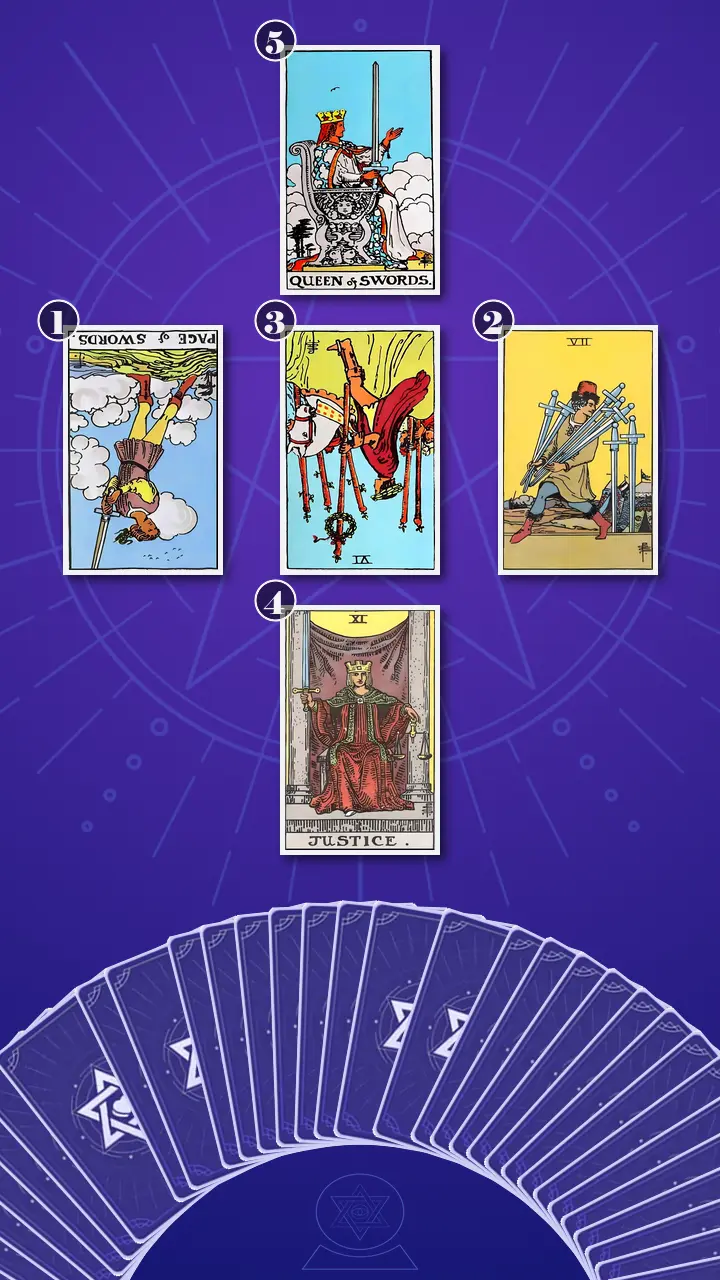
I asked Jordan to take one slow breath and keep the last meeting in mind—not as a ritual performance, just as a way to focus the question. Then I shuffled until the pace of the cards matched the pace of the conversation and laid out a spread I use often for office politics and work boundaries: the Relationship Spread · Context Edition.
I chose it because this was not really a confidence problem in the vague, self-help sense. It was interactive. Jordan mattered, the coworker mattered, and the meeting itself—the social field, the timing, the manager's attention, the blur of live attribution—mattered just as much. This spread gives me a clean diagnostic chain: Jordan's current meeting stance, the coworker's room-taking pattern, the public dynamic that keeps rewarding the wrong voice, the deeper corrective truth beneath it all, and then the most constructive next step.
I told her the structure out loud as I placed the cards. 'The first card will show me what happens inside you in those crucial few seconds before you speak. The center card will show what the room is rewarding right now. The fourth card is the one I care most about tonight—it will tell us what fairness actually requires from you. And the last card will give us a real sentence-level response, something you can use the next time this happens.'
Reading the Air in the Room
The Page Who Edited Herself Quiet
I turned over the card in position one, the one representing Jordan's current self-position: how her meeting behavior expressed the freeze, the over-monitoring, and the attempt to repair attribution afterward.
Page of Swords, reversed.
I almost smiled—not because it was light, but because it was precise. This card is the split-screen brain. One tab is the agenda. One tab is Slack. One tab is your notes. And your attention is split the same way: part of you has the idea, part of you is already defending it, and part of you is scanning the room to see whether you are socially allowed to say it cleanly.
'Say it cleaner. Not yet. Okay, now it's too late.' I said the rhythm of it out loud, the little three-beat spiral the card was showing me. 'That is this Page reversed.'
The Page of Swords is usually verbal readiness, curiosity, quickness. Reversed, that air energy becomes excess watchfulness and blocked timing. The sword is raised, but not grounded. In modern work terms, it is like watching the typing indicator disappear because you kept editing the message in your head instead of sending it. Jordan was not lacking ideas. She was overprotecting them until the room moved past the exact second that would have protected her authorship best.
'Freezing is not proof you lack value,' I told her. 'It's what happens when visibility feels socially expensive.'
Jordan gave a short laugh that landed with more fatigue than humor. 'Wow,' she said. 'That's accurate enough to be rude.'
I laughed softly with her. 'I know. But accuracy is kinder than vague encouragement.' Her fingers, which had been gripping the paper cup by the seam, finally loosened. That was the first small sign that self-blame was starting to give way to recognition.
The Coworker Who Thrives in Blur
Next I turned over position two, the other-party pattern: how the coworker engages the room and benefits from blurred attribution in the specific meeting context.
Seven of Swords, upright.
'This doesn't force me to call your coworker a cartoon villain,' I said immediately, because I could see Jordan brace for that oversimplification. 'But it does describe someone who moves fast in ambiguity.'
The Seven of Swords showed exactly what she had already lived: she introduces a concept, rough around the edges but solid; a few minutes later, the coworker picks it up, trims the phrasing, and says it back at the precise moment the room is ready to applaud it. The card's sideways glance is the whole thing—someone testing how much authorship can blur without being challenged. In Slack terms, it is the summary post getting the visibility while the original comment sits technically visible but functionally forgotten above the fold.
Energetically, this was not balance. It was excess strategy and opportunism feeding on Jordan's softness around ownership. I was careful here, because obsessing over motive can become its own trap. 'The more useful question,' I said, 'is not whether he knows exactly what he's doing every time. The more useful question is this: what communication habit of yours currently makes attribution easy to erase?'
Jordan pressed her lips together and looked down at the card. 'He always says it like he just connected dots in a smarter way,' she said. 'And then I feel ridiculous bringing up that I connected them first.'
I nodded. 'That is the blur this card rewards. Not truth. Blur.'
When the Wrong Person Gets the Laurel
Then I turned over the center card, position three: the core meeting dynamic, what the group setting rewards right now and why recognition gets misdirected even when the original contribution is already in the room.
Six of Wands, reversed.
This card sat at the center of the spread like a bruise. Public praise was happening; it was just landing in the wrong place.
I described the scene before Jordan could. 'A manager nods at the echoed version. A follow-up question goes to the wrong person. You keep taking notes with a fixed smile while your chest goes hot. Inside, it's a three-line script: I said that. If I correct it now I look petty. If I don't, this becomes theirs.'
She went completely still.
The Six of Wands usually shows visible recognition, the laurel, the crowd, the person everyone remembers. Reversed, the recognition system is blocked or distorted. The idea may be shaping the meeting, but the room is rewarding polish, timing, seniority, or confidence more than original authorship. It is like the repost getting all the likes while the original creator is still sitting three posts back, close enough to see it happen.
The fluorescent light from the studio window caught the gold in the card for a second, then slid away. I noticed Jordan's jaw set again right as I said the next part. 'This is why the experience feels so intense. It is not only unfair. It is publicly unfair. And public unfairness always tempts people like you to overcompensate by doing even better invisible work instead of fixing the visibility gap itself.'
She exhaled through her nose, slow and sharp. 'That's exactly what I do.'
'I know,' I said. 'You make the deck cleaner, the notes sharper, the follow-up better. But the card is blunt: better invisible work does not solve meeting attribution blur.'
When Justice Spoke Like Google Docs Version History
The Card Beneath the Pattern
When I turned the fourth card, the room changed a little. It always does with this one. Even the late light on my table seemed to straighten itself into two narrow bars beside the card, like pillars.
This was the position of the underlying corrective principle: the deeper lesson about fairness, boundaries, and self-advocacy that challenged the fear beneath the pattern.
Justice, upright.
I looked at Jordan and slowed my voice on purpose. 'Ten minutes before planning, you have the agenda, Slack, and your notes open, trimming one sentence because you can already hear how it might be challenged. Then someone else says the cleaner version first, and your whole body goes into late-reply mode. That is the moment you have been treating fairness like a wish instead of a practice.'
Stop waiting for the room to balance the scales for you; start placing your work on them with calm, factual attribution.
I let the sentence hang there.
Then I gave her the frame that arrived in my mind the instant I saw Justice. Whenever this card appears in a work reading, I do not think about punishment. I think about Google Docs version history. I think about Jira owner fields. And because I am an artist, I also think about Mondrian—clean black lines turning visual chaos into a structure the eye can finally trust. I call it my Mondrian Grid Method: strip the messy feeling into three clean blocks. Origin.Echo.Next move. In live language, that sounds like: 'I raised the lighter onboarding direction earlier.' 'What you're building on does connect to that.' 'The next step I see is testing it with first-time users.' No courtroom speech. No character assassination. Just a visible record. Credit needs a sentence, not a showdown.
Jordan's reaction came in three waves so clearly I could almost count them. First, a freeze: her inhale stopped halfway and two fingers hovered above the lip of her cup. Then the cognitive hit: her gaze lost focus and drifted past my shoulder, not away from me but into memory, like she was replaying last Thursday's meeting in real time with a different script laid over it. Then the release: her shoulders dropped all at once, followed by a shaky exhale that seemed to surprise her with its own force. Relief came first, and right behind it, a little dizziness—the strange vulnerability that arrives when the path gets clearer and you realize you may actually have to walk it.
'But if I say it that plainly,' she said, and now there was heat in her voice, not just sadness, 'doesn't that mean I've been letting this happen?'
'No,' I said. 'It means you are finally seeing the mechanism. That is different from blaming yourself. This is not you making it dramatic. This is you naming what happened. Visibility is not vanity when the work is yours.'
I leaned forward slightly. 'Now, with this new lens, think back over last week. Was there a moment when this insight could have changed how you felt?'
She nodded almost immediately. 'The roadmap meeting,' she said. 'If I had just said, 'Yes, that's building on the onboarding direction I raised earlier, and the next step I see is...' I wouldn't have spent the entire subway ride home writing paragraphs in my head.'
That was the hinge. Not perfect confidence. Not total emotional immunity. Just the first clean step from resentful self-silencing to grounded real-time self-advocacy.
The Queen's Mic in a Noisy Room
The Voice That Names and Advances
Finally, I turned over position five, the constructive response: the communication stance that could reattach authorship and move the conversation forward without overexplaining.
Queen of Swords, upright.
'This,' I said, 'is the grown version of your voice.'
The Queen of Swords does not ramble, apologize, or give the room a TED Talk about why she deserves to exist. She names what is true and then keeps the conversation moving. In modern terms, she is like a noise-cancelling mic in a chaotic meeting: crisp, clear, no extra static. This card mapped perfectly onto the real-life scenario Jordan needed most. When her point gets echoed, she says, 'Yes, that's building on the framework I raised earlier, and the next step I see is...' Then she stops making the case for her right to say it. She has already said it.
Energetically, this was balance at last. The same sword suit that appeared first as anxious vigilance in the Page was now mature, precise, and unhooked from panic. The issue had never been lack of intelligence. It was the evolution of delivery—from wind-whipped self-monitoring into authority with boundaries.
I asked Jordan to try the line out loud once. She did. The first version was too fast. The second was steadier. On the third, her tone changed. Less apology. More fact.
'That sounds... normal,' she said, almost suspiciously.
'Exactly,' I said. 'Professional self-advocacy is supposed to sound normal. Not theatrical. Not icy. Just legible.'
From Resentment to a Usable Script
When I pulled the whole spread back together, the story was clean. Jordan had been entering meetings as the reversed Page of Swords: prepared, intelligent, but so busy managing risk that she missed timing. The coworker, shown by the Seven of Swords, benefited from ambiguity and speed. The room itself, shown by the reversed Six of Wands, rewarded the polished version over the original source. And underneath all of it sat Justice, not asking Jordan to become louder or harder, but asking her to stop treating fair credit like something the room should magically notice without her participation. The Queen of Swords then showed the correction: calm, concise authorship plus forward motion.
The blind spot was simple and painful. Jordan had been confusing neutral authorship with conflict. She was treating a professional skill—naming her contribution—as if it were a personality flaw. The transformation direction was just as clear: move from waiting for fairness to appear on its own to calmly attaching her name to her work in real time. Don't wait for the room to remember. Help it remember while the moment is still alive.
I gave her three small steps. Small on purpose. Actionable advice works better than a pep talk when the body still expects social danger.
- Name It Early PracticeBefore your next planning meeting, place one sticky note by your laptop or webcam that says, 'The direction I want to propose is...' Use it once within the first 10 minutes of a medium-stakes meeting. Keep it to one sentence and under 15 seconds.If you feel exposed, that does not mean you are doing it wrong. Cut one filler word like 'just' or 'maybe' instead of rewriting the entire point.
- Oscars Speech Training: The 15-Second Credit-AnchorWrite three calm lines in your Notes app and read each one out loud twice this week: 'That's the direction I raised earlier.' 'Yes, that builds on the framework I mentioned.' 'I'd like to reconnect that to the proposal I introduced.' If the moment happens live, use one script exactly as written, then add one next step.The pressure will be to overexplain so you sound reasonable. Skip the essay. One sentence of attribution plus one sentence of direction is enough.
- Fairness Through ProcessWhen you own the doc or agenda, add initials or names next to proposal bullets before the call starts, and send the recap within 15 minutes after the meeting with decisions and named owners. In the room, think of it like jazz solo planning: you do not need to wrestle the whole song back, just play the next clean note after you reattach the idea.If your mind says, 'This sounds petty,' treat that as an old alarm, not a final truth. You are not proving motive or putting anyone on trial; you are making authorship visible.
I watched her write the second script into her phone before she even stood up. That told me more than any dramatic breakthrough ever could.

A Week Later, the Quiet Proof
Five days later, Jordan sent me a message after her team's Monday planning call. Her coworker had echoed part of an onboarding idea she introduced at the start of the meeting. This time, she did not wait for the perfect opening or draft a post-meeting Slack repair. She said, 'Yes, that builds on the direction I raised earlier, and the next step I see is a quick test on first-use friction.' Her manager turned back to her and asked the follow-up question to her.
Afterward, she updated the Notion notes with owner tags, bought herself a coffee, and sat alone by the window for ten quiet minutes—steady, not euphoric, still a little shaky.
That is how this kind of clarity usually arrives. Not as a personality transplant. Not as the end of every awkward meeting forever. It arrives as one cleaner sentence, spoken a little earlier, with a little less apology. That was Jordan's whole journey to clarity: from hindsight and cleanup to presence and authorship.
There is a very specific kind of office loneliness in sitting under fluorescent light with your jaw locked, hearing your own idea come back in someone else's voice, and not knowing whether protecting your work will cost you your likable image. I never call that vanity. I call it the moment your work needs a clearer channel.
If you didn't have to sound perfect, what one calm sentence would you want ready as your own version-history line the next time your work needs your name attached to it?