Feeling Fake When Friend Groups Mix—and Choosing One Truer Thread

The 6:11 Line 1 Spiral of Feeling Fake When Friend Groups Mix
If someone can host the room, keep the vibe moving, and still go home feeling weirdly absent from their own night, I know I’m not looking at a lack of social skill. I’m looking at mixed friend-group anxiety that has learned to wear competence.
That was Jordan (name changed for privacy) when she appeared on my screen from Toronto: twenty-eight, an account manager at a creative agency, funny, capable, the kind of person who keeps group chats alive. She told me that at 6:11 p.m. on a Friday, southbound on Line 1, she was standing by the subway doors with one hand around the pole and the other around her warm phone, reopening Notes to rehearse how she’d introduce an agency friend to her oldest friend. The fluorescent lights buzzed overhead. Wet winter coats smelled faintly of damp wool. By the time the train reached downtown, her shoulders were halfway to her ears.
She had searched some version of the same question more than once: why do I feel fake when my work friends meet my old friends? why do mixed friend groups make me so self-conscious? Then she said the line that told me exactly where we were going. “I can host the room,” she said, “but I cannot relax in it.”
What she described was not just awkwardness. It was self-consciousness turned bodily: a tight smile, high breathing, restless shoulders, and a mind that treated every pause like a live alert. It sounded like DJing three playlists at once and never hearing the actual song. She wanted all the people she cared about in one room, and at the same time she feared the different versions of herself they knew would not fit together there. Later, she told me, she would stand in her kitchen at 1:07 a.m., still in birthday makeup, scrolling Stories like security footage and comparing who she had sounded like in each corner of the room.
I told her, gently, “We’re not here to prove which version of you is real. We’re here to see why the room becomes a test, and how to help you feel present inside your own life again.”

Choosing the Shadow Spread
I asked her to put both feet on the floor, take one slower breath, and hold the question in plain language: “Why do I feel fake when different friend groups mix?” Then I shuffled under the small brass lamp on my desk, not as theatre, but as a way to give the nervous system a cleaner transition into honest attention.
For her, I chose the Shadow Spread, a tarot spread for the hidden fear beneath social self-editing. This is how tarot works best for me: not as fortune-telling, but as pattern-mapping. Jordan did not need a decision spread. There was no perfect guest-list hack that could solve this. She needed a small, exact structure that would show the full chain: the visible symptom, the hidden fear under it, the protective strategy holding it in place, and the integration path that could actually change the system.
I laid the four cards in a straight line. The first would show the surface pattern: the bouncing, tone-shifting, and live room-monitoring. The second would reveal the shadow underneath: the fear of being exposed as inconsistent or not fully belonging. The third would show the control pattern that made her feel safer for a moment but cost her presence. The last card would point toward a steadier way forward.
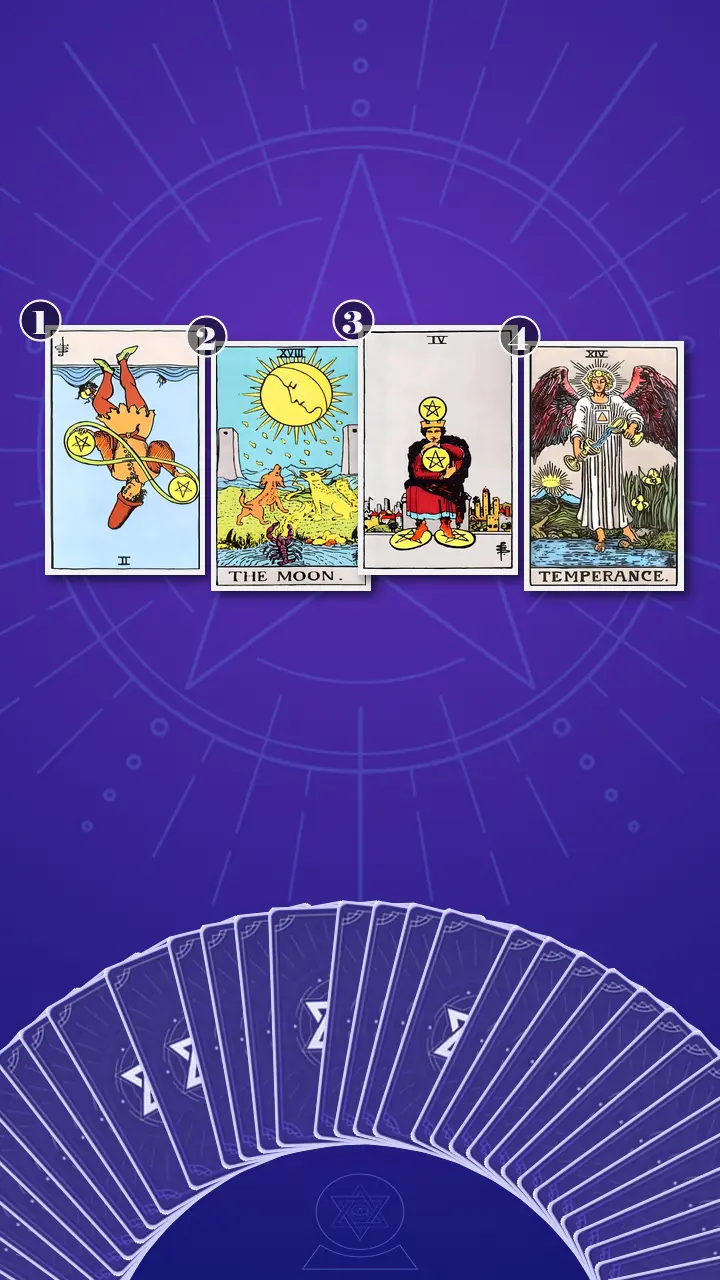
Reading the Hidden Fear Beneath Social Self-Editing
Position 1: The Night She Managed Instead of Attended
I turned the first card. “This position shows the visible symptom from the diagnosis: the real-time social juggling and self-editing that appears when friend groups overlap. The Two of Pentacles, reversed.”
The image translated immediately into her birthday dinner. I could see her with one hip angled toward her work friends while laughing with her oldest friends, then getting up the second the energy shifted at the other end of the table. She edited her tone on contact, never fully landed in one conversation, and left the night feeling like she had attended three versions of the same event without really inhabiting any of them. Reversed, this card wasn’t balance. It was overload — like keeping six browser tabs playing audio at the same time until the whole system starts to overheat.
I said, “You weren’t fake. You were overmanaging the room.”
I explained that her flexibility had tipped into frantic logistics. Instead of being the person whose birthday it was, she became live event operations: check on them, fix that lull, laugh here, soften there. Presence had been replaced by performance.
Jordan gave a short laugh that carried a little sting. “That’s so accurate it’s almost mean,” she said, rubbing her thumb against the rim of her mug. It was the exact reaction I expected when recognition lands before relief does.
Position 2: The Pause That Turns Into a Verdict
I turned the second card. “This position reveals the underlying fear: being exposed as inconsistent and not fully belonging. The Moon, upright.”
I’ve spent a decade guiding people through artificial night skies, and one thing I’ve learned is how quickly the human mind mistakes partial light for full truth. That is The Moon. Jordan told me about one tiny moment: her coworkers and long-term friends exchanging a slightly awkward hello, a joke landing differently, one unreadable half-smile. Nothing dramatic happened. But her mind rushed into the dark and filled in the blanks: that pause means comparison, that look means they noticed, they can tell I act different with different circles. It was a little like Severance, except the split was social rather than corporate.
This card carried excess uncertainty and projection. Not danger, but low visibility. Like reading a vague text as if it were a performance review. I told her, “What if mixed rooms feel exposing because they touch a belonging wound, not because they reveal a fraudulent self?”
Just then, a thin siren passed under her Toronto window and faded. She went still in three clear stages: first her breath paused, then her eyes drifted off-screen as if replaying a specific table-side glance, and then her shoulders softened by a fraction. “That’s the exact thought spiral,” she said quietly. “I don’t even need anything bad to happen.”
Position 3: Control as Belonging Armor
I turned the third card. “This position shows the defense strategy and limiting pattern: how control and compartmentalization temporarily manage discomfort. The Four of Pentacles, upright.”
The scene was tactile at once: arriving early, planning where people would sit, over-introducing everyone with polished mini bios, topping up water, keeping her body half-turned toward the next possible problem. The energy here was not generosity alone. It was a grip. Security through control. Like color-coding her whole personality into audience-safe folders and using the seating chart as emotional firewall software.
I told her, “The problem isn’t that your tone changes. It’s that fear gets to decide the change.”
That was the engine room of the reading. The Moon generated imagined exposure, and the Four of Pentacles answered by tightening everything. Safe stories for this group. Looser jokes for that one. No lull left alone. Short term, it lowered the chance of visible friction. Long term, it made her feel absent from her own celebration. Belonging gets thin when you spend the whole night editing yourself for it.
She let out one long exhale. “If I keep the energy moving,” she said, eyes on the card, “nobody has time to notice the seams.”
“Exactly,” I said. “That strategy is intelligent. It’s also exhausting.”
When Temperance Poured Between Two Cups
Position 4: The Thread That Could Hold the Whole Room
When I turned the fourth card, the atmosphere changed. The first three had shown me the symptom and the hidden machinery. This was the bridge. “This position points to the key shift: how to move from performance to integrated authenticity in mixed social space. Temperance, upright.”
I asked Jordan to picture that moment on the train before her dinner — phone warm in her hand, Notes app open, already planning who would click with whom before anyone had even arrived. That was the old script. If she managed the room perfectly, maybe the mismatch in her would stay hidden.
You do not have to keep juggling identities to stay safe. Blend them with intention, like Temperance pouring one cup into another, until your real tone can hold the whole room.
I let that sit between us for a beat.
My Cosmic Redshift Communication Check
Then I reached for one of the lenses I use most in my own work, something I call Cosmic Redshift Communication. In astronomy, a star can look slightly different depending on where the observer stands and how the light reaches them; the wavelength shifts, but the source is still the same star. That is what Temperance was showing her. Her humor might sound a little sharper with old friends, a little more polished with coworkers, a little more careful with newer people. Context changes the register. It does not automatically change the source. Authenticity is not identical performance. It is a stable inner frequency carried across different rooms.
Jordan froze first — breath held, fingers suspended around her mug. Then her gaze went soft and unfixed, as if she were watching the whole birthday rewind and noticing how early the self-editing had started. When she finally spoke, resistance came before relief. “But if that’s true,” she said, “doesn’t that mean I’ve been making my own birthdays harder than they needed to be?”
I answered the truth as kindly as I could. “It means you built a brilliant survival system around belonging. It made you look effortless. It just outlived the emergency.”
Her shoulders dropped after that, not all at once, but enough to change her face. The tight smile unclenched. She gave a small laugh that wobbled at the edges. “So I don’t need one perfect personality?”
“No,” I said. “You do not need one perfect personality. You need one truer thread.”
I asked her to replay the last dinner with this new lens. “Can you find one moment that felt like proof at the time, but now looks more like ordinary first-meeting awkwardness?” She nodded almost before I finished the question. “The pause after introductions,” she said. “I turned it into a verdict.”
“Good,” I told her. “Within the next ten minutes, write one word you want to embody at the next mixed gathering and put it somewhere easy to find. If it feels cheesy, keep it private. The point isn’t to force confidence. It’s to give your nervous system one steadier cue than room management.”
That was the real crossing in the reading: not from awkward to flawless, but from hyper-self-monitoring and social shape-shifting to something more integrated, more values-led, more legible to herself.
From Overmanaging the Room to a Truer Thread
Once all four cards were visible, the story was clean. The reversed Two of Pentacles showed the symptom: social tab-switching until her own birthday felt like operations. The Moon showed the hidden fear: every pause or unreadable expression turning into imagined judgment. The Four of Pentacles showed the protective strategy: grip harder, curate harder, manage harder. Temperance changed the architecture instead of decorating it. It did not ask her to be identical in every conversation. It asked her to choose one steady core quality and let that become the through-line.
The blind spot was simple and brutal: Jordan had been measuring authenticity by how frictionless the room felt. But a smooth room is not the same thing as a real one. A little awkwardness is not the same thing as a social emergency. Her way forward was to stop managing how every group read her and start choosing what value she wanted to remain loyal to while the room behaved like a normal imperfect room.
I gave her a pocket version of my Social Star Map — not a seating chart for other people, but a map for her own attention.
- One-Word AnchorBefore the next mixed hang, open Notes and write one word you want to embody across the night — “warmth,” “steadiness,” or “honesty.” If it helps, text one trusted friend: “My only goal tonight is to stay in warmth, not to manage the whole room.”If the word feels cheesy, shrink it to initials, an emoji, or just hold it in your head while you wait for the TTC. Simple is the point.
- Fact vs Story CheckAt the next ambiguous moment, do a ten-second check: fact = “there was a pause”; story = “they think I’m fake.” If your body spikes, step to the washroom or plant both feet and take three slower breaths before you rejoin.You do not need to prove your fear wrong in real time. You only need to stop treating the first fearful interpretation as the final verdict.
- Five-Minute StayAt the next mixed event, choose one conversation and stay in it for five full minutes before scanning the room. Let one introduction be shorter than usual. Choose one task — refilling everyone’s drinks, rescuing every lull, over-explaining how people know you — that you will not automatically take over.You may feel rude or weirdly idle at first. That doesn’t mean you’re doing it wrong. It means your hostess-to-human reset has started.
Jordan looked doubtful at that last one. “But what if I can’t even get five minutes because everyone wants something from me?”
“Then go smaller,” I said. “Stay seated through one lull. Let one silence breathe. Ask one real question instead of scanning the whole table. The goal is not to become unavailable. It’s to let support be a choice, not a disguise.”

A Week Later: The Quiet Proof
A week later, Jordan sent me a voice note before a smaller drinks night. She had typed “warmth” into Notes, texted one trusted friend, and promised herself she would not refill every glass just to escape being perceived. Afterward she messaged again: “It was still a little awkward at first. I still felt the shoulder thing. But I stayed in one conversation, and I didn’t feel like three separate press releases.”
That was the proof I wanted for her. Not a magically perfect room. Not the end of overthinking after a party forever. Just the first evidence that she could stay recognizable to herself across different conversations. That is what I love about a Shadow Spread tarot reading for feeling fake in mixed social settings: it does not hand someone a better mask. It helps them notice the fear-control loop, then return ownership to the part of them that can choose a truer thread.
The next morning, she told me, she woke with the old thought — What if I came off weird? — and laughed before making coffee.
Sometimes the loneliest part of your own celebration is standing in the middle of a room you built, smiling tightly, while quietly trying to stop different versions of yourself from colliding. If that feeling is familiar, I hope you remember this: noticing the collision is already the beginning of clarity.
So when the next mixed room starts buzzing and the old urge to manage every transition comes online, what one quality would you stay loyal to — and what would you want that truer thread to make possible for you?
Every reading at AceTarot is a Journey to connect with inner wisdom and empower next step.
Learn more about our Journey to Clarity.