People-Pleasing With the Aux: From Panic-Editing to One Honest Song

The 11:32 Uber and the Hover Over Skip
If you're a twenty-something creative in Toronto who can explain a design decision at work but freezes the second someone says, "Your turn, play something," this might be less about music and more about people-pleasing with the aux. That was the exact question Casey (name changed for privacy) brought to my table: "Why do I self-edit my music taste when friends hand me the aux?"
She described a shared Uber after pre-drinks in the west end: the car smelling faintly of fries and cold air, bass still thudding up through the seats, somebody in front half-turning with the cable and grinning, "Your turn." Her thumb started flicking too fast through Spotify. She passed three songs she genuinely loved, landed on a polished indie track everybody already knew, and kept one finger hovering over the skip button as the first bars came in.
What struck me was not indecision. It was the speed of the social scan. She told me her chest goes tight, her jaw sets, and the first few seconds of a song feel like standing under a bright kitchen light with a secret written across your shirt. Alone on the 504 streetcar, those same tracks feel like home. In public, they suddenly feel like evidence. She wanted her friends to know her real taste; she was equally afraid that one honest song would make the room go weird, or worse, make her feel quietly outside of it.
I told her I knew that particular kind of contraction. It is not vanity, and it is not bad taste. It is the nervous system trying to protect belonging by editing first. "Let's make a map of that moment," I said. "Not so the cards can tell you who you are, but so you can see what happens when the aux starts to feel like a social audition, and find some clarity inside it."

Choosing the Compass: A Four-Card Map for Finding Clarity
I asked her to take one slow breath and hold the question in plain language. Then I shuffled between us, slowly enough for the room to stop feeling buzzy and start feeling focused. For me, that is how tarot works best: not as theater, but as a clean threshold from reaction into observation.
For this reading, I used a Situation-Obstacle-Advice-Outcome spread. I like this four-card spread for fear of judgment in everyday friendships because it is simple where the mind wants to spiral. We did not need prediction, and we did not need ten extra branches of possibility. We needed a straight line from the visible habit, to the deeper fear underneath it, to the inner shift that restores self-trust, and finally to a practical next step.
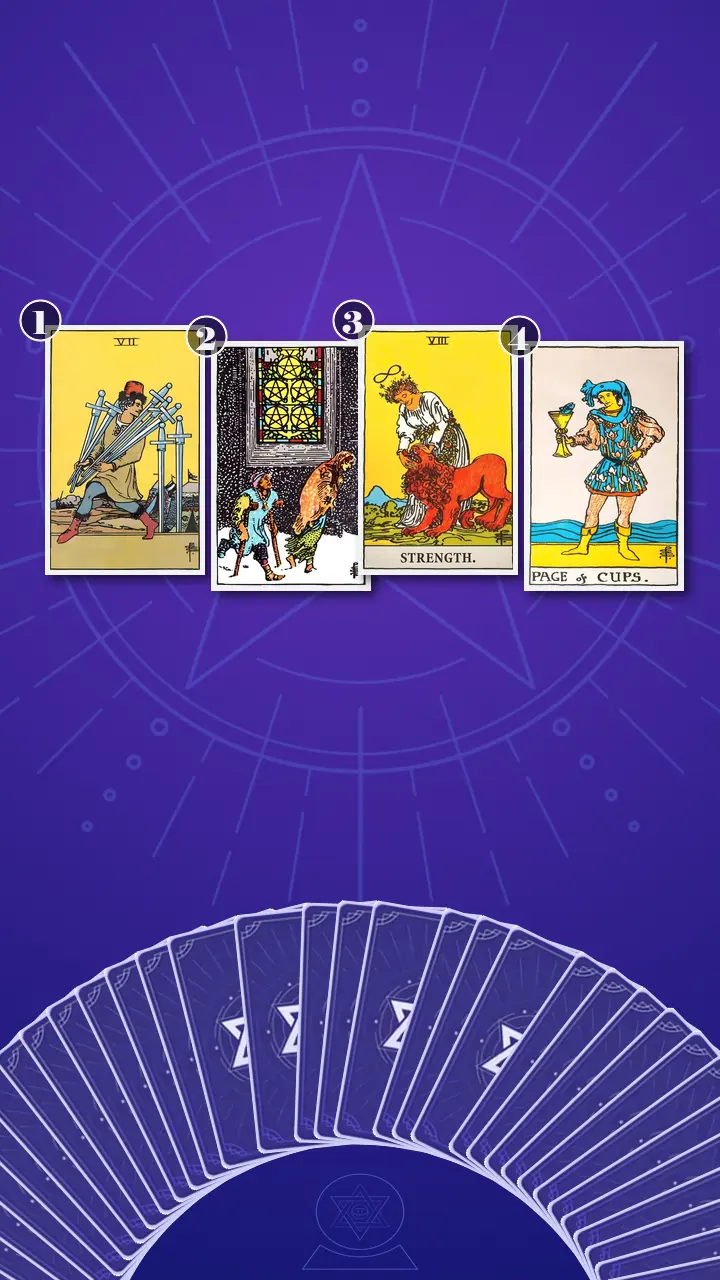
I told her what each position would do. The first card would show the symptom in real time: how she edits herself the moment attention turns toward her taste. The second would reveal the hidden obstacle: the belonging fear underneath the behavior. The third would name the antidote: the inner quality that interrupts approval-seeking. The fourth would show how this becomes practical in real life. Laid out left to right, the cards looked almost like a playlist moving from guarded opener to more personal closer.
Reading the Queue Instead of the Room
Position 1: The Friend Who Turns Into a Strategist
Now I turned the first card, the one representing the visible symptom: how Casey edits her music choices in real time when attention turns toward her taste. It was the Seven of Swords, upright.
This card is strategy, selective disclosure, and staying one step ahead of imagined consequences. I told Casey it looked exactly like being handed the aux in a friend's car and switching from listening mode to damage-control mode: scrolling past the tracks that would actually say something about you, then choosing the one least likely to make anybody raise an eyebrow. Like curating your Spotify queue the way some people curate an Instagram main feed: polished, acceptable, safely readable.
In energy terms, this was excess Air. Too much forecasting, too much social scanning, too much trying to outmaneuver a possible reaction. The figure on the card keeps looking back over a shoulder; that is the same over-the-shoulder movement Casey makes when she checks the mirror, the back seat, the room, everybody's face but her own body. The swords left behind felt like the songs still stranded in her private playlists. In the Jungian language I sometimes use, this is the social persona grabbing the aux before the private self gets a turn. Not fake, exactly. Just edited enough to stay safe.
She went still, then gave one short laugh that landed with a little bitterness. "That is so accurate it's rude," she said. I smiled and answered softly, "The aux is not a courtroom. But I can see why your body keeps acting like it is."
Position 2: The Outside-the-Vibe Feeling
Then I turned the second card, the one representing the hidden obstacle: the belonging fear that makes authentic taste feel socially risky. It was the Five of Pentacles, upright.
This is the card that answered the real why. Not, "Why am I weird about music?" but, "Why does one honest choice suddenly feel like it could cost warmth?" The image on the card shows figures out in the cold while a lit window glows nearby. I told Casey it mirrored that Saturday-kitchen feeling perfectly: the speaker beside a bowl of limes, the fridge humming, a slow intro starting, one friend opening beer bottles, another answering a text, nobody reacting right away, and her whole system deciding, There it is. Wrong call. Skip before I end up outside the vibe.
In energy terms, this was scarcity hardened into the body. Not enough inner safety. Too much meaning placed on neutral signals. Distraction becomes disapproval. Silence becomes exile. "You are not overreacting to music," I told her. "You are reacting to exposure." Safe songs keep the vibe smooth. Real songs let people actually meet you. The trouble is that your nervous system keeps translating normal social messiness into proof that you are about to lose your place in the room.
She stopped touching her teacup. First her breath caught. Then her gaze slid past me to the rainy window, unfocused, as if she were replaying a dozen small moments at once. Finally she nodded, once, with that tiny wince people make when a pattern lands in the body before it lands in words. "Yes," she said. "Neutral always feels like they hated it." I felt an old memory flicker through me from my years on ships, watching singers and newly in-love strangers make the same mistake with silence. Human beings are exquisitely bad at reading delayed feedback when something tender is on the line.
When Strength Took the Aux Back
Position 3: The Card That Interrupts Approval-Seeking
When I turned the third card, the room changed. Even the radiator gave a single click and went quiet. This was the advice position, the key shift: the inner quality that could interrupt approval-seeking and support more honest self-expression. The card was Strength, upright.
Before I said anything else, I named the doorway. This is that moment in the Uber or kitchen when the intro starts, nobody reacts instantly, and your whole body rushes to skip before the song has even had time to become part of the room. That is the hinge. That is where you have been mistaking fast reaction for safety. Strength is not asking you to become louder or more provocative. It is asking you to stay steadier for thirty seconds.
The Sentence in the Middle of the Reading
Stop treating the aux like a courtroom, and start holding the lion of your taste with a steadier hand so one real song can breathe.
Casey's hand froze on the edge of her phone case. Then her eyes widened slightly, just enough for me to see the thought move through her: if this is true, then the emergency is not the song. It is the way I start managing everybody else's face before I have even stayed with myself. Her shoulders dropped an inch. Then, almost immediately, she frowned. "But if I don't manage it," she said, with a flash of resistance, "what if it really does get awkward?"
That was where I brought in one of the tools I use all the time, what I call a Social Dynamics Audit. "Right here," I told her, "you switch roles the second the aux lands in your hand. You stop being a friend sharing a track and become the room's unpaid vibe manager." Then I used my Interaction Logic Decoding lens to make the loop visible: trigger, face-scan, panic edit, short relief, long loneliness. "Strength breaks the loop in one specific place," I said. "Body check before face check." I asked her to unclench her jaw and picture letting a song with a strange intro play for thirty seconds. Not forever. Thirty seconds. Like resisting the urge to force-quit an app the second it lags, or loosening your grip on the steering wheel instead of jerking the car every time the road goes uneven. "I can survive not managing this immediately," I said, and I watched her quietly try the sentence on from the inside.
There was the reaction chain I had been waiting for: first the stillness, then the faraway look of memory replay, then a long exhale that seemed to come from somewhere below her ribs. Her face softened, but there was a hint of dizziness in it too, the vulnerability that comes when a heavy bag finally leaves your shoulder and your body has to recalibrate without it. I asked her, "Now, with this new perspective, think back to last week: was there a moment when this insight would have made you feel different?" She laughed once, this time without bitterness. "The Uber on Friday," she said. "If I'd just let the intro live, I might have stayed in the song instead of leaving myself." That was the shift in plain language: from approval-driven self-censorship to grounded self-trust in public self-expression.
Before we moved on, I had her do something small and immediate. Right there at the table, within ten minutes of that realization, I asked her to open Spotify and make a tiny list of three tracks: one safe, one real, one maybe. She starred the one that felt most like her. Then I had her say, out loud and without a joke, "I've been really into this one lately." She grimaced, then smiled. I reminded her she could stop at any point; the practice was not forced exposure. It was simply making the next honest choice easier.
One Honest Song Is Enough
Position 4: The Practical Shape of a Sincere Offering
Then I turned the fourth card, the one representing the grounded next step: how Casey could share taste more sincerely without turning the moment into a performance test. It was the Page of Cups, upright.
I love this card in questions like this because it never asks for a total personality overhaul. It asks for a small, sincere offering. In modern life, it feels like posting a song to your Instagram Notes because it fits the moment, not because it is guaranteed to land. Or sending the slightly weird meme that actually makes you laugh, instead of the one you know everyone will get in two seconds.
In energy terms, this was balanced Water after all that mental overcontrol: feeling allowed back into the moment. The fish rising from the cup is that slightly awkward, slightly brave sensation of letting something more personal surface before you have fully rehearsed how it will land. "One honest song is enough," I told her. "It does not have to become your whole personality." The point is not to prove elite taste. It is to offer one personally meaningful track without apologizing, overexplaining, or rushing to manage the room.
She smiled in a way I only see when a person can suddenly imagine themselves doing the thing in real life. "So not a TED Talk," she said. "Exactly," I told her. "A song, not a pitch deck."
Aux Without Audition: The Next 48 Hours
When I stepped back from the full line of cards, the story was clean. The Seven of Swords showed the protective editor: the part of Casey that learned to lead with the socially acceptable cut. The Five of Pentacles showed why: her system treats a neutral reaction like being left outside the warmth of the group. Strength replaced crowd control with self-possession. The Page of Cups translated that steadiness into one low-stakes, real offering. In other words, this was never a problem of bad taste. It was a problem of belonging panic turning a casual aux moment into a likability test.
I told her the blind spot was equally clear: she had been treating social ambiguity as accurate feedback. A distracted glance, a slow intro, the ordinary noise of a kitchen, the way a group chat keeps moving before anyone answers you back — her mind had been reading all of it as proof when much of it was just life being messy. The transformation direction was not "be fearless" and it was definitely not "make everyone get it." It was gentler and more useful than that: move from face-scanning to self-trust, from curating for universal approval to offering one personally meaningful song and letting it breathe.
"But I don't have time to become calm in those moments," Casey said. "Everyone's waiting."
"Exactly," I said. "So we remove the part that lets you spiral." I borrowed from my own Scenario Mapping practice and built the plan around the actual places this happens — Ubers, kitchen hangs, shared speakers, low-pressure nights with people she already likes — because insight only matters if it can survive real life.
- Build a Three-Song Scenario Map Before your next car ride, Uber, or apartment kitchen hang, save exactly three tracks in a note or mini playlist called "real but shareable": one safe, one real, and one maybe. When the aux lands in your hand, choose from that tiny list instead of opening your whole library and spiraling. Do it on your commute home or while you're alone, not in the social moment. Two quiet minutes now can save you ten frantic seconds later.
- Use a No-Apology Handoff When you press play, use one clean sentence: "I've been really into this one lately." Do not add a joke, an apology, or a mini TED Talk about why the song deserves approval. Then look at the window, dashboard, or your drink for one breath before scanning faces. If that feels too exposed, use the lower-bar version and say nothing at all. The goal is sincerity, not confession.
- Practice the Thirty-Second Courage Buffer The moment someone says, "Your turn," notice the first body cue — tight chest, hot face, hovering thumb, held breath. Silently name it in one word, then let the song play for thirty seconds before deciding whether to skip, unless someone explicitly asks to change it or you genuinely want to. Start with fifteen seconds if thirty feels too big. Afterward, do a quick Efficacy Review: what did you imagine happened, and what do you actually know happened?
These steps were small on purpose. I was not asking her to become the bravest person in the car by Friday. I was asking her to stop panic-editing on second three. Let the song exist before you decide what everyone thinks of it.

A Week Later, the Quiet Proof
A week later, Casey texted me from a Friday night ride home: "I played the starred one." She had used the clean sentence, let the track run, and kept her eyes on the window for one breath before looking around. One friend asked, "Wait, who is this?" Another kept talking about dinner. The world did not split. She stayed with the song anyway.
Her second message was the one I loved: "I still had the weird little stomach drop after the intro. But it felt like a wave, not a verdict." That is what a real Journey to Clarity looks like most of the time. Not certainty. Not unanimous approval. Just enough steadiness to remain present while something true about you enters the room.
That is the work I trust most in tarot. The cards do not hand over a more likable personality. They reveal the protective logic, the wound underneath it, and the small door back to agency. Casey did not need different taste. She needed permission to stop turning a song choice into evidence against herself.
There is a very specific loneliness in sitting in a warm car or kitchen with people you like, phone in your hand, chest tight, and still feeling like the real version of you is waiting just outside the room. If that is where you are tonight, noticing the hover over the skip button is already the beginning of finding clarity.
If you stopped asking your next song choice to prove you belong, what one track would you be curious to offer just because it feels like yours?
Every reading at AceTarot is a Journey to connect with inner wisdom and empower next step.
Learn more about our Journey to Clarity.