Letting the First Verse Play: From Music Taste Shame Toward Self-Trust

The Friday Kitchen, or Why Music Taste Shame Feels So Personal
When Maya sat down across from me, I recognized the pattern immediately: if you are the twenty-something city creative who can talk confidently about fonts, films, or galleries but still freezes when the Bluetooth speaker gets handed to you in a crowded flat kitchen, this is probably your why-am-I-embarrassed-by-my-music-taste moment.
Maya (name changed for privacy), a 25-year-old junior graphic designer in London, described Friday at 7:18 p.m. in her shared flat kitchen so clearly I could almost smell it myself: the oven fan buzzing, someone spraying perfume by the fridge, her phone already warm in her palm because it was connected to the speaker. A song she genuinely loved came on. She smiled for half a second, felt her cheeks flare hot, her throat pull tight, and her thumb hit skip before the chorus. ‘Okay, not this one,’ she heard herself say.
Then she looked at me and asked, ‘Why does hitting play feel more exposing than telling someone a secret?’ Her public playlists were polished and uncontroversial; her real favorites lived in private, in Liked Songs, in the hidden version of her Spotify On Repeat that nobody else got to audit. This was music taste shame, yes, but more specifically the kind of self-censorship that appears the second other people can hear a favorite song. She was torn between openly enjoying what she loved and protecting herself from other people’s judgment before they even had time to form one.
I told her gently, ‘You are not embarrassed by the song. You are embarrassed by being seen loving it.’ The feeling in her body was not abstract at all. It moved like heat trapped under a collar: face first, then throat, then straight down the arm into the hand rushing for the skip button. I knew we were not here to teach her to stop caring overnight. We were here to make a map through the fog and find clarity about why pleasure kept turning into a belonging test.

Choosing the Compass: The Shadow Spread · Context Edition
I asked Maya to take one slow breath and hold the question in the most ordinary way possible: not as a dramatic life crisis, but as a precise moment in the body. Then I shuffled slowly, the cards making that soft paper hush I have trusted for years. For me, tarot works a little like Jungian dream work: the point is not to declare whether a song is ‘good’ or ‘cringe,’ but to let the psyche show where meaning has become tangled.
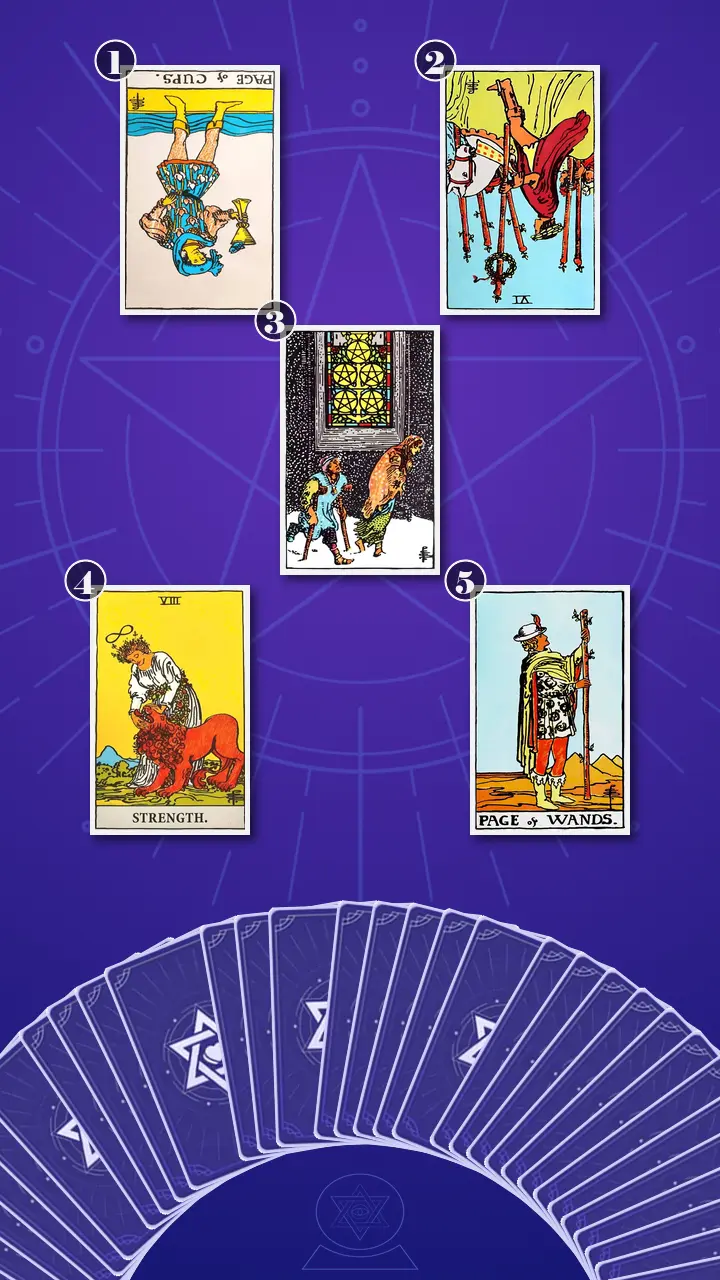
For a question like ‘Why do I skip songs I love when people can hear them?’ I chose a five-card shadow-work tarot spread I use often: The Shadow Spread · Context Edition. It is the best fit when the issue is not really a decision, but a loop of self-censorship and belonging fear. This spread moves cleanly from the visible habit, to the trigger, to the wound beneath it, then to the medicine and the first real-world next step. In other words: symptom, imagined audience, root fear, antidote, audible experiment.
I told her what I would be watching for as I laid the cards into a descending diamond. The first card would show the mask her nervous system puts on in real time. The third would tell us what deeper fear the moment touches. The fourth card, the heart of the reading, would show the inner quality that could help her move from performing taste to trusting taste. The fifth would tell us how that insight becomes something she can actually try in a kitchen, a car ride, or a text thread this week.
Reading the Top Line of the Diamond
Position 1: The Song You Cut Off Before the Chorus
I turned over the card for the visible coping pattern or mask. It was the Page of Cups, reversed.
That card always catches my eye because of the fish emerging from the cup: something small, tender, a little surprising, rising before the mind can fully control it. In Maya’s life, it translated almost perfectly into the kitchen scene she had just described. In a shared flat before a night out, the opening bars of a song that made her feel instantly softer would come on; she would smile, then hear that softness as if it had suddenly been put on display, say, ‘Okay, not this one,’ and skip before the chorus so nobody got to decide what that softness meant about her.
This was blocked emotional openness, not bad taste. The energy here was not absent love, but love interrupted. It felt to me like typing a sincere text and deleting it the second the typing indicator appears. The Page of Cups reversed says: something genuine rises, and you pull it back before it can land. I watched Maya give a short, dry laugh, tuck her chin, and rub her thumb against the edge of her sleeve. ‘That is... weirdly accurate,’ she said. ‘Like, rude accurate.’
Position 2: The Crowd You Invent Before Anyone Speaks
I turned to the card representing the trigger that activates the shadow response. It was the Six of Wands, reversed.
This is the card of the imagined audience. The upright version has a rider lifted above the crowd, crowned, seen, approved. Reversed here, that visibility becomes unstable. The second speaker control lands in Maya’s hand at pre-drinks, the room becomes a silent panel of judges inside her nervous system. I could practically hear the clipped inner monologue in the card: What will this make me look like? Too much? Too basic? Too earnest? Too teenage? The kitchen is still just a kitchen. The office is still just an office playlist. But her body turns it into an audition.
I told her, ‘Taste stops feeling like joy when it starts feeling like evidence.’ The energy dynamic here is excess in the approval lens and deficiency in self-directed fire. Instead of desire moving outward in a clean line, it gets outsourced to the crowd. She is no longer asking, ‘Do I love this?’ She is asking, ‘Will this land?’ It is like treating the aux cord like a job interview and neutral faces like live downvotes in a comment section.
When I see this card, I still think of my years on transoceanic decks, watching travelers at sunset suddenly perform a cooler version of themselves the moment a speaker was involved. The ocean was vast, the evening beautiful, and still the fear of being perceived could shrink a person to a thumbnail. I asked Maya, ‘Whose face are you bracing for before anyone has actually reacted?’ She gave one sharp nod and let out the uneasy half-laugh I was expecting. ‘Honestly? Everyone’s.’
Position 3: The Cold Story Under the Warm Room
I turned over the card representing the hidden wound or fear beneath the pattern. It was the Five of Pentacles, upright.
The room seemed to quiet around that one. On the card, two figures move through cold and snow while a lit window glows nearby. In Maya’s modern life, the translation was immediate: one awkward silence after a chorus, one half-heard joke, even no reaction at all, and suddenly the emotional weather inside her changes. A shared listening moment stops being about music and starts feeling like standing outside the pub in the cold while everyone else remains warm and inside.
This is why the habit never felt trivial to her. The energy drops from performance anxiety into scarcity and exile. In Jungian terms, the shadow here is not a ‘bad’ preference; it is the tender part of herself she has learned to push outside the room first, before anyone else can. I said it slowly so her body had time to hear it: ‘A mixed reaction is not a social eviction notice.’ Her breathing paused. Her gaze went unfixed for a second, as if replaying a car ride or a kitchen silence only she could see. Then her shoulders dipped a fraction. ‘Yes,’ she said quietly. ‘That is why it feels bigger than a song.’
When Strength Held the Lion of Visibility
Position 4: The Medicine That Does Not Need a Performance
When I turned the fourth card, the late light by the window narrowed into one bright strip across the table, and even the distant traffic seemed to flatten into hush. This was the key card of the reading, the antidote. It was Strength, upright.
Strength in this position does not say, ‘Become shameless overnight.’ It says: learn to stay in contact with yourself while you are being perceived. The woman on the card does not attack the lion or run from it. Her hands are open, steady, almost tender at its mouth. In Maya’s life, this is the exact body moment before the skip: hot face, tight throat, hand reaching for the phone. The medicine is not fake confidence. It is one more breath.
This is where I used the lens I call Energy State Diagnosis. I look at the leak through three layers: environment, relationships, and self. In Maya’s environment, there is the speaker, the open room, the sense of nowhere to hide. In the relationship layer, there is the imagined panel of judges and the old fear that one wrong reveal could lower her status or belonging. In the self layer, there is the hot face, the tight throat, the reflexive hand. The leak is clear: her energy leaves pleasure and rushes into surveillance. That is what this card interrupts.
I asked her to picture that Friday kitchen again: glass clinks, someone is hunting for eyeliner, her phone is warm in her palm, and the song that makes her feel most like herself has just reached the opening line. Her thumb moves before anyone else’s face does.
You do not need to cage your joy before anyone hears it; hold the lion of visibility with a steady hand and let one real favorite stay on.
She did not relax immediately. First came the freeze: her breath caught high in her chest and her fingers suspended in midair above her knee. Then came the mental replay; her eyes slipped past me, unfocused, as if she were watching herself in that kitchen from the doorway. And then, instead of relief, a flash of irritation. ‘But if I leave it on,’ she said, almost angry, ‘I am just sitting there feeling stupid in public.’ I nodded, because that resistance was honest. ‘Yes,’ I said. ‘And that is the whole distinction. Strength is not asking you to enjoy the first wave of discomfort. It is asking you not to confuse discomfort with danger.’ I felt the truth of that in my own bones; growing up by Venetian canals taught me that you do not calm a surge by damming it with panic. You regulate the current until it can move without flooding the banks. Maya’s jaw loosened. Her shoulders lowered. The flush in her face remained, but it was no longer running the room. I told her, ‘Confidence here is not “I do not care.” It is “I do not have to leave myself.”’ Then I asked, ‘Now, with this new lens, think about last week. Was there a moment when this would have changed the feeling?’ She let out a long breath, almost a laugh. ‘Yes,’ she said. ‘I think I would have let the first verse happen.’ This was the shift I wanted for her: from self-conscious image management to steadier self-trust under visibility.
Position 5: One Honest Verse in an Open Room
I turned over the final card, the first conscious expression of integration. It was the Page of Wands, upright.
I love this closing card here because it does not demand a personality transplant. It asks for an experiment. The Page stands with an upright staff in an open landscape, not certain, not fully formed, but willing. In Maya’s life, that means choosing one bold, specific song in a low-stakes setting, letting it exist without a disclaimer for one full verse, and treating the moment as practice rather than verdict. This is a beta launch, not a brand manifesto.
The energy shifts here from blocked tenderness into playful fire. The spread begins with a reversed Page who cannot let the message out, and it ends with a Page willing to send one clear signal before certainty arrives. I smiled and told her, ‘You do not need a full identity reveal. Just one honest verse.’ For the first time since she sat down, she smiled without wincing. ‘Okay,’ she said. ‘One verse I could maybe do.’
The One Honest Verse Method
By then the full story of the spread was clear to me. First, her softer taste gets cut off before it can fully arrive: Page of Cups reversed. Then the ordinary speaker moment turns into a performance review: Six of Wands reversed. That performance anxiety drops into an outsider wound: Five of Pentacles. The blind spot is not that she is ‘too sensitive.’ It is that her body has learned to treat visibility as if it were proof of possible exile. The transformation direction is cleaner than that old story: move from treating taste as a public performance to treating it as a personal truth that can survive mixed reactions.
Maya frowned a little and said, ‘But I do not exactly live in some perfect safe bubble. Most of my life is just people in kitchens.’ I liked the practicality of that. It gave me something real to work with. ‘Good,’ I said. ‘Then we do not wait for a perfect room. We lower the threshold.’ I told her I wanted to borrow a rule from Venice: when canal currents run high, you do not order the water to stop. You guide it through smaller gates. That became our action plan, a set of small audible experiments rather than a big identity performance.
- 30-Second No-Skip PauseWithin the next week, choose one trusted person and one favorite song in a low-stakes setting such as your kitchen, a bedroom doorway, or a short car ride. Let the song play for the first 30 seconds before deciding whether to skip it, and keep your phone face-down or on the counter so your thumb is not hovering.If 30 seconds feels too exposed, do 10. Name the body sensation instead of the social story: hot face, tight throat, stomach drop. The point is choice, not endurance.
- No-Disclaimer PlayThis week, text one basically kind friend a song link with no defense brief attached, just something simple like ‘This has been on repeat’ or ‘This one got me.’ If someone asks what you are into lately, name one real artist first before the safer answer.Start with text if live audio feels too intense. A single sentence or even one emoji counts. You are gathering evidence, not seeking permission.
- Neutral Is Not Rejection NoteAfter the next shared listening moment, open Notes and make two quick lines: ‘What actually happened’ and ‘What I predicted it meant.’ Write the exact cue that set you off, whether it was silence, a half-smile, someone talking over the intro, or your own urge to explain.End with the grounding sentence ‘Neutral is not the same as rejection.’ If writing feels like too much, record a 20-second voice note instead.
I told her this is how I answer questions about how to stop apologizing for music taste or how to be less self-conscious when getting the aux. Not by forcing indifference, but by building perception-tolerance reps. One honest verse. One no-disclaimer play. One fact-versus-mind-reading check. Small, clear, repeatable.

A Week Later: The Quiet Proof
A week later, Maya sent me a message just before midnight. She had been in the kitchen again, same flat, same speaker politics, same reflex waiting in her hand. This time she left the song on through the first verse. One flatmate kept chopping limes. Another asked, almost casually, ‘Wait, who is this?’ No one formed a jury. No one issued a verdict. Maya told me her face still went hot and she still made tea afterwards just to have something to do with her hands, but the feeling passed without turning into exile.
That is often how a Journey to Clarity actually looks in real life. Not dramatic certainty. Not never caring again. Just the first quiet proof that the room can survive one unedited truth, and so can you. The Shadow Spread · Context Edition did not tell her to become louder than she is. It helped her move from hiding her real music taste to trusting that a genuine preference can stay public for a moment without becoming a case for the defense.
When a song you love comes on and your throat tightens before anyone has even reacted, what hurts is how fast pleasure turns into a belonging test.
If one favorite did not have to prove anything tonight, what might it feel like to hold the lion of visibility steady and let it stay on for one more verse?