When 'We'll Figure It Out' Isn't a Plan: Testing Long Distance
Love vs Logistics at 10:18 P.M.
When a late-twenties city professional can survive a packed Toronto commute and a client fire drill but starts unraveling the second a move date lands in the calendar, I know I am not looking at simple indecision. When the same person also has a Notes app called "be realistic" sitting beside a small forest of Google Flights tabs, I know I am looking at love-versus-logistics paralysis in deciding whether to try long distance or end the relationship before the move.
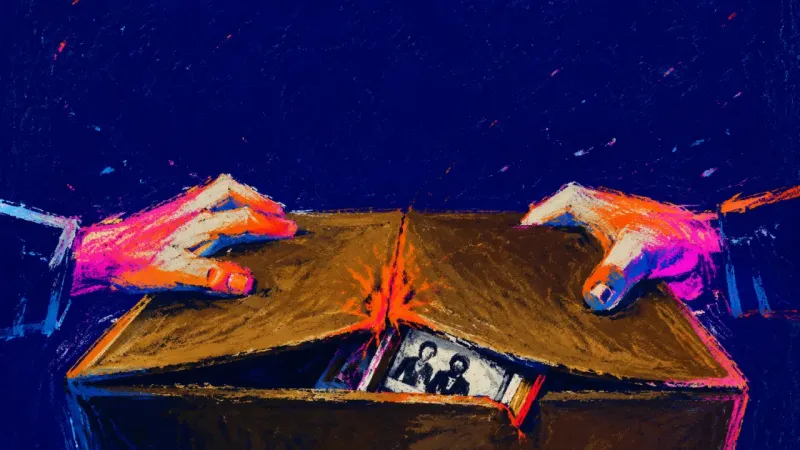
Maya (name changed for privacy) was twenty-eight, an account manager at a tech company, and very good at functioning in every room except the one this decision lived in. As she spoke to me, I could almost see the Sunday night she kept returning to: 10:18 p.m. in her small downtown apartment, still in work trousers, half-sitting on the edge of the bed with three flight tabs open, old photos glowing on her phone, and cardboard dust hanging faintly in the air from half-packed storage boxes. The radiator clicked. Her phone felt hot in her hand. She kept toggling between budget math and memories as if one more swipe might produce a cleaner answer than either love or grief was willing to give.
She wanted to preserve a relationship that still felt warm, real, and deeply alive. She was equally afraid that trying long distance would turn the breakup into something slower, blurrier, and more cruel. "I just need to know what we're doing before this gets messier," she said. Then she swallowed and added, "If we try long distance, I need it to be real. Not a slow fade."
She kept calling it practicality, but her body had already cast a more honest vote. The uncertainty sat in her like wet rope pulled tight from stomach to throat, as if she were trying to hold an airport departure gate open with one hand while pretending she was only checking the schedule.
I nodded. "That makes sense," I told her. "You are not failing at love. You are standing in a very modern kind of heartbreak, where affection and logistics keep colliding and nobody gets to be the villain. Let me help you draw a map of the fog. That is what this journey to clarity is for."
Choosing the Compass: A Decision Cross Tarot Spread for a Work-Move Relationship
I asked her to place one hand on her stomach and one on her throat, take one slow breath, and hold the question without trying to solve it. Then I shuffled slowly. I have never cared for mystifying that part of the process. The point is not theatre. The point is to give the nervous system a visible bridge from spiraling to observing.
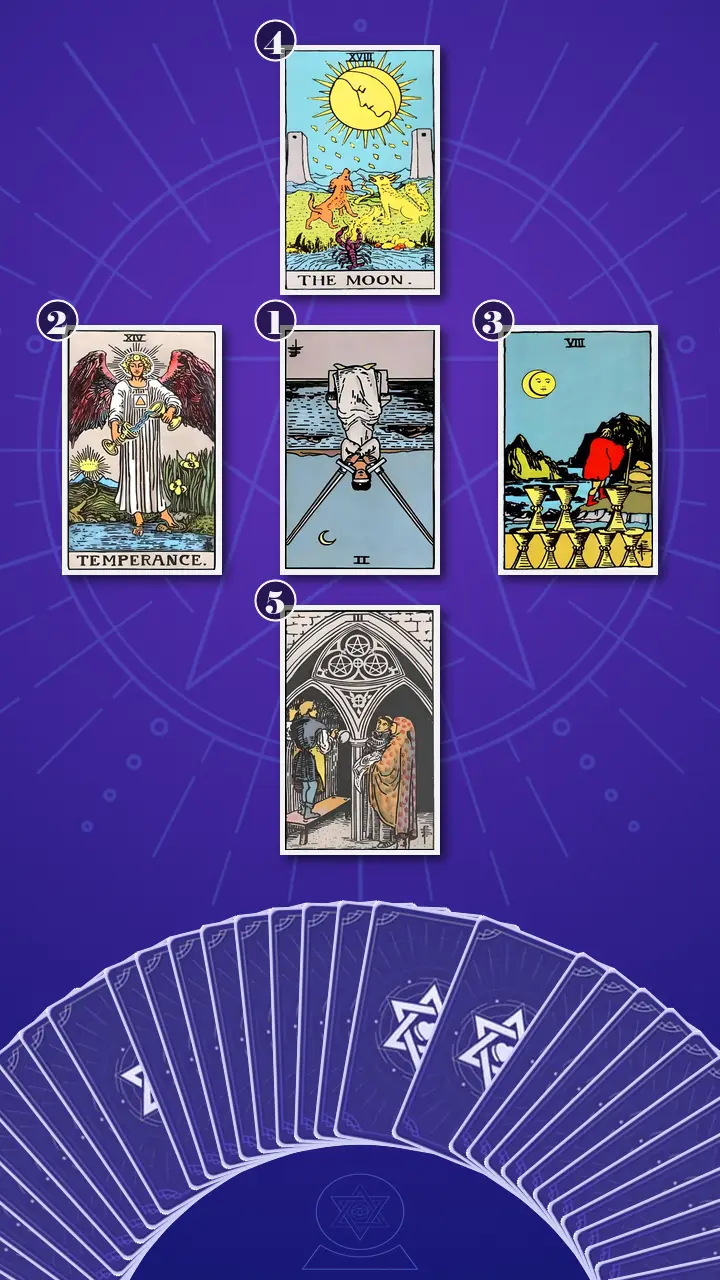
For her reading, I chose a five-card spread I call the Decision Cross · Context Edition. It is one of the most useful tarot spreads for whether to do long distance or break up after a work move, because it does not reduce a relationship to a yes-or-no verdict. Instead, it gives the problem the smallest structure capable of holding its real complexity: the visible stalemate, the emotional truth of each path, the hidden fear underneath the urgency, and then the grounded standard that can actually guide the next step.
I explained the shape as I laid the cards down. The center would show the visible knot in the relationship: the stop-start conversations, the indecision, the habit of turning emotional truth into logistics. The card above it would show the hidden force driving the pressure for immediate certainty. The left and right cards would compare the two live paths—trying long distance, or ending now—without flattening either into fantasy or failure. And the final card below would give us the decision compass: a standard of reciprocity, structure, and sustainability strong enough to outlast a single emotional conversation.
That is why I trust this spread. When people ask me how tarot works in moments like this, my answer is simple: a good spread does not tell you what to feel. It helps you see what question you are truly answering.
Reading the Knot Beneath the Move
The Visible Knot: Why We Keep Talking Logistics Instead of Feelings
I turned over the card representing the visible knot in the relationship: the stop-start conversations, the indecision, and the specific habit of turning emotional truth into logistics.
Two of Swords, reversed.
It was painfully exact. In modern life, this card looks like reopening the same conversation in different forms—flight tabs, deleted drafts, indirect questions about visits—while carefully avoiding the sentence that would actually reveal the need underneath. The blindfold becomes over-research in place of direct honesty. The crossed swords over the chest become analysis used as body armor.
In this position, the reversed card showed blockage breaking the surface. The old strategy of staying neutral, staying composed, staying "reasonable" was no longer protecting anything. It was costing intimacy. Every time Maya asked about airfare, PTO, or texting frequency when what she really wanted to ask was, "Will we both still show up when this gets hard?" she bought herself a few minutes of control and lost a little more clarity. It was like a subway train stuck between stations: technically still moving, emotionally going nowhere.
I said, "Sometimes the most exhausting part isn't the distance. It's trying to get certainty to do a job only honesty can do."
Maya gave a short laugh that had no real humor in it. She rubbed her thumb along the rim of her paper cup and looked down. "That is brutal," she said. "Also, yes. I keep asking practical questions first because I don't want to sound needy." Her shoulders lifted toward her ears, then dropped by a fraction. That small movement told me the card had landed exactly where it needed to.
The Path of Long Distance: Temperance and the Ordinary Week
I turned over the card representing what trying long distance would actually require emotionally and practically, beyond romantic intention alone.
Temperance, upright.
This card did not sell me a fantasy. It showed balance. In real life, it looks like two people blending schedules, money, emotional repair, and separate routines into something livable. One foot on land and one in water: feeling and practicality in contact at the same time. The water moving between the cups is not grand passion. It is regulation. It is pacing. It is the unglamorous art of keeping two real lives connected without pretending distance changes nothing.
I told her, "If you choose long distance, the question is not whether the love is real. Love is real. So is bandwidth. Temperance asks whether two calendars, two nervous systems, and two stressed adult lives can be paced well enough that love does not become emotional overtime for one person."
The energy here was balanced, but only conditionally. That mattered. This was not the movie-trailer version of long distance, not the TikTok take where devotion alone is supposed to solve time zones, stress, cost, and resentment. This was the ordinary-week version: who calls when the onboarding week is brutal, what happens after a missed check-in, whether visits are financially realistic, whether conflict gets repaired or simply goes dormant until the next goodbye.
Maya studied the card for a long moment, then looked at me with the first real steadiness I had seen from her. "So it isn't 'Do we feel enough?'" she said. "It's more like, 'Can we regulate enough?'"
"Exactly," I said. "That, in practice, is how to know if long distance is realistic."
The Path of Ending with Dignity
I turned over the card representing what ending now would protect, grieve, or release, so the option could be seen clearly rather than as failure.
Eight of Cups, upright.
I have always thought this card is kinder than people first imagine. The figure does not walk away because the cups were empty. The cups are still standing. Something mattered here. In modern life, this card can look like one honest conversation before the move where two people acknowledge the love, the history, the warmth—and still decide not to stretch grief into a months-long blur of half-availability and false reassurance.
The energy here was not deficiency. It was movement with integrity. As an archaeologist, I have spent a great part of my life handling fragments of beautiful things. Not every vessel is restored by pouring more water into it. Sometimes the most respectful act is to stop pretending a cracked seam can survive a voyage it was never built for.
I told her that this path felt less like a villain story and more like Past Lives: real connection, altered map, no easy person to blame. That comparison caught her immediately. Her lips pressed together. Her eyes brightened with the kind of wetness people often resent in themselves because it arrives before permission.
"That would still be heartbreak," she said.
"Yes," I answered. "But heartbreak and failure are not the same thing."
She gave me a slow, sad nod. I watched her shoulders soften. The grief in the room did not get lighter exactly, but it did become cleaner.
Where Fear Writes the Ending Too Early
I turned over the card representing the hidden fear and projection pattern driving the pressure to get immediate certainty.
The Moon, upright.
The room seemed to quiet the instant it appeared. A passing siren outside my window thinned into the distance, and for a moment even the traffic sounded far away. This card is the mind under low light: shapes blur, instincts get loud, and missing information starts hiring fear to finish the story.
In Maya's life, this looked like a neutral text—"Long day. Can we talk tomorrow?"—becoming a full private film about abandonment, false hope, or regret before any real facts had arrived. It looked like the iMessage typing bubble disappearing and somehow becoming a major emotional event. One part of this was happening on her screen; another part was happening in her fear. The dog and the wolf on the card held that split perfectly: intuition on one side, panic on the other, both staring down the same narrow road.
The Moon here showed excess water: emotion overflowing its container and turning into projection. It explained why the reversed Two of Swords felt so pressured. She was not simply trying to make the right relationship decision. She was trying to make a decision that would guarantee she never felt foolish, abandoned, or unable to trust herself again. That is too much work for any choice to perform.
I felt an old fieldwork instinct rise in me then, one I still trust. In excavations, the most deceptive layer is often the freshly disturbed one—dramatic, loose, full of noise, but not the deepest truth. "This is where I use what I call the Time Stratigraphy Method," I told her. "We separate the newest layer of panic from the older layer of value. Fear is quick. Truth is older."
She went still in a precise three-step sequence I have learned not to interrupt. First her breath paused. Then her gaze unfocused, as if a recent FaceTime goodbye were replaying behind her eyes. Then a long exhale left her chest. "So the urgency isn't always intuition," she said quietly. "Some of it is just me trying not to get blindsided."
"Yes," I said. "And that is the first real shift in perspective."
When the Cathedral Appeared
The Decision Compass Beneath the Fog
Then I turned over the final card, the one that would tell me how to judge the whole crossroads. I felt the atmosphere change the way it sometimes does when a trench reveals stonework beneath loose soil—no drama, just the unmistakable sense that the real structure has finally come into view.
I turned over the card representing the decision compass: the concrete standard of reciprocity, structure, and sustainability that could guide the next conversation.
Three of Pentacles, upright.
In modern life, this card looks like a shared note on the screen with real headings: communication rhythm, visit cadence, money and time limits, what each person does when stressed, how conflict gets repaired, what would signal that the arrangement is no longer sustainable. Its energy was balanced earth. It did not ask who felt more. It asked who could build. This stops being a loyalty test and becomes a build test.
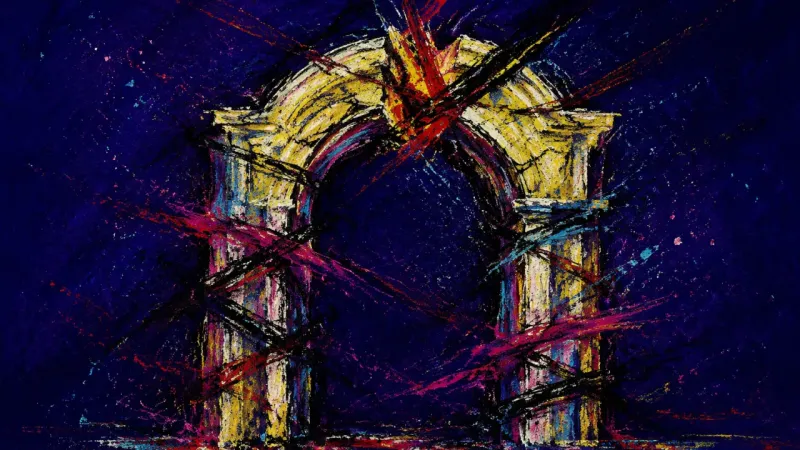
This was where my old academic life and my tarot practice met cleanly. I use a lens I call Historical Case Matching. When I compare relationship crossroads to civilization crossroads, one pattern appears again and again: cities do not endure because their citizens feel intensely about staying. They endure because roads are maintained, grain is stored, labor is shared, and the blueprint is visible to more than one set of hands. Affection may found a settlement. Structure is what keeps it from becoming a ruin. Three of Pentacles always reminds me that a shared future is less like a vow whispered in the dark and more like a cathedral arch—beautiful, yes, but only because its weight is distributed honestly.
After so many nights of Google Flights tabs, deleted drafts, and old photos, Maya had been living as if the answer might finally appear if she just thought harder than her fear. What this card offered was far cleaner: the relationship would not be clarified by extracting a pain-free feeling from the conversation. It would be clarified by testing whether mutual capacity, reciprocal effort, and sustainable structure actually existed.
This is not a loyalty test based on hope; build one honest blueprint together, and let the cathedral show you whether this connection has real structure.
I let that sentence sit between us.
Her reaction moved in layers. First, her fingers froze half-curled around the cup, as though her body had recognized the truth a second before her mind did. Then her eyes widened and lost focus, not theatrically, but with that private shock that comes when past conversations suddenly reorder themselves. I could almost see her replaying each "We'll figure it out" call and noticing the empty space where a shared plan should have been. Then emotion arrived: a flush rose at the base of her throat, her inhale turned rough, and her shoulders dropped all at once. For one brief second, she looked almost angry.
"But if that's true," she said, voice thinner now, "then I may have been trying to turn hope into infrastructure by myself."
"That is not stupidity," I told her. "That is attachment under pressure. But it is information."
She swallowed, blinked hard, and nodded. Relief was there, but so was the faint disorientation that often follows clarity—the little blank space that opens when fantasy leaves and responsibility enters. I asked, "Now, with this new lens, think back to last week. Was there a moment when this would have made you feel differently?"
Her answer came quickly. "Yes. I asked about visit weekends, and he said, 'We'll make it work somehow.' I felt comforted for maybe three minutes. Then I felt worse. I think I knew why. I was the only one holding the blueprint."
Before we moved on, I asked her to open a note and write three headings: Must have, Can flex on, and Not sustainable for me. One bullet under each. Nothing more. I told her she did not have to send it that day. Clarity first, pressure later if at all.
That was the pivot in the reading. Not from love to indifference, but from panic-driven overthinking and emotional self-silencing to grounded clarity about what both people could realistically sustain. "A shared future isn't proven by how hard you hope," I said. "It's proven by what both people will actually build."
From Vague Hope to a Shared Blueprint
Once all five cards were on the table, the story became very clear. The reversed Two of Swords showed the present stalemate: deleted drafts, late-night overthinking, logistics standing in for vulnerable truth. The Moon showed the hidden engine underneath it: fear filling in the blanks, trying to turn uncertainty into certainty by sheer mental force. Temperance and the Eight of Cups then gave us the two live paths without sentimentality. One path asked for sustainable rhythm, collaborative realism, and emotional regulation. The other offered clean grief instead of prolonged limbo. Three of Pentacles resolved the entire spread by changing the decision standard itself.
The blind spot was equally clear. Maya had been assuming there must be one right decision that would prevent regret. That is the belief that keeps so many intelligent people trapped at relationship crossroads. You do not need a pain-free option to make a clean decision. The deeper shift is from asking, "How do we avoid pain?" to asking, "What level of effort, honesty, and structure can we both realistically sustain across distance?"
I told her I wanted her next steps to be small, concrete, and observable. In archaeology, I learned never to declare a structure sound because I admired the façade; I inspected the joins. In old voyage records, I learned never to promise the whole sea; I marked the next reliable stretch of water. Relationship advice ought to be just as practical.
- Blueprint-First Conversation Ask for one 45-minute call this week that is only for the decision, not a drifting check-in. Open one shared note with four headings: communication rhythm, visit cadence, money and time limits, and how conflict gets handled when you're apart. End the call with either one light trial structure or one clear no—not five warm maybe-options. If it feels "too formal for love," remember that structure is not the opposite of care. It is how care becomes observable.
- Time Stratigraphy Reset Before replying to any triggering move-related text, spend five minutes making two columns: Facts and Story I'm Telling Myself. Keep each side to three bullet points. Notice whether your stomach tightens first or your throat does. Set a timer. This is a sorting exercise, not a self-improvement marathon. One fact and one fear-story are enough if your body is already activated.
- Voyage Log Trial If both of you still want to explore long distance, agree on a two-week realism test before the move or immediately after it starts: two intentional calls, one check-in text window, a rough visit budget, and one direct answer to the question, "When you're stressed, do you reach out more or disappear more?" Then set a review date. Do not design forever. Test the next stretch of water. If only one person keeps updating the map, that is information—not a cue for you to row harder.
I put it to her as plainly as I could: "If only one person is holding the blueprint, that's not a plan. That's emotional overtime." She smiled at that—grimly, but with recognition. It was not a smile of comfort. It was a smile of contact with truth.
A Week Later, the Jaw Unclenched
A week later, Maya wrote to me. She had asked for the 45-minute conversation. She had opened the shared note. They had filled in the headings together, and the result had been clarifying in the way honest documents often are: there was warmth, but not equal structure. Enough care to grieve each other properly. Not enough shared capacity to call it a workable long-distance system.
They ended it kindly. She told me she slept through the night for the first time in weeks, then woke with the old thought—what if I got it wrong?—and laughed softly at the ceiling instead of spiraling. Clear, but still tender. Steadier, not numb.
I have spent a lifetime studying ruins, roads, ports, and the choices that allowed some structures to endure while others became memory. The lesson is rarely that certainty arrives on command. It is that self-trust begins when we stop demanding guarantees and start reading what is actually being built. This was her journey to clarity: from deleted drafts to honest criteria, from fear-made stories to grounded standards.
When you are trying to hold love with one hand and the departure gate with the other, your body can start bracing for a mistake before any decision has even been made.
If you let the next conversation be less about avoiding pain and more about what the two of you can actually sustain, what small truth would you want on the blueprint first?