

The Devil Tarot Card Meaning
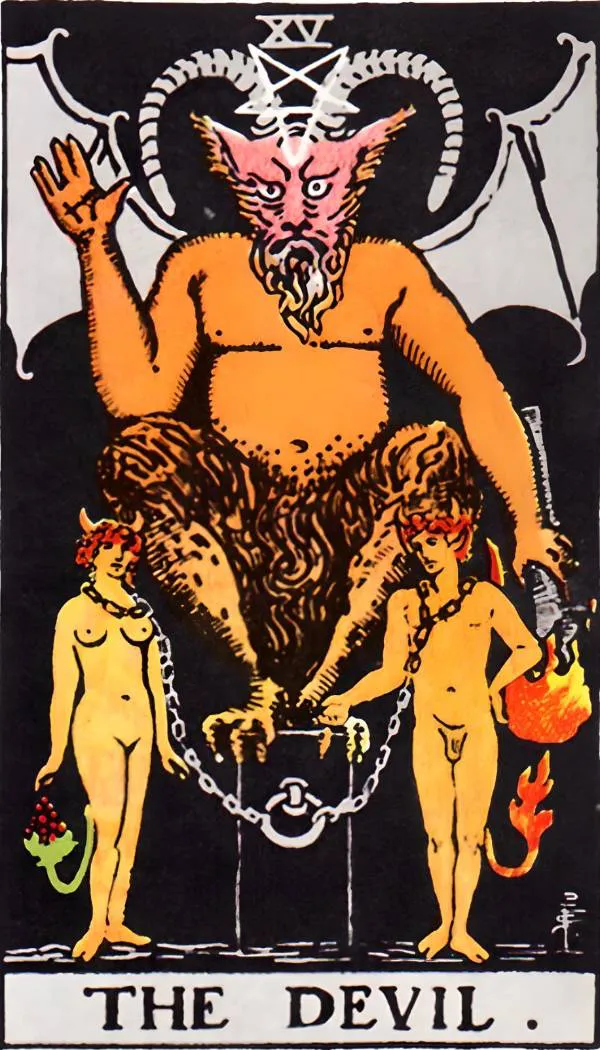
This card's theme is the Devil, with the main character being the Devil himself. What is the specific image and name associated with this deeply rooted term? In the West, the image of the Devil seems quite fixed, with a name, a history, and an origin, rather than being just a general term. There has been a certain tradition over time, and the depiction of this card is most valued for its adherence to tradition, as if changing the image of the Devil would be a noteworthy record. Thus, when it comes to the Devil, there is a particular emphasis on his identity and image.
The focus of the Devil card is the Devil, so let's first explore his appearance and identity. The Devil's appearance: The traditional Western image of the Devil has several characteristics: he has two horns, which are derived from the image of the horned god. Additionally, there are some unusual features - the main body is naked and covered with animal hair, with a pair of bat-like wings, and hands and feet depicted as the greedy and cruel talons of an eagle. In the mid-eighteenth century, the Devil in Tarot cards was portrayed in this manner, presenting the bestial nature of a beast.
Actually, the goat-headed appearance of the Western Devil originally came from important Egyptian gods, such as the main god Amun and the creator god Khnum, both of whom had the form of a goat-headed human. Due to becoming the religion opposed by Christianity, these gods of fertility from various places were all belittled. These gods, along with other horned gods from various regions, retained their faith and formed what is known as 'paganism', and these types of gods were collectively referred to as 'horned gods'. For Christianity, which is considered the 'orthodox' religion, these pagans are considered to be witchcraft and magic, and the horned god actually conflicts with their religious practices. Thus, the horned god was regarded as equivalent to the 'Devil', and the goat horns later became a symbol of the Devil.
'Pan', the god of the forest, is also a god with a goat-like appearance in Greek mythology. Pan is a creature with a head and body almost entirely in the form of a goat, with only the upper body and arms resembling a human, and is also one of the original images of the horned god. However, the overall image of the Devil is a blend of many other images. The one that is most similar to the Devil's appearance should be the Satyr. He is a 'forest god' in Greek mythology, also with a half-goat and half-human shape, with a human upper body and goat's hind legs, including genitals, tail, and animal hair on the legs and hooves. Satyr is a follower of Dionysus, the god of wine, and is also associated with drama and art. Of course, his most famous characteristic is his strong sexual desire.
From the image of the Devil, the goat head is a fixed and natural product, mostly a variation of the horned god, and the wings may have been added later to indicate a confrontation with God and angels. The reproductive power and celebration of life of the horned god are also the most contradictory to the belief in Jehovah that opposes materiality and advocates for a spiritual heaven.
So, is the Devil depicted in this card the famous 'Satan'? The Devil is, of course, the chief of devils, and the title of the chief of devils is Satan. Ancient nouns with similar pronunciations have been discussed, such as the 'storm god' Seth from Egyptian mythology, the Roman god of agriculture Saturn (corresponding to Cronus in Greek mythology), and the 'forest god' Satyr. Most of these names have the meaning of being opposed to the current orthodox god, and thus they were also used by Jehovah/Christianity as the title of the Devil. This name has already appeared in the Old and New Testaments of the Bible. The Devil as Satan is not a self-proclaimed title, and it may also be a general term, in any case, it is a synonym for the Devil. There are also many devils, each with their own named titles.
Therefore, 'Satan' can be considered a 'title', and it is not limited to one person. Some 'great demons' are also named Satan, and Beelzebub is also a devil's name that has appeared in the Bible. As for the famous 'Lucifer' or 'Lucifuge', the original meaning is the morning star (which is Venus), and it is said to be the seraphim in heaven, with power, ability, and glory only second to God. The story of him becoming a fallen angel and then ruling hell as the demon king is very famous. The origins of many other names come from literary works or various writings that name the devil characters. Names we often hear, such as 'Mephisto' / 'Mephistopheles', come from 'Faust'. The 19th-century French occultist Eliphas Levi, who painted a devil image called 'The Baphomet of Mendes', made this devil's name Baphomet very famous. In fact, these names and titles each have their complex and different origins.
Levi's painting transformed the image of the Devil into one with high magical power and cultivation, with the same goat-like head, a pair of goat horns, and a chin like a goat's beard. What is different is that there is a torch between the two horns, the genitals are symbolized by a double snake staff, the lower body is covered with clothes and seems to be in a sitting position, looking like some kind of mysterious ritual. Later Tarot cards' depictions of the Devil were mostly modified according to the prototype drawn by Levi. The Waite Devil card also made changes based on this image, still using the goat head to symbolize lust, and the lower body is in the form of a beast with long hair.
The Devil usually has a pair of wings on his back, and the Waite card's Devil is no exception. This pair of wings is in the shape of a bat, showing a gray and dull color, and in the West, bat-like wings are used to represent falling into darkness. The body does not necessarily have to be painted in this image, any species as long as it has this kind of wings represents something related to the Devil. The lower body of this Devil is covered with long hair, representing the intensity of desire and the primal nature of a beast.
The Devil extends his right hand, and the palm lines on the hand are clearly visible. The two lines that intersect horizontally and vertically represent the meaning of misfortune and evil thoughts. The style of the fingers is a special gesture, indicating the doctrine of the Devil. This gesture is also very close to the gesture of the Pope, but what he shows is disaster and temptation, not blessings and guidance.
Between the two horns on his head, there is the symbol of an inverted pentagram, which is the symbol of the Devil. The original meaning of the pentagram is the balanced development of various elements, with the spiritual aspect growing accordingly. However, the inverted pentagram connects to things underground, with the tip of the shape drilling downwards, representing the meaning of falling, due to excessive materialization and falling into darkness, which is a downward energy. This card can thus connect the Major Arcana and Minor Arcana, symbolizing the fifth element Major Arcana leading the four elements Minor Arcana with the pentagram. Another meaning of the number five is connected with the card number 15, which is the meaning of the inverted pentagram or a mysterious manipulator outside the pentagram.
Most devils also have their followers, usually two 'small demons' in front of the Devil. Since Papus, the imps have been changed to naked humans, one man and one woman entangled with each other. The Waite Devil card has inherited this, and in front of the Devil, there is a very obvious pair of men and women in the picture. We can easily think of the couple in the Lovers card, but their identity here is equivalent to 'small demons', so they also have tails, but no wings. This couple may be Adam and Eve, and their faces seem almost identical to them. And the overall shape of the two is closer to the aforementioned Satyr.
The Devil squats, his claws tightly gripping a long black cubic stone, which is the altar of the Devil. In front of the cubic stone is a large metal ring, and the ring is linked by two iron chains to two vassal slaves. These two chains are respectively placed around the necks of the man and the woman.
Because the man and the woman have already fallen, they have also grown horns on their heads and have sprouted evil tails, and they have already become the form of small demons. The tails of both men and women are raised upwards. The end of the woman's tail has the flame of the fruit of wisdom (like grapes), and the end of the man's tail also has the fruit of the tree of life, clearly showing the stage of falling after being tempted to eat the forbidden fruit. The Devil holds a torch in his left hand, which is the fire of desire. The torch droops down, and this fire almost touches the man's tail, causing him to burn and catch fire, and the fruit of the tail has formed into flames.
In the territory of this Devil, the expressions of the man and the woman are different from the man and the woman in the paradise under the jurisdiction of the angel, and the focus of their eyes is different from that in the 'Lovers' card. Here, the man looks at the lower body of the woman, and the woman looks blankly into the distance. Like the position in the Lovers card, the woman is on the left of the picture and the man is on the right. They are now controlled by the Devil, and they may have become the captives of the Devil because of their fall. This couple is united by the Devil as a witness, indicating that they are united because of desire. The love between the two is now controlled by the Devil, and the love is dark from now on.
The overall background presents a dark tone, and there is a feeling of the fire of desire. From the overall picture, vitality and vitality are still vigorous, and even the passion is even more intense. It's just that the spirit tends to the dark side, the energy focuses on a narrow place, or performs dramas that the world does not recognize.
The Horned Goat
The central figure resembles the mythical Baphomet or the Horned Goat, representing the darker forces of nature, primal instincts, and our base desires. This image is a reminder of humanity’s vulnerable nature to materialism, temptation, and bondage to one’s own vices.
The Inverted Pentagram
On the forehead of the Devil is an inverted pentagram, which traditionally symbolizes the descent into matter, or the material world taking precedence over the spirit. It can represent a distortion of values and an imbalance between the material and spiritual realms.
The Torch
The torch that the Devil holds burns downwards, emphasizing the descent of wisdom and enlightenment in the material realm. It suggests the misuse of power and knowledge for lower desires.
The Chains
The chained man and woman are symbolic of the chains that bind individuals through ignorance, materialism, and addiction. The fact that the chains are loose implies that the bondage is self-imposed and can be removed with self-awareness.
The Wings
The bat-like wings of the Devil symbolize the descent into the lower realms or the shadow side of our nature. They hint at the hidden aspects of our psyche, which we might be unaware of or choose to ignore.
The Raised Hand
The raised right hand of the Devil, in a gesture similar to that seen in The Magician card, implies that he has power and dominion in his realm. But unlike the Magician, whose power is derived from higher spiritual sources, the Devil’s power is based on materialism and lower desires.

When 'You're Too Much' Made Me Go Quiet-And I Practiced Safe Visibility

The Chair-Scrape Moment That Stung—And the Text I Finally Sent

From Shame-Spike Autopilot to Intentional Rest: The 60-Second Pause

When Apple Watch Rings Feel Like Grades: Rebuilding a Calibrated Week

I Thought I Had to Sound Exceptional—Then Wrote a Progress Report Instead
