From Neon PDF Panic to Evidence-Based Memory: Small Retrieval Wins

Finding Clarity in the Neon PDF
If you’re a Toronto early‑career analyst studying for a certification and your PDFs look like a neon art installation, but you still blank the second you close the tab—welcome to the highlight trap (aka “I studied, but I can’t recall it”).
Taylor said that to me on a video call, but I could already see the scene in my head because they described it with the kind of precision you only get when you’ve lived it a hundred nights.
It was 9:18 PM on a Tuesday in a Toronto condo living room. They were on the couch with their laptop balanced on a throw pillow. The PDF glowed icy-blue against a dim room, and a desk lamp made that faint electric buzz that somehow feels louder when you’re trying to be “productive.” Their trackpad looked like it had been working overtime; their fingers kept hovering, hunting for the next line to “secure.”
“My page looks done,” Taylor told me, jaw tight enough that I could hear the words through it. “But the second I try to explain it out loud, it’s just… empty. So I highlight more because at least then I can see I did something.”
I asked, gently, the question that usually lands like a small bell: “When you close the PDF, can you pull even one idea back without looking?”
Their shoulders lifted—almost protective. “Not reliably. And it makes me feel like… maybe I’m not actually competent. Like I’m confusing effort with learning.”
The overwhelm wasn’t a vague mood. It was a physical thing: a tight jaw like a clamp, a pinched forehead, and restless hands that kept reaching for the highlighter the way some people reach for their phone when the silence gets too honest.
“Okay,” I said. I was sitting in my café after closing, the last espresso machine hiss still hanging in the air. “Let’s make this practical. We’re not here to judge you for trying. We’re here to get you to a next step that actually builds memory—real recall, the kind you can use in a meeting without the page open. Let’s draw a map through the fog and find some clarity.”

Choosing the Compass: Celtic Cross · Context Edition
I asked Taylor to take one slow breath—not as a ritual for luck, but as a reset for attention. I shuffled while they held the question in mind: After I highlight everything, what’s my next step to remember it?
“Today I’m using a spread called the Celtic Cross · Context Edition,” I told them. “It’s the classic Celtic Cross, but we’ll treat the ‘outcome’ as an integration practice, not a fixed prediction—because your question isn’t ‘what will happen to me?’ It’s ‘what do I do next, in a way I can repeat?’”
For anyone reading along: this spread is perfect for a situation like “I highlight everything but remember nothing,” because it forces a full chain. It doesn’t just say, “Stop doing that.” It shows: what you’re doing right now, what’s blocking you, what’s driving it underneath, what you’ve been trying, what you actually want, the immediate pivot, and then how your environment and performance pressure shape your studying. It’s basically a diagnostic for a career crossroads moment inside your own brain: effort vs evidence.
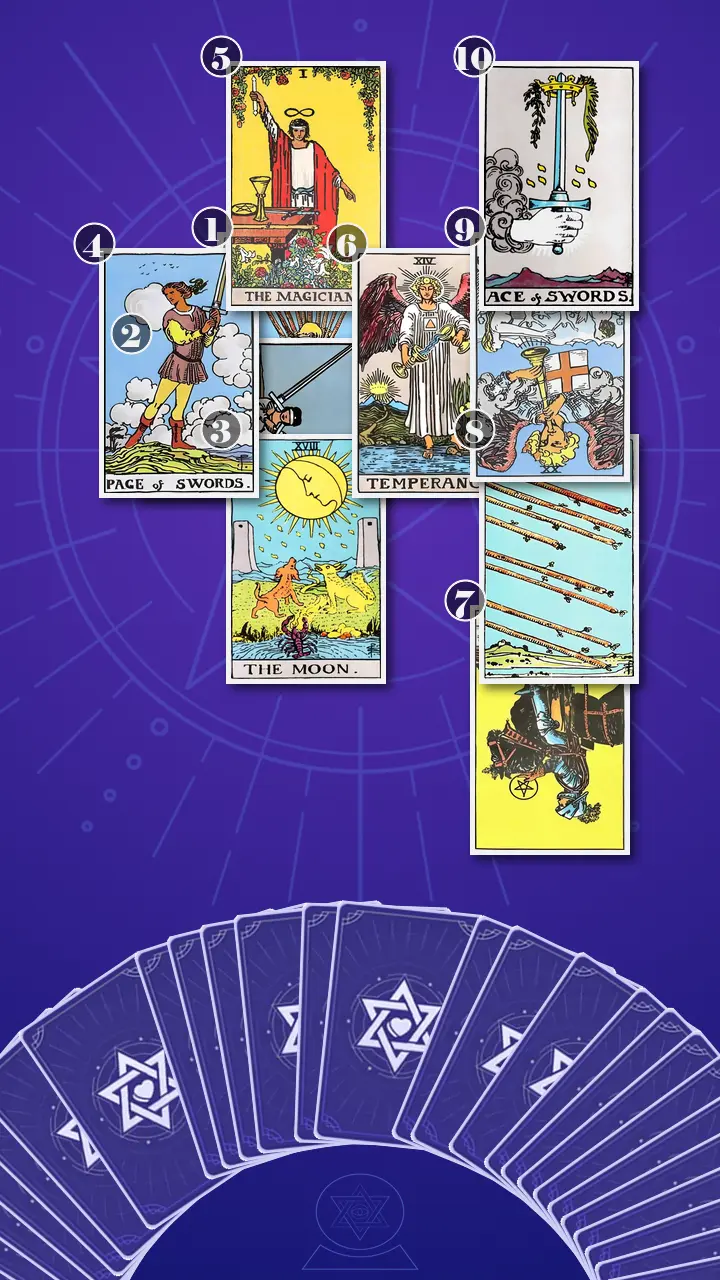
“Card 1 will show your current study behavior,” I said. “Card 2 crosses it—your friction point. Card 3 goes under the surface to the root driver. And Card 6 is the near-future pivot: the next actionable step you can practice this week.”
Reading the Map: Why Rereading Highlights Doesn’t Work
Position 1 — The current bottleneck after highlighting
“Now we turn over the card that represents the current study behavior and felt bottleneck after highlighting,” I said, and I flipped it.
Ten of Wands, upright.
“This is carrying too much at once,” I told Taylor. “It’s like you’re trying to hold an entire chapter in your arms—so you highlight nearly everything. The effort is real. The responsibility is real. But it’s overloaded. You can’t even see the road clearly because the bundle blocks your view.”
I connected it directly to their life: “This is that moment where the page is fully lit up, and somehow you feel farther from home base—the ability to explain it simply—because you’re carrying too many details with the same weight.”
Energetically, Ten of Wands upright is excess: too much fire, too much “do more,” until your study session becomes a weight-training workout that never turns into skill.
Taylor let out a small laugh that was half a wince. “Yep,” they said. “That’s… actually brutal. I leave sessions feeling like I did a lot, and also like I did nothing.”
“Not brutal,” I corrected softly. “Accurate. And accuracy is kind.”
Position 2 — The friction point that blocks memory
“Now we turn over the card that represents the specific blocker that keeps highlighting from turning into memory,” I said.
Two of Swords, upright.
“Choice paralysis,” I said immediately. “This is the non-choice that creates the burden.”
I watched Taylor’s eyes flick to the side—like they were already seeing themselves doing it. “Picture it,” I said. “Your cursor is hovering. Highlight tool selected. You reread the same line three times. And your inner monologue goes: ‘If I don’t mark it, I’ll forget it’ → ‘If I mark it, I’m safe.’ Then your jaw tightens, because you’re choosing safety—marking—over clarity—deciding.”
That’s the Two of Swords energy in blockage form: mental guarding. The blindfold isn’t lack of intelligence. It’s the belief that more information will fix the uncertainty—when what you need is a decision rule.
Taylor nodded so fast it was almost funny. “It’s like having thirty browser tabs open,” they said. “Closing one feels like I’ll lose the important one.”
“Exactly,” I said. “A neon page is proof you touched it—not proof you can retrieve it.”
Position 3 — The root driver beneath the habit
“Now we turn over the card that represents the underlying psychological root of relying on highlighting,” I said.
The Moon, upright.
The moment The Moon shows up, the room always quiets. Even through a screen, I felt it. “This is mental fog,” I told Taylor. “Not laziness. Not a character flaw. Fog.”
I leaned into the sensory truth: “Under pressure, you can’t tell what ‘real learning’ looks like. So you chase visible proof. The screen glow gets harsher, the desk lamp buzz gets sharper, and your forehead tension becomes the metronome of uncertainty. You highlight because it feels like lighting the path—but it’s not the same as walking it.”
The Moon is uncertainty—not knowing whether a session ‘worked.’ When you don’t trust your inner compass, you grab the most immediate external signal. In modern life, that signal is neon yellow across a PDF.
Taylor went still. I saw their shoulders drop a fraction, like their body was relieved to have this named without judgment.
“So it’s not that I’m undisciplined,” they said quietly. “It’s that I don’t have a way to measure it.”
“Yes,” I said. “You’ve been forced to rely on vibes.”
Position 4 — The recent approach that shaped the pattern
“Now we turn over the card that represents the recent pattern that led to the current method,” I said.
Page of Swords, upright.
“Research mode,” I said. “Curious. Scanning. Collecting definitions. You’ve been mentally quick—opening five tabs to make sure you understand. The energy is useful for gathering, but it’s easy to get stuck in input.”
Page of Swords is excess in the mind: sharpness that doesn’t land. Like hovering in draft mode because publishing forces a decision.
“This fits your resource-hopping,” I told Taylor. “YouTube explainer → blog post → flashcard app. It feels like progress because your brain stays busy, but the cycle never completes with output.”
Taylor gave me a look that said: called out. “I literally rebuild my Quizlet deck instead of using it,” they admitted.
“That’s the Page,” I said, smiling a little. “Smart, vigilant, and allergic to finishing the loop.”
Position 5 — The conscious goal beneath the studying
“Now we turn over the card that represents what you’re trying to achieve through studying,” I said.
The Magician, upright.
“You want agency,” I said. “A method that actually works. Not vibes. Not ‘I hope it clicks.’ The Magician says you already have tools—markers, apps, time blocks, effort. But the move is to use your tools to produce output: questions, summaries, practice prompts.”
Magician energy is balance when it’s used well: intention plus technique. It’s not about more highlighters. It’s about turning what you touched into what you can say.
Taylor exhaled, small but real. “That’s all I want,” they said. “To feel like I can walk into a meeting and not panic.”
When Temperance Poured Between Two Cups
I paused before the next card. “This one matters,” I said. “It’s your pivot.”
Position 6 — The immediate next step after highlighting
“Now we turn over the card that represents the next actionable step after highlighting to improve recall,” I said, and I flipped it slowly.
Temperance, upright.
Temperance isn’t flashy. It’s the card of small, repeatable alchemy. The figure pours between two cups, one foot on land, one in water—structure and intuition sharing a border.
“This says memory is built by moving information back and forth,” I told Taylor. “Input ↔ output. Not leaving it sitting on the page.”
And then I used the language that’s basically my native tongue—coffee.
“In my café, I call this Knowledge Filtration,” I said. “A coffee filter has one job: it lets the essentials through and keeps the sludge behind. Highlighting can be your grounds. But until you pour hot water through—until you extract meaning into your own words—you don’t have coffee. You just have a pile of dark stuff that smells promising.”
Stop treating a fully highlighted page as proof you learned it, and start pouring that information between cups—summary, question, recall—until it becomes yours.
Here’s what I saw in Taylor’s face in the beat after I said it: first, their breathing paused (like the body bracing for a verdict). Then their gaze unfocused for a second, like their brain replayed every moment they’d stared at a neon page and felt nothing land. Then the breath came back—longer—like a tight knot in the chest finally loosened.
“But… that means highlighting isn’t studying,” they said, and there was a flicker of irritation under the honesty. “Like, I’ve been doing it wrong?”
“It means you’ve been using a tool as a finish line,” I said, steady. “That’s not ‘wrong.’ That’s human. Especially when The Moon is running the background and your inner judge is loud. Temperance is just giving you a bridge.”
I slid the bridge onto the table in micro-timings, because your nervous system needs safety before it can learn:
The 7-minute Temperance Loop (do it once, right now):
1) Pick one highlighted paragraph.
2) Close the PDF for 60 seconds.
3) On a sticky note (or Notes app), write: (a) one sentence in your own words, (b) one example you could say in a meeting, (c) one question you’d ask to test it.
4) Reopen the PDF and correct in ONE pass only.
Boundary: if your chest tightens or you start spiraling into ‘I’m behind,’ stop after step 3—partial reps still count as data.
I watched Taylor’s hands stop fidgeting. That alone was a miracle.
“Now,” I said, “with this new perspective, think back to last week. Was there a moment—maybe in a meeting, or on the TTC, or at your desk—where this loop would’ve changed how you felt?”
Taylor blinked, hard. “Yesterday,” they said. “Someone asked me to summarize a framework. I could picture the highlighted sentence, but I couldn’t say it. If I’d practiced closing the page and doing one sentence… I would’ve had it.”
That was the shift happening in real time: from overwhelm and tight control to the first evidence-based step toward steadier confidence. Not motivation. Not a personality overhaul. A method you can repeat.
The Staff Upward: Pressure, Fear, and the Clean Blade
Position 7 — Your self-pattern with discipline
“Now we turn over the card that represents your current self-pattern in study discipline,” I said.
Knight of Pentacles, reversed.
“Your effort is real,” I said quickly, because this card can sting. “But the rhythm is either rigid one day and gone the next, or it’s consistent time spent on motions that don’t create new results. You might be equating consistency with repetition—rereading—instead of consistency with practice—retrieval.”
Knight of Pentacles reversed is stagnation: a routine that feels safe because it’s tangible, but it doesn’t move.
“This is where I’d use my Focus Period Diagnosis,” I added, practical. “Not because caffeine is magic, but because your brain has windows. If coffee late in the day makes you wired and scattered, your retrieval practice will feel ten times harder. If you’re sensitive, we schedule the loop earlier—or we switch to half-caf for the ‘output’ part.”
Taylor gave a skeptical half-smile. “I do slam a coffee at like 7 PM and then wonder why I can’t settle,” they admitted.
“We’re not aiming for heroic,” I said. “We’re aiming for repeatable.”
Position 8 — Your environment’s pace and distractions
“Now we turn over the card that represents external pressures shaping your learning,” I said.
Eight of Wands, upright.
“Fast pace,” I said. “Deadlines. Rapid communication. Notifications. Slack pings. Group chats. The feeling that someone on LinkedIn is always passing something.”
Eight of Wands is excess in speed. It pushes you into “quick capture” mode—highlighting because it’s instantaneous—when memory needs spaced contact, not a single intense pass.
Taylor grimaced. “I study with my phone face-up,” they said. “Every ping makes me feel like I need to do more right now.”
“So we design a method that works with speed,” I replied. “Short recall sprints. One page. One loop. Done.”
Position 9 — The hope-fear knot around evaluation
“Now we turn over the card that represents the hope-fear knot around performance and forgetting,” I said.
Judgement, reversed.
“This is the harsh inner verdict,” I said. “The voice that says, ‘If I forget, I fail.’ And because that feels unbearable, practice questions start to feel like a courtroom—so you avoid them.”
I gave them the exact modern scene: “You open a practice question. Your body flinches—heat rises in your face. And you immediately switch back to highlights because it’s safer. The inner judge goes, ‘If I blank, I’m done.’ Temperance wants a different voice: ‘This is just a baseline.’”
Judgement reversed is blockage through shame. And the antidote is very unsexy: treat evaluation as data.
“Practice questions aren’t a verdict—they’re data,” I said, and I watched Taylor’s eyes soften again, like their nervous system wanted to believe me even if their habits didn’t yet.
Position 10 — The integration practice: the clean blade outcome
“Now we turn over the card that represents the clearest way to convert highlights into rememberable knowledge,” I said.
Ace of Swords, upright.
“This is clean clarity,” I said. “One blade. One thread of meaning. After highlighting, the remembering step is to distill: turn the page into a short set of prompts and one-sentence answers, then practice retrieving them later.”
Ace of Swords is balance through definition. It’s the opposite of a neon mural. It’s three crisp prompts you could answer in a meeting. It’s the difference between recognition and retrieval.
“Clarity isn’t more notes,” I told Taylor. “It’s fewer, sharper prompts.”
From Highlights to Recall: Actionable Advice for Your Next 48 Hours
I took a sip of my now-lukewarm espresso and stitched the story together for them—because people don’t change from scattered facts; they change from a coherent explanation.
“Here’s the pattern,” I said. “You’re carrying the whole chapter (Ten of Wands) because you can’t decide what’s essential (Two of Swords). Underneath that is uncertainty about what ‘counts’ as learning (The Moon), and lately you’ve been stuck in research mode—more input, more tabs (Page of Swords). Your conscious goal is competence you can use on demand (The Magician). Temperance gives you the pivot: mix input into output in tiny doses. Then we stabilize the routine so it moves (Knight reversed), protect it from the environment’s speed (Eight of Wands), and quiet the inner judge by treating tests as data (Judgement reversed). The outcome is Ace of Swords: distillation.”
“Your cognitive blind spot,” I added, “is thinking a visual record equals learning. It’s understandable—especially under pressure—but it keeps you stuck. The transformation direction is clear: shift from collecting information to proving learning through quick, low-stakes retrieval practice.”
Taylor hesitated. “But I can’t always do seven minutes,” they said. “Some nights I’m cooked. And my brain is like, ‘If you can’t do it perfectly, don’t start.’”
“That’s the Knight reversed talking,” I said. “So we build a low-energy version on purpose. Ugly notes allowed.”
- The Close-the-PDF Recall Check (one page)After you finish highlighting one page, close the PDF for 60 seconds. Record a 30-second out-loud summary in your voice memo app (or just say it to the room). Then reopen and do one-pass correction only—no reread spiral.If your chest tightens, stop after the summary. Partial reps still count—your goal is evidence, not drama.
- One-Question-Per-Highlight RuleFor each highlighted section, write exactly ONE question prompt in a simple list: “What are the 3 steps of X?” / “Why does Y matter?” / “How would I explain this in a meeting?” Don’t format. Don’t reorganize. Just prompts.If you feel the Notion-dashboard urge, set a 2-minute timer. When it ends, you stop—even if it’s messy.
- The 12-Minute Knight Flip (low-energy default)Set a timer for 12 minutes. Close the text and write three bullet points from memory. Reopen and correct with one pass. Done. If you’re truly wiped, do the 5-minute version: one bullet, one check.Pair this with my “Study Blend Aromas” strategy: brew a small, consistent cup (or even just smell the beans). The point isn’t caffeine—it’s a repeatable cue that says, “We’re doing output now.”
Before we ended, I gave Taylor one optional add-on—because sometimes memory needs a hook that feels human, not clinical.
“If you want,” I said, “use my Flavor Memory Method. When you write your one-sentence summary, label it with a coffee profile: ‘citrus = quick definition,’ ‘chocolate = deep reasoning,’ ‘smoke = common pitfall.’ It’s just a mnemonic—an extra handle for retrieval.”

A Week Later: Ownership, Not Certainty
Six days later, Taylor messaged me at 7:06 AM—Union Station energy, I could tell. “Did the Temperance loop,” they wrote. “Closed the PDF. Said it out loud. It was ugly. It worked. I went into a meeting and I didn’t have to ‘circle back.’”
They didn’t tell me they’d become a new person. They told me they had one small piece of proof.
Clear but vulnerable—because that’s what real change looks like: they slept through the night for the first time in weeks, but in the morning their first thought was still, “What if I’m wrong?” The difference was, they didn’t reach for the highlighter like a life raft. They made coffee, breathed, and did one recall check.
That’s the whole Journey to Clarity, really. Not certainty. Ownership. Moving from “I need to look prepared” to “I can prove what I know, gently, with data.”
When you’re terrified that blanking will expose you, you end up carrying the whole chapter like an overstuffed backpack—tight jaw, tense forehead, neon pages—because “looking prepared” feels safer than risking a quiet, honest self-check.
If you treated one tiny recall check tonight as information (not a verdict), what would be the smallest “close the PDF and say it” moment you’d be willing to try?