The 8:42 PM TTC raise draft—And the moment I stopped explaining

Finding Clarity in the 8:42 PM TTC Scroll
You leave a 1:1 in Toronto thinking “this was the moment,” then spend the commute writing a raise message that turns into a nervous essay—classic self-advocacy paralysis.
Jordan showed up to our session exactly like that: a Zoom window lit by a too-blue laptop glow, a Line 1 commute still sitting in their body like static. They told me it had been 8:42 PM on a Tuesday, squeezed between winter coats and a tote bag, phone in one hand, the other hand bracing on a pole that was colder than it looked. Notes open. “Hey—quick follow up from our 1:1,” typed and deleted. Typed and deleted. The fluorescent lights flickered just enough to make the whole train feel like it was glitching.
“My chest does this thing,” they said, pressing a palm lightly to their sternum. “Like I’m holding my breath. And then my brain… insists on writing the footnotes.”
I could picture it too clearly: Slack drafts you never send. A brag doc you swear you’ll keep updated. LinkedIn “Excited to share…” posts that hit like a tiny, unnecessary punch. And the core contradiction humming underneath all of it—Jordan wanting to be compensated fairly, while fearing that asking directly will make them sound demanding… or worse, replaceable.
The apprehension wasn’t abstract. It had weight. It was the feeling of trying to talk over a GPS right before the exit—narrating every possible turn until you miss the actual one. Their voice sped up when they described it, then dropped into a quieter register: “I’m not scared of the work. I’m scared of the conversation.”
I nodded, slow and deliberate. “Okay. We’re not going to fix your personality. We’re going to fix the structure. Today, we’re going to turn the thesis into a request—so you can ask for a raise without overexplaining, and walk away with a clean next step.”

Choosing the Compass: The Transformation Path Grid (6)
I asked Jordan to take one full breath—not because we needed a ritual, but because the nervous system needs a doorframe. A moment where we leave the train platform of rumination and step into a room where the question can be held without sprinting.
“Keep your question simple,” I said. “After your 1:1, how do you ask for a raise without overexplaining?”
For this, I used my own spread: the Transformation Path Grid (6) · Context Edition. I like it for work conversations because it doesn’t just describe your feelings—it maps cause and effect. It shows the present loop, the snag, the deeper driver, the pivot, the practical plan, and the healthiest frame for follow-up.
To you reading this: that’s why this spread works for a post–1:1 raise conversation. When you’re stuck rewriting the raise request email or drafting a too-long-to-send Slack message, you don’t need more “reasons.” You need a sequence that moves you from mental overload into grounded, actionable advice.
I explained the grid like descending steps. “The first card is what you do right after the 1:1—your visible pattern. The second is the communication snag—how the ask gets distorted. The third is the deeper fear underneath. The fourth is the turning point: the internal shift that unlocks a clean ask. Then we land in practice and integration—what to bring, what to say, and how to hold the outcome as a normal process conversation.”
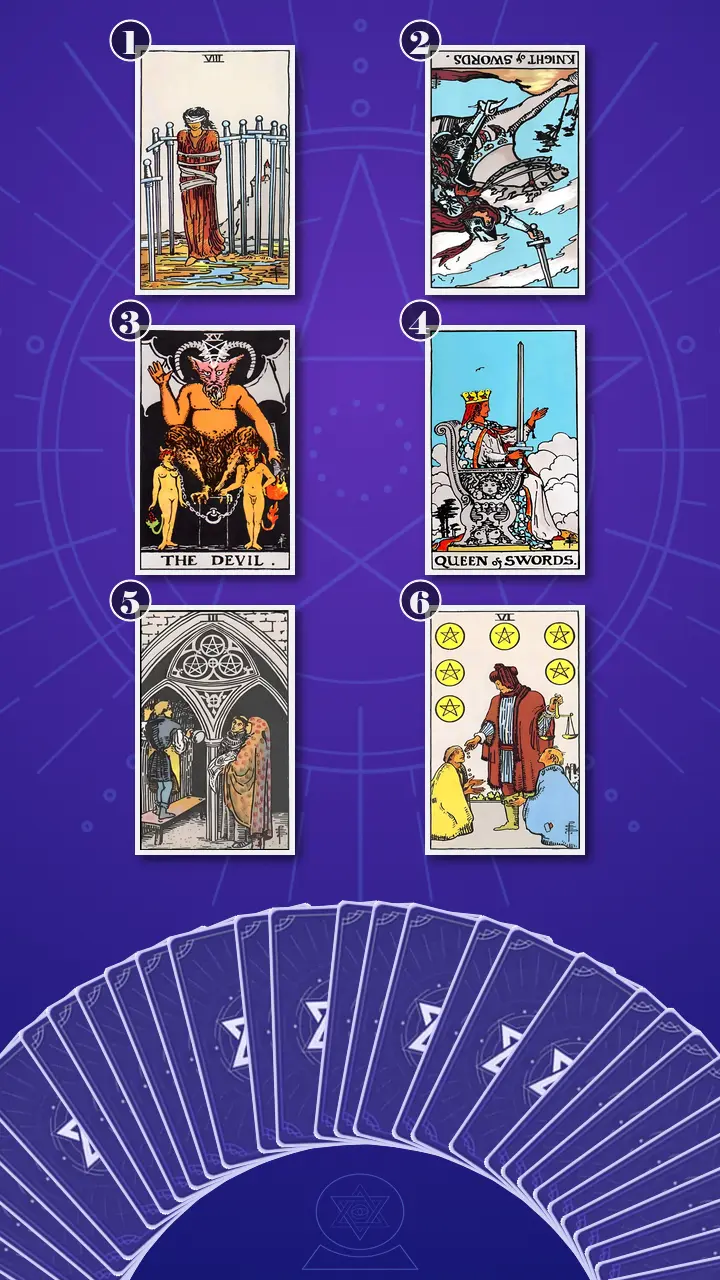
Reading the Map: Where the Words Get Loud
Position 1: The Post–1:1 Loop You Call “Being Responsible”
“Now flipped open, is the card representing what Jordan is doing right now right after the 1:1: the visible behavior pattern around drafting and self-censoring.”
Eight of Swords, upright.
In modern life, this looks like Jordan leaving a supportive-but-busy 1:1, opening Notes on the TTC, and staring at a half-written raise ask like it’s a wire they’re afraid to cut. Draft → delete → add context → panic → delay. The trap isn’t a lack of reasons. It’s the belief that directness is dangerous.
Energetically, the Eight of Swords is a blockage made of Air—thought that tightens into a blindfold. In the card, the bindings are loose, and there’s a gap in the ring of swords. The exit exists. But your body doesn’t believe it yet.
Jordan let out a small laugh that wasn’t quite humor. “That’s… uncomfortably accurate,” they said, eyes flicking down and away. “Like, yeah. I could step out. But I don’t.”
“That laugh,” I said gently, “is you noticing the gap. Not fixing it. Just seeing it.”
Position 2: The Snag That Turns a Raise Ask Into a Nervous Essay
“Now flipped open, is the card representing the communication snag that turns a raise request into overexplaining: how the ask gets distorted in the moment.”
Knight of Swords, reversed.
This is the exact scene Jordan had described without knowing they were describing a tarot card: right after the 1:1, adrenaline still hot in the bloodstream, Slack opens, fingers start typing fast—like they’re trying to win an argument nobody started. Caveats appear. Objections are answered before they’re spoken. Proof stacks like attachments on a support ticket until the actual request gets buried.
Energetically, reversed Knight of Swords is excess that misfires—too much speed, too much sharpness, pointed in the wrong direction. It’s not confidence. It’s defensive momentum.
I watched Jordan’s face as I named the inner monologue out loud, the one that pretends it’s being “professional” while it’s actually bracing for impact: “If I explain first, they can’t misread me… If I cover every angle, I can’t be dismissed…”
Their head dipped once—sharp, almost involuntary. Then I saw their lips shape the word just without sound, like their brain was already trying to soften what hadn’t been said.
“Notice what this turns the conversation into,” I said. “Not requesting. Defending. Not a professional process. A personal trial.”
Jordan blinked hard. “Yeah,” they said quietly. “And then I reread it and I’m like… why do I sound like I’m debating my own existence?”
“Because your nervous system thinks money is where respect can be taken away,” I said. “So it tries to out-run that feeling with words.”
Position 3: The Fear Under the Words
“Now flipped open, is the card representing the deeper driver underneath overexplaining: the attachment or fear that makes money-talk feel personally risky.”
The Devil, upright.
When The Devil shows up in a work question like this, it’s rarely about your boss being evil. It’s about a bind inside you: the idea that being liked equals being safe. In the card, the chains are loose, but the figures act like they aren’t allowed to move.
Jordan’s modern-life version is brutally common: asking for a raise starts to feel like a referendum on worth. Like if you’re direct about money, you’ll be read as entitled. Difficult. Replaceable. So you over-explain to earn permission to want more, even though compensation is a normal process conversation.
Energetically, The Devil is blockage through attachment. It’s the moment you confuse approval with survival. The moment you moralize money.
I let a beat of silence land. In my day job, when I’m guiding people through the planetarium, I watch their faces when the simulated night sky shifts: the instant their eyes realize the stars aren’t moving randomly. There’s a pattern. And then—relief. Not because the universe got kinder, but because it got legible.
“You’re not on trial,” I told Jordan, voice steady. “You’re in a business conversation.”
They went still in a way that wasn’t frozen—more like something inside them stopped bracing. Their shoulders lifted once, then dropped, as if their body had been holding a posture it didn’t remember choosing.
When the Queen’s Sword Became a Boundary
Position 4 (Key Card): The Turning Point That Changes Everything
The room—two cities, two time zones—felt suddenly quiet, like someone had closed a door on a hallway of noise.
“Now flipped open, is the card representing the key internal pivot that changes the conversation: the mindset and language boundary that unlocks a clean ask.”
Queen of Swords, upright.
This is where the energy changes. The Queen of Swords isn’t “say less because you should be confident.” She’s “say less because clarity is a boundary.” In modern terms: Jordan practicing a single sentence they can say without apologizing—“I’m requesting a compensation adjustment to $X / X% based on my scope and impact.”—pairing it with two high-signal outcomes, asking one process question, and then stopping. The power move is the pause.
Energetically, she’s balance in Air: the mind sharp enough to be precise, calm enough not to spiral, and sovereign enough to let silence do its job.
Setup. I could feel Jordan right back on the TTC: thumbs hovering, cursor blinking, chest tight, already writing footnotes to avoid the moment of simply asking. Their brain was trying to build a closing argument when what they needed was a request that could be answered.
Stop trying to earn approval with paragraphs; speak one clean truth like the Queen’s upright sword, then hold the boundary long enough for a real negotiation to begin.
Reinforcement. Jordan’s reaction came in a chain, not a single expression. First: a tiny freeze—breath caught, eyes widening a fraction, fingers hovering near their mouth like they wanted to interrupt but couldn’t find the opening. Second: the cognitive shift—gaze unfocused for a second, like they were replaying a dozen drafts and seeing the same pattern in all of them. Third: the emotional release—an exhale that sounded like something unclenching from the inside out, jaw softening, shoulders dropping low enough that the collar of their hoodie wrinkled differently.
“But if I stop explaining…,” they started, and there it was: the old chain tugging.
“Then you’ll feel exposed,” I finished for them, kindly. “Not unsafe. Exposed. That’s a different thing. And it’s survivable.”
Here’s where my astronomy brain comes in. In celestial mechanics, a stable orbit isn’t created by pushing harder. It’s created by finding the right velocity and letting gravity do what it does. I call this Orbital Resonance in workplace terms: noticing how your energy and the environment’s energy lock together—sometimes in a supportive rhythm, sometimes in a frantic feedback loop.
Jordan’s current resonance was: adrenaline after a 1:1 → rapid drafting → overexplaining → shame → delay → more adrenaline next time. The Queen of Swords changes the orbit. One clean ask becomes the new gravitational center. The pause is not awkwardness. It’s the handoff. It’s the moment you stop spinning and let the conversation become shared.
I leaned in a touch. “Now—use this lens and think back. Last week, was there a moment where you started writing ‘just’ or ‘sorry’ or ‘might not be the right time,’ and if you’d had the Queen’s sword, you would’ve stopped after one clean line?”
Jordan swallowed. “Yesterday,” they said. “I had it open. I literally backspaced the first line, like, seven times.”
“That’s the moment we’re going to practice for,” I said. “Not the perfect moment. The real one.”
And in that pivot, I named it plainly—because it matters for anyone who’s Googled how to ask for a raise without overexplaining at midnight: this is the move from self-advocacy paralysis and fear-driven overexplaining to calm, boundary-led self-respect in a normal compensation conversation.
Position 5: The Grounded Prep That Keeps You From Spiraling
“Now flipped open, is the card representing the practical way to prepare and deliver the request without spiraling: what to bring, how to structure, what to ask next.”
Three of Pentacles, upright.
This card is the antidote to the “prove your existence” feeling. It’s a worksite review. Shared criteria. Visible contribution. In modern life, it’s Jordan bringing a one-page brag doc (not a novel): three outcomes, one scope expansion, and one sentence tying responsibilities to market value.
Energetically, Three of Pentacles is balance in Earth. It doesn’t ask you to be louder. It asks you to be legible.
And this is where I pulled in another tool from my own kit: the Solar Sail Principle. In space, you don’t curse resistance—you angle into it. You use a steady force to move over time. In a workplace, the “resistance” might be a busy manager, a review cycle, a budget process. You don’t fight that by writing longer paragraphs. You harness it by asking the one process question that turns chaos into a timeline.
Jordan nodded slowly. “So like… instead of apologizing for asking, I anchor it in a process they can actually do.”
“Exactly,” I said. “Scope. Impact. Process. That’s not needy. That’s operational.”
Position 6: Holding the Outcome as Fair Exchange (Not a Verdict)
“Now flipped open, is the card representing what it looks like when the request is held as a fair exchange: the healthiest frame for receiving, negotiating, or timing a follow-up.”
Six of Pentacles, upright.
The scales matter here. Six of Pentacles says: compensation is a measured agreement, not a favor granted because you were likable enough. In modern life, it looks like Jordan hearing “yes,” “not yet,” or “we need a plan,” and staying steady—because the conversation is about reciprocity and structure, not personal worth.
Energetically, this is balance in Earth: give and receive without guilt, negotiate without self-erasure.
Jordan’s eyes softened. “I think I’ve been treating ‘not yet’ like… a secret ‘no’ and also a secret ‘you’re not good.’”
“Six of Pentacles disagrees,” I said. “It treats ‘not yet’ as information. Timing. Budget. Criteria. It keeps you in relationship with yourself.”
Proof Points, Not Paragraphs: Actionable Advice You Can Use This Week
I drew the story back together for Jordan—because a spread is only useful if it becomes a map you can follow at 9:03 AM, not just a vibe at midnight.
Here’s what the cards said in one line: right after the 1:1, Jordan gets mentally “bound” (Eight of Swords), then tries to sprint their way to safety through words (Knight of Swords reversed), because money feels like a worth-test (The Devil). The turning point is borrowing the Queen of Swords’ internal manager voice—one clean sentence, then the boundary of a pause. From there, you ground in shared criteria (Three of Pentacles) and hold the outcome as fair exchange, not a verdict (Six of Pentacles).
The cognitive blind spot hiding in the middle is deceptively simple: Jordan has been treating more context as professionalism, when in reality structure is what reads professional. The transformation direction is equally simple, and it’s the whole point of finding clarity: move from proving to requesting.
Then I gave Jordan a plan that fits into real life—Slack, calendar invites, and all.
- Do the “Queen of Swords Pause Drill” for 10 minutes before you touch Slack/email.Write one sentence: “I’m requesting a compensation adjustment to $X / X% based on my scope and impact.” Add exactly two bullets (one outcome, one scope expansion). Add one process question: “What’s the process and timeline for reviewing this, and what would you need from me?” Read it out loud once. Take one full breath. Then practice stopping after the question.Tip: If your chest tightens, drop to the smallest version: one-sentence ask + the process question. You can offer the bullets only if asked.
- Use the 20-word / 60-word script method (and only speak the 20-word one first).Draft a 20-word version you can say live, and a 60-word version you can paste only if they ask for details.Tip: Run a “Space Debris Clearing” pass: circle every softener (“just,” “sorry,” “might,” “if possible”) and delete at least one on purpose. Debris looks harmless until it clogs the orbit.
- Request a 15-minute follow-up with a clear title—no long preface.Send a calendar invite or message like: “Can we do 15 minutes this week for ‘Compensation adjustment discussion’?”Tip: Use my “Earth-rotation perspective” before the meeting: for one minute, imagine the Earth turning under you—Toronto moving from morning to afternoon whether you overthink or not. Let that remind you: time will pass either way; you may as well ask cleanly while you’re in motion.
I also offered Jordan one optional practice that tends to click for people who need a physical metaphor: my career visualization via elevator movement. “Imagine your ask as an elevator with three labeled stops,” I said. “Stop 1: your one-sentence request. Stop 2: two impact anchors. Stop 3: your process question. Then the doors close and you do not sprint back into the hallway to keep talking.”

Ownership, Not Certainty
A week later, Jordan messaged me a screenshot—cropped, like they didn’t want to make a big deal out of it. It was a short Slack draft they’d actually sent. No disclaimers. No apology tour. Just a clean request, two proof points, one process question.
“I counted to three,” they wrote. “It felt like jumping off something small. My body hated it for half a second. And then my manager just… answered. Like it was normal.”
They didn’t tell me the final outcome yet. They didn’t need to. The proof wasn’t the yes. The proof was the shift: from fear-driven overexplaining to calm, boundary-led self-respect—treating compensation as a normal conversation with structure and next steps.
Clear but vulnerable: Jordan slept a full night after sending it, then woke up with the first thought—“What if I’m wrong?”—and this time, they smiled a little anyway.
When you’re about to ask for a raise and your chest tightens, it’s not because you lack evidence—it’s because part of you thinks being direct about money might cost you respect, so you try to protect yourself with paragraphs.
If you let your next raise ask be a request instead of a defense, what’s the one clean sentence you’d be willing to say—and then pause after?