The 11:30 p.m. Resignation Draft—And a Route, Not a Cliff Exit Plan

The 11:30 p.m. Draft That Feels Like a Cliff
If you hover over “Send” and your chest tightens because you want freedom and you want to leave with integrity (not chaos), you’re not alone.
Jordan showed up on my screen from a Toronto condo living room at 11:30 p.m., laptop heat warming their thighs through sweatpants. The fridge hummed in that steady, indifferent way appliances do, and every so often a streetcar rattle threaded through the silence like a reminder that the city kept moving even when their cursor didn’t. Gmail was open. The resignation draft was open. Their jaw looked like it was holding a secret.
“It is literally one email,” they said, staring past the webcam like the sentence was written on the wall. “And it feels like a cliff.”
I watched their fingers do that restless loop I’ve seen a hundred times: draft → benefits portal → PTO policy → back to the draft, as if the right tab would finally give them permission to be calm. Their shoulders crept up a fraction each time a notification popped on their screen.
What they were asking me was simple on paper: Before I hit ‘Send’ on my resignation email, what’s my next move?
But the engine underneath it was heavier: wanting to reclaim autonomy and leave a misaligned job vs fearing instability and being judged as irresponsible or not capable. The kind of contradiction that makes a person rewrite “I’ve decided” into “I’m considering” at midnight, then hate themselves for not being decisive.
“We’re not going to force a brave, messy leap tonight,” I told them, gentle and precise. “We’re going to find clarity by turning this from a cliff into a route. Something you can actually execute without wrecking your nervous system.”

Choosing the Compass: The Transformation Path Grid (6)
I asked Jordan to put one hand on their chest and take one slow breath, not as a mystical ritual, but as a transition. A way to tell the body, We’re not being chased. Then I shuffled, slow enough that the sound of the cards could replace the Slack pings in their head for a minute.
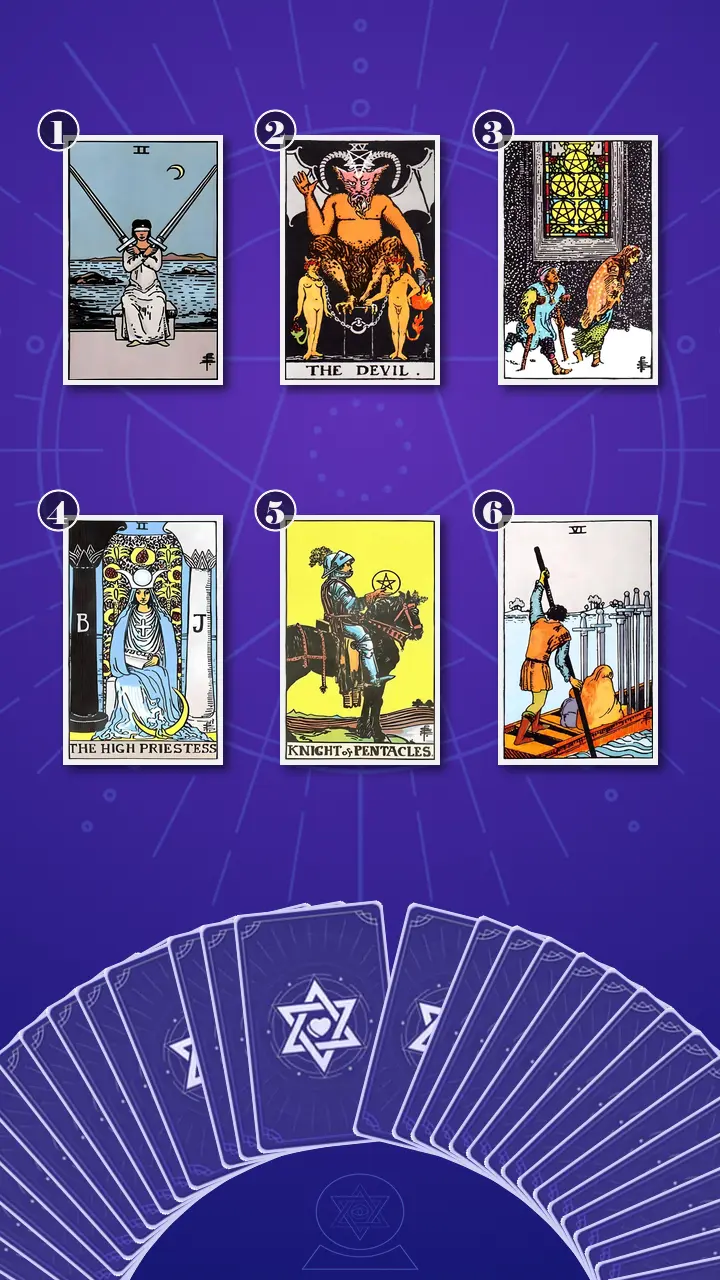
“Today, we’ll use a spread I call the Transformation Path Grid (6) · Context Edition,” I said. “It’s built for exactly this kind of moment: stuck at the keyboard, trying to think your way into certainty.”
For anyone reading along who’s ever Googled “what to do before sending a resignation email,” this is why I like this layout: it creates a clean chain—stuck moment → what’s gripping me → what’s underneath → what unlocks it → what do I do next → how does it stabilize. It avoids fortune-telling. It’s decision-making with structure, and structure is what anxiety respects.
I laid the cards in a simple 2x3 grid like a checklist turning into a pathway. “The first card is the observable ‘hovering over Send’ moment. The second is the primary blockage—the thing you’re afraid to disrupt. The fifth card is the one-week next move. Not the whole exit. Just the next step.”
When the Knight of Pentacles Refused the Cliff
“One more thing,” I added, because this is where my past always sneaks in. I spent years on Wall Street, trained in rooms where people pretend feelings don’t exist but still make billion-dollar decisions based on them. What I learned there is simple: if you don’t name the pressure, you start obeying it.
“So we’ll read the cards like a practical map,” I told Jordan. “And if you want, we’ll borrow a business lens—think SWOT without the PowerPoint. Strengths, weaknesses, opportunities, threats. Except tonight the ‘threat’ is not your manager. It’s the loop.”
Position 1: The Exact “Hovering Over Send” Moment
Now we’re turning over the card that represents the exact ‘hovering over Send’ moment: what Jordan is doing and feeling right now in concrete, observable terms.
Two of Swords, upright.
I didn’t even have to reach for poetry. This card is literal: a blindfolded figure holding two swords crossed over the chest, still water behind them. Suspended. Guarded. The energy here is a blockage—not a lack of intelligence, but an overactive self-protection system.
I said, “This is like when it’s 11:30 p.m. and you’re staring at your resignation draft like it’s a bomb. You keep adjusting a sentence (‘I’ve decided’ vs ‘I’m considering’) because choosing a tone feels safer than choosing a timeline. Your jaw is tight, your tabs multiply, and you tell yourself you’re being responsible—while staying suspended so you don’t have to feel the discomfort of committing.”
Jordan let out a small laugh—quick, sharp, almost embarrassed. Then it turned bitter at the edges. “Okay,” they said. “That is… rude. But accurate.”
I nodded. “Sometimes tarot feels like it’s reading your browser history. But notice what it’s actually showing: this isn’t laziness. This is decision paralysis disguised as responsibility.”
Position 2: The Primary Blockage Keeping It Unsent
Now we’re turning over the card that represents the primary blockage keeping the email unsent: what Jordan is attached to or afraid to disrupt.
The Devil, upright.
The chains on this card always get people—because they’re loose. The message isn’t “you’re doomed.” It’s “you’re acting like you have no choice.” The energy is excess: too much attachment to security and approval, to the identity of being “the reliable one,” to the belief that being liked is the same thing as being safe.
“If you’re rewriting tone at midnight,” I said, keeping my voice neutral, “you’re usually trying to control someone else’s reaction.”
Jordan flinched, just a little. Their eyes dropped from the screen to the edge of their laptop like they’d been caught doing something private.
“This,” I continued, “is the Slack green dot as a soft chain. Availability equals worth. The paycheck and benefits feel like permission to exist. And reputation—being seen as calm, low-maintenance, competent—starts to feel like a contract you can’t renegotiate.”
I let the words land, then gave them the line their body was already saying: “I’m not trapped, I’m… terrified of being seen as difficult.”
Jordan’s mouth opened, closed. Then: “Wow. I didn’t realize I was treating my job like a contract I can’t renegotiate.”
In my head, a trading-floor flashback flickered—contracts, clauses, signatures, the way people call something “fair” when it’s just structured. I kept it brief, because this was about them, not me: Fair isn’t a vibe. It’s terms.
Position 3: The Root Fear Under the Blockage
Now we’re turning over the card that represents the deeper root driving the blockage: the scarcity, identity, or safety narrative underneath the immediate decision.
Five of Pentacles, upright.
Two figures in a snowstorm, hunched, moving past a warm stained-glass window. This card is the nervous system’s disaster slideshow. The energy is deficiency: not enough safety, not enough certainty, not enough buffer—at least, that’s what it feels like, even when the math is “fine-ish.”
“This is like when you check your bank balance and rent date,” I said, “and suddenly your brain runs a disaster slideshow: being without benefits, scrambling for interviews, quietly ashamed, pretending you’re fine. Even if you have some savings, your body reacts like you’re already in a snowstorm. The email stops being a work decision and becomes a test of whether you’ll be safe.”
Jordan swallowed. Their shoulders rose toward their ears, then froze there. Their stomach visibly tightened like they were bracing for impact.
“I hate that this is true,” they said quietly. “I’m not even broke. But rent day feels like a recurring push notification I can’t swipe away with logic.”
“That’s exactly it,” I replied. “It’s not weakness. It’s your nervous system reacting to uncertainty like it’s danger. And that’s why the Devil’s chain grips so hard.”
Position 4: The Catalyst That Changes the Decision Quality
Now we’re turning over the card that represents the catalyst that changes the decision quality: what Jordan needs to acknowledge, consult, or clarify before acting.
The High Priestess, upright.
Scroll in her lap. Veil behind her. A quiet that doesn’t apologize. This card is discernment—not delay. The energy is balance: enough silence to hear what’s true, not just what’s loud.
“Instead of asking five friends and getting five different answers,” I said, “you go quiet on purpose. You write down what has been consistently true in your body and mood for months—Sunday dread, relief when you imagine leaving, resentment building. Then you identify one missing fact you can gather calmly—like benefits end date or your actual runway number—so your next move comes from discernment, not panic.”
The room on Jordan’s end felt like it got quieter. I could almost hear the fridge hum more clearly. They closed one browser tab. Then another. Their hands, finally, stopped fidgeting.
“Strategic pause isn’t procrastination,” I reminded them, “if you can name what you’re waiting to learn.”
Jordan nodded once, slow. “I think… I’ve been treating ‘more information’ like a hiding place. But I can’t even say what information.”
“That awareness,” I said, “is the turning point.”
Position 5 (Key Card): The Next Move Before You Hit Send
I told Jordan, “We’re turning over the most practical card in this whole reading—the one that answers your actual question.” The air on the call shifted. Not mystical. Just focused, like the moment right before you make a clean decision.
Now we’re turning over the card that represents the next move (one-week actionable): the most grounded, dignity-protecting step to take before hitting Send.
Knight of Pentacles, upright.
This knight doesn’t charge. The horse is still. The pentacle is held at chest level like a promise you can keep. The energy here is balance—steady follow-through instead of drama.
Jordan’s face tightened, and I could see the familiar reflex: If it’s steady, does that mean I’m not brave? Their eyes narrowed, a flash of irritation cutting through the fear.
“But if I do it slowly,” they said, voice sharper, “doesn’t that mean I’ve been… overreacting? Like I made this a big thing for no reason?”
The reaction came in a chain I’ve learned to respect:
First, a brief freeze—breath held, shoulders locked. Then cognition trying to punch through—eyes unfocusing as if replaying every draft edit, every midnight search for “how to resign professionally.” Then emotion—anger softening into something more tender, almost grief, at how long they’d been holding their jaw like armor.
I kept my tone steady. “No. It means your system has been trying to protect you. And now we’re giving it a plan.”
Setup: Jordan was back on that couch at 11:30 p.m. in their mind, laptop open, resignation draft staring back. Tabs toggling. The cursor blinking like a dare. Their jaw tight, hands unable to settle, trying to think their way into certainty instead of choosing a responsible sequence.
Stop treating this like a single perfect leap and start treating it like a steady route, because the Knight’s still horse and held pentacle ask you to move by plan, not by panic.
Reinforcement: I watched Jordan’s body respond before their words did. Their shoulders dropped a fraction like someone finally set down a heavy grocery bag. Their lips parted on a slow exhale they hadn’t realized they were holding. Then their hands moved—not to the Gmail draft, but to their calendar app, hovering there like it was suddenly allowed to be relevant. Their eyes went slightly glassy, not dramatic, just human, as if the pressure that had been packed into one button was dispersing into something manageable.
“Don’t make one email carry the entire weight of your future,” I said softly. “A clean exit is a route, not a cliff.”
This is where I brought in my signature framework without turning it into jargon. “When I roadmap career transitions, I treat them like IPO preparation cycles,” I told them. “Not because you’re a company, but because the logic holds: you don’t ‘go public’ on vibes. You do due diligence. You build the narrative. You pick timing. You protect the downside. That’s Knight of Pentacles energy.”
Then I gave them the exact exercise, because insight without a next move is just more thinking. “Set a 10-minute timer. Open a notes app and write three columns: ‘Money facts,’ ‘Work facts,’ ‘Body facts.’ Add 3 bullets each—no opinions. Then choose one tiny step that reduces uncertainty, like confirming your benefits end date. If you feel your chest tighten, pause and stop. This is a check-in, not a pressure test.”
I leaned in slightly. “Now, with this new frame—route plan, not cliff email—think back to last week. Was there a moment, maybe on the TTC or right before rent day, when this would have changed how trapped you felt?”
Jordan blinked, once, then again. “Yeah,” they whispered. “Tuesday. My manager sent a last-minute invite right after I edited the draft. I spiraled and told myself I couldn’t send it before that meeting. But… if I’d had a route, I could’ve just scheduled the conversation window and stopped trying to optimize timing like it was an algorithm.”
“Exactly,” I said. “This isn’t just about quitting. It’s a shift from Send-button panic and fear-driven perfectionism to grounded self-trust through a planned, low-drama exit sequence.”
Position 6: Integration and Near-Term Stabilization
Now we’re turning over the card that represents integration: what a healthier transition energy looks like once Jordan acts from plan and self-trust rather than pressure.
Six of Swords, upright.
A boat crossing water. A ferryman steering. The swords are still in the boat—meaning the thoughts come with you—but they’re no longer pinning you to the shore. The energy is movement: Air that stops being gridlock and becomes travel.
“After you act from a plan,” I said, “your mind stops spinning the same loop. You still feel nerves—because transitions are real—but it’s navigable. You’re in motion: updating documents, having conversations, closing tabs, and letting the awkwardness pass through without making it proof you made the wrong choice.”
Jordan’s face softened. They looked tired, but in a different way—like someone who can finally imagine sleeping instead of negotiating with a draft.
The Route-Not-Cliff Exit Plan (Actionable Advice)
I pulled the whole story together for them, because this is the part people miss when they’re stuck in analysis paralysis: the cards weren’t telling Jordan to leap. They were showing why the leap felt impossible.
“Here’s the narrative,” I said. “Two of Swords is you freezing at the threshold, turning a real decision into a wording problem. The Devil is the grip—golden handcuffs and approval fear—making you feel like you need permission to leave. Five of Pentacles is the root—rent-day panic, benefits anxiety, the fear of being ‘out in the cold.’ The High Priestess is the turning point: lived data over noise. And the Knight of Pentacles is the bridge: a steady sequence. That’s how you get to Six of Swords—movement with a hand on the wheel.”
Then I named the blind spot, because naming it is what loosens it: “Your cognitive blind spot is believing you can buy perfect safety with perfect wording. That’s why the email keeps getting rewritten. The transformation direction is moving from ‘one perfect irreversible leap’ to ‘a step-by-step exit plan with one immediate, low-drama next action.’ Responsibility is a sequence, not a vibe.”
“Okay,” Jordan said, almost laughing again, but this time there was relief in it. “So what do I do tomorrow?”
“Small, concrete steps,” I replied. “The kind your nervous system can cooperate with.”
- Schedule the move:Open your calendar and book a 20-minute slot this week called “Exit Plan Step 1.” Do it tonight, before you reopen the Gmail draft.Tip: If your brain says this is “too slow,” name it: that’s the cliff-story talking.
- Run the 10-minute facts check:Set a timer for 10 minutes. In Notes, make three columns—“Money facts,” “Work facts,” “Body facts”—and write 3 bullets each (no opinions). Then pick one uncertainty-reducer: confirm benefits end date, PTO payout, or resignation policy (Canada-specific if needed).Tip: Stop at 10 minutes on purpose; closing the laptop counts as a boundary.
- Do the two-step quit (Conversation → Email):Draft a 3-sentence spoken script for the resignation conversation (appreciation → decision → timeline). Then send a low-drama meeting request: “Could we grab 15 minutes today/tomorrow for a quick chat?” After that conversation (same day if possible), send the resignation email using your simplest version—no over-explaining.Tip: If you get activated, it’s allowed to read your script; this is dignity, not performance.
Because Jordan lived online like most of us do, I gave them one more optional move from my “prospectus mindset” toolkit: “If part of your fear is ‘what does this say about my competence,’ we can also do a LinkedIn optimization pass later—treat your profile like a prospectus. Not to perform confidence. To reflect your actual value.”

A Week Later: The Quiet Proof
Seven days later, Jordan messaged me a screenshot. Not of the email. Of their calendar. A single block labeled “Exit Plan Step 1,” checked off. Under it, a note: “Benefits end date confirmed.” One sentence. One fact. One small anchor.
They told me they still felt a little shaky—clear, but not invincible. The bittersweet part was how ordinary it looked: they’d done it alone at a kitchen counter with a half-cold coffee, then sat quietly for three minutes, staring at the blank space where panic used to be.
That’s what a real Journey to Clarity often is. Not fireworks. Not a personality transplant. Just the first steady proof that you can move without forcing perfect certainty.
When your finger hovers over “Send” and your chest goes tight, it’s not because you’re lazy—it’s because you’re trying to buy perfect safety with perfect wording, and that’s an impossible trade.
If you didn’t have to make one irreversible leap tonight, what’s one small, concrete step you’d be willing to take this week that would make your exit feel even 5% more grounded?