When Job Links Feel Like Verdicts: From Bracing to Cleaner Boundaries

When Helpful Career Advice Feels Like Criticism at 1:12 p.m.
When Maya (name changed for privacy), a 27-year-old marketing professional between roles in Toronto, sat across from me, the first thing she said was, "I know she's trying to help, but it never feels like help." If you're in your late 20s, between roles in a city where rent already makes every career wobble feel louder, and a midday text from your mom with a job link hits harder than most rejections, I have learned not to look at the link first. I look at the bruise it lands on.
She described a Tuesday at 1:12 p.m. so clearly I could almost see it on the table between us: LinkedIn open, a resume document waiting in another tab, an oat latte gone lukewarm at her elbow, the radiator humming in a small apartment that never really stops feeling like an office. Then her phone lit up with a text from her mother: "Maybe this one?" The screen glow felt suddenly too bright. Her thumb hovered over the link. Her chest tightened. Her stomach dropped before she had even opened the posting.
That was the contradiction in plain view: she did want help with job leads, but the second help arrived, it seemed to imply a verdict about her. She did not scan the role for fit first. She scanned it for what it said about her. Then came the thought she hated and believed at the same time: if I were doing okay, she would not need to send this. Shame moved through her like an elevator dropping half a floor—small, metallic, immediate—followed right behind by irritation, guilt, and that lonely sadness that makes a person want to answer defensively or not at all.
I told her gently, "That reaction makes sense. A practical gesture can land like criticism when your worth already feels shaky." Then I added the line I have had to say to many bright, overwhelmed people in exactly this kind of season: "Sometimes the link isn't the wound. It's the speed with which it becomes a verdict." We were not there to prove whether her mother was right or wrong. We were there to map the space between the phone buzz and the story it woke up. That was our journey to clarity.

Choosing the Compass: a Five-Card Relationship Spread for Support vs. Judgment
I asked Maya to place both feet on the floor and take one slow breath before she touched the deck. I shuffled slowly, not for mystique, but because a little ritual can do what endless overthinking cannot: it gives the nervous system a clean threshold to cross.
For a question like this—why does help feel like criticism, why do job links from my mom make me feel judged—tarot works best as a mirror, not a sentence. It helps me separate layers that arrive all at once in real life: the body reaction, the other person's likely intent, the private interpretation, the older wound, and the next usable response.
That is why I chose the Relationship Spread · Context Edition, a five-card relationship spread for family tension around job hunting. The question lives inside an interaction, yes, but the real leverage is in how that interaction gets interpreted. Five cards are enough to trace the whole loop—symptom, perceived intention, projection, root fear, and boundary-based response—without turning the reading into another overcomplicated project.
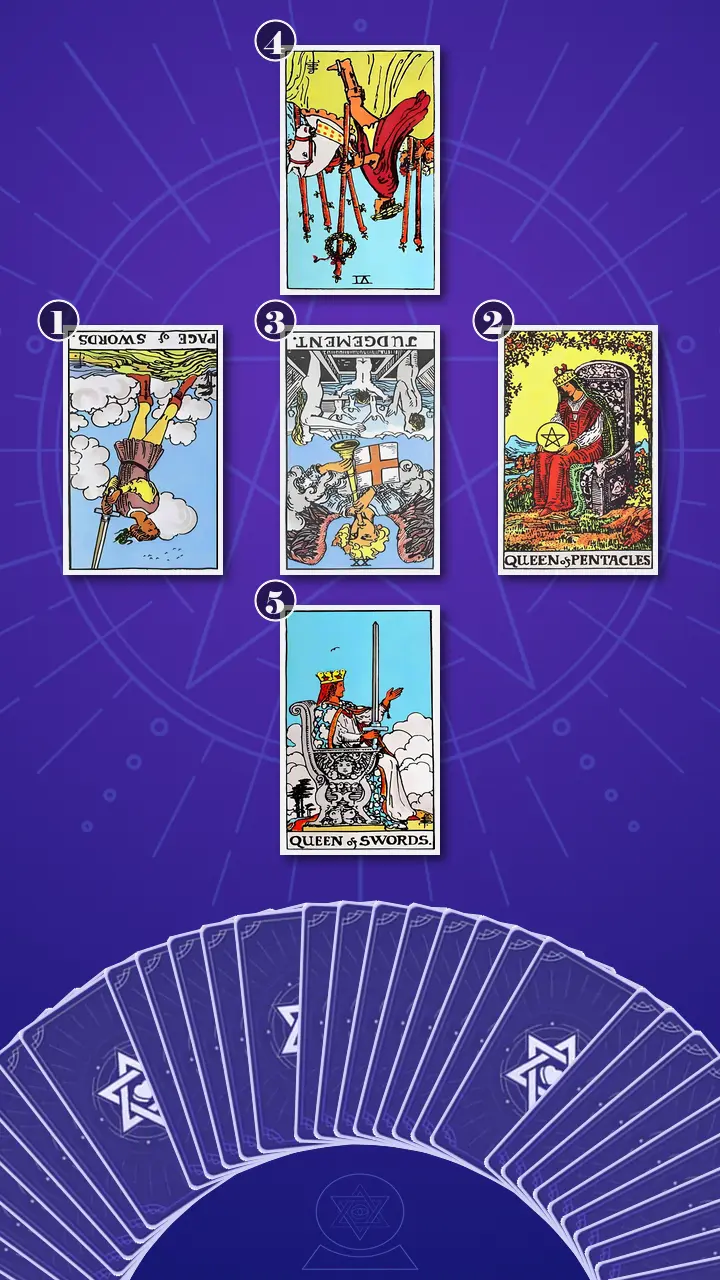
I showed her the cross as I laid it down. The card on the left would show her immediate self-state when the text lands. The card on the right would show her mother's likely care style. The center card would reveal the meaning-making filter that turns help into judgment. Above it would sit the deeper wound underneath the reaction. Below it, the clearest next response. Read together, the layout looked like a compass: two people on the horizontal line, inner truth on the vertical one.
Reading the Cross: Where the Thread Turns Into a Courtroom
The First Flinch
The first card I turned was the one showing Maya's immediate self-state and observable reaction when the job link lands. It was the Page of Swords, reversed.
I told her this was the exact energy of a mind that does not receive information neutrally because it is already braced for impact. In modern life, it looks like this: your phone buzzes in the middle of a job-search morning, you reread the wording, notice the time stamp, wonder why this role, draft two replies in Notes, and somehow twenty minutes pass before you even open the actual posting. It has the same nervous-system spike as a Slack message that says "quick question" when you are already afraid you are underperforming.
Energetically, this is Air thrown off balance. Thought is not helping you think clearly; it is threat-scanning. The raised sword on the card becomes the posture of your whole body with the phone in your hand—jaw set, ribs tight, shoulders slightly forward, ready to defend before there is a real attack to defend against.
Maya let out one short laugh that had more sting in it than amusement. "So basically," she said, "I'm doing FBI analysis on punctuation instead of reading the role." I nodded. "Yes," I said. "And that doesn't make you dramatic. It means your mind is trying to protect you by getting ahead of the pain. The trouble is, it starts treating information like a threat."
The Care Package in Link Form
The second card showed the likely care style or practical intention being perceived from the other person, without pretending that intent automatically cancels impact. It was the Queen of Pentacles, upright.
Whenever this Queen appears in a relationship reading, I pay attention to how love is being expressed through usefulness. Some people send soup, weather alerts, apartment listings, grocery coupons, or an article they think will help. Some send job links. This card felt very much like, "I found something tangible and wanted to place it in your hands." A care package in link form.
That did not mean Maya had to like the timing or the format. It did mean the likely mode behind the text was provision, not a hidden indictment. I told her, "Intent and impact are not the same thing. Neither are support and surveillance." Then I asked the softer question that often opens a door without forcing forgiveness: "What if this was clumsy care, not coded criticism?"
I watched the tension shift by a degree. Her jaw loosened. Not all the way, but enough. That is often how the Queen of Pentacles works in real readings: not as instant peace, but as the first possibility that the practical gesture may not be saying what shame insists it says.
The Loudspeaker in the Middle
The next card was the center of the spread, the place that reveals the meaning-making filter between message and meaning. It was Judgement, reversed.
This was the choke point. I told Maya that this card was not really about her mother at all; it was about the inner system that turns a neutral prompt into a verdict. The pattern sounded like this: "She sent a link" becomes "She thinks I'm not doing enough" becomes "I need to defend myself or disappear." A normal text thread becomes an invisible review panel. One small notification and suddenly your stalled applications, your current title, your whole search history feel like they are on a bright projector.
The radiator in my room knocked once against the wall just then, sharp as a gavel, and I remember thinking how perfectly the environment had joined the reading. When I see Judgement reversed, I often think of old Highland fog: a fence post can look uncannily like a person watching you from the hill. The landscape has not accused you. Visibility has changed. In this card, a phone notification becomes that fence post—ordinary, but loaded by the body before the facts catch up.
I asked her quietly, "How many times has the conversation become a courtroom before anyone else has said a single critical word?" She looked straight at the card and gave a small, pained nod. "That fast," she said. "Every time." That was the moment of deep recognition. Not because the card judged her, but because it finally named the speed of the pattern.
The Invisible Audience
The fourth card sat above the center, where the deeper wound and underlying fear live. It was the Six of Wands, reversed.
This card showed me that the pain was not only about her mother's texts. Underneath them sat a much older and more exhausting question: what will this say about me if this is where I am now? The Six of Wands reversed is what happens when healthy pride gets tangled with visibility. Instead of asking, "Do I want this role?" you start asking, "Will this sound respectable enough on a family call?" It is LinkedIn used as a scoreboard instead of a tool. It is feeling like your job search has an invisible audience even when you are alone in your apartment.
In elemental terms, this was blocked Fire. The part of the self that should move with direction and self-belief had been outsourced to applause, status, momentum, being seen as on track. No wonder every outside suggestion stung. If worth is already fragile, practical input lands on the fear of public exposure. And with so little Water in the spread, the feeling itself is not being felt cleanly; it is being translated straight into thought, defense, and performance.
Her throat moved before her words did. She looked away toward the window, then back to me. "The invisible audience part got me," she said. I answered exactly as I felt: "Of course it did. If the search already feels public inside your own mind, every text is going to sound like it comes with a microphone attached."
When the Queen of Swords Cleared the Thread
The Antidote Beneath the Cross
When I turned the final card, the room went noticeably quieter. A pale strip of afternoon light slid across the table and caught the blade in the image, and for a second the whole spread seemed to sharpen around it.
This was the card in the position that points to the key shift and the next response that supports stronger self-trust. It was the Queen of Swords, upright.
I love this card when someone has been living inside distorted Air, because she does not ask you to become less intelligent, less sensitive, or instantly more grateful. She asks you to become cleaner. In modern terms, she is the difference between treating every notification like an emergency and finally putting a filter on your inbox. She replaces, "What does this say about me?" with, "Is this useful, not useful, or a boundary moment?" That is the developmental arc in the spread: from the Page of Swords reversed, the vigilant scout turned threat detector, to the Queen of Swords upright, the adult mind that can tell fact from projection and speak without collapsing into shame.
Here I used one of the tools my clients know me for: Body Signal Interpretation, part of my Nature Empathy Technique. I have spent a lifetime watching weather on the hills, and bodies are not so different. A tight chest, a dropping stomach, a locked jaw—these are first alerts, not final truths. They tell me a wound has been activated before the mind starts testifying. The Queen of Swords does not ask Maya to ignore her body. She asks her to read it correctly. The message is this. The story is that. My choice is here.
I asked Maya to picture the exact moment again: LinkedIn open, coffee cooling beside her, her mother's text arriving before she had clicked a single role. Her body had already clenched before the information had even landed. That mattered, because the verdict was arriving faster than the facts.
The sentence that changed the room
The link is information. The verdict is the story.
This is not a courtroom sentence; it is your cue to lift the Queen's sword, cut your inner critic out of the text thread, and answer from clean truth.
She went still first. Her fingers, which had been tapping softly against her mug, froze in mid-motion. Then came that second phase I know well—the eyes unfocusing, not with distance, but with memory replaying at high speed. I could almost feel her mind pulling up every unread link, every clipped "I'll look later," every late-night draft in Notes that never got sent. When she finally spoke, relief did not come alone. It arrived with resistance. "But if that's true," she said, her voice low and a little sharp, "doesn't that mean I've been doing this to myself?"
I shook my head. "No," I told her. "It means you've been protecting a sore place with the fastest tool you had: analysis, defense, disappearance. That isn't moral failure. It's an old strategy. We are just updating it." Her shoulders dropped then, all at once, like a coat slipping off a hook. She took one long breath. Then another, steadier one. I asked her, "Now, using this new perspective, can you think of a moment last week when this insight would have changed what you felt?" She nodded before she answered. "Tuesday," she said. "I would have saved the link for later instead of acting like I needed to build a case." That was the real crossing in the reading: from shame-triggered defensiveness to self-trusting clarity and cleaner boundaries, from bracing to sorting.
From Fact / Story / Need to Cleaner Boundaries
When I stepped back from the full spread, the story was remarkably clear. On one side sat Maya's reactive, overclocked mind, already scanning for danger. On the other sat a mother likely speaking in the language of practical care. Between them, dead center, was Judgement reversed—the inner evaluator hijacking the exchange and converting a simple job link into evidence of failure. Above it sat the deeper wound: self-worth tied to looking competent, visible, and on track. Below it sat the antidote: the Queen of Swords, asking for discernment, truthful language, and respectful boundaries.
Her blind spot was not that she needed to be more grateful. It was that she had been treating the first sting in her body as proof that the story was true. In my Elemental Balance lens, the spread was all dry weather: Air everywhere, Earth trying to help, Fire blocked around recognition, and almost no Water at all. In ordinary language, that means there were plenty of thoughts and plenty of practical inputs, but very little room to simply feel the hurt without cross-examining it. That is why unsolicited career advice felt invasive so quickly. The path forward was not to accept every job link. It was to stop letting shame translate it for her.
I gave her three small steps, because actionable advice works better than grand speeches when somebody has been living with decision fatigue.
- Fact / Story / Need FilterThe next time her mother sends a role, Maya is to open a pinned note on her phone, copy the exact text message into it, and spend five minutes writing one line under three headings: Fact, Story, Need. Fact is what was literally said. Story is what her inner critic added. Need is the clean next option: reply, save, decline, or ask for space.If her chest is already tight, I asked her to use my five-minute balcony energy awakening practice first: step onto a balcony, stoop, or open window, feel the air on her face, soften her jaw, and name one fact out loud before touching the thread. A pause is not rudeness.
- Boundary-First ReplyIn one calm moment this week—not right after a trigger—she is to text her mother one honest boundary. The script I suggested was: "I know you mean well, and I appreciate that. Job links feel overwhelming unless I ask for them first. Could you check with me before sending?" If that felt too exposed, the lighter version was: "Please batch them for Fridays, and I'll review when I'm in job-search mode."Keep it to two sentences. Draft it in Notes first if that feels safer. Clear is kinder than clipped.
- Unseen Win PracticeOnce this week, she is to choose one career task nobody else will see—tailor one resume bullet, clean up portfolio file names, or research salary ranges for a single role—and do only that for fifteen minutes with her phone on Do Not Disturb.When the timer ends, she is to write one sentence that begins, "This mattered because it helped me..." not "This will make me look..." If fifteen minutes feels heavy, five minutes still counts.
These steps were small on purpose. When someone is searching for how to set boundaries with parents about job hunting, the answer is rarely a dramatic confrontation. More often, it is one cleaner response, practiced enough times that the inner courtroom begins to lose its authority.

A Week Later, the Quiet Proof of Finding Clarity
A week later, Maya sent me a screenshot. She had texted, "Please ask before sending roles, or batch them for Friday and I'll look then." Her mother replied, "Okay, love." Maya celebrated alone in a coffee shop with one solid application sent—lighter, still a little shaky, but no longer rehearsing a defense.
That is how clarity usually arrives. Not as perfect certainty. Not as a magically friction-free relationship. The five-card relationship spread had not changed her mother into a different person. It had given Maya her steering wheel back. She could now tell the difference between support and projection, between contact and condemnation, between a body alarm and the truth.
If tonight you recognize that chest-locking moment, remember this: when one small text can send your mind straight into building a defense case, you are usually not reacting to the link alone; you are reacting to the fear that other people can see you as not enough.
If the next job link did not have to become a courtroom, what would you want to do with it instead—ignore it, save it for later, or lift your own Queen's sword and answer with one honest boundary?
Every reading at AceTarot is a Journey to connect with inner wisdom and empower next step.
Learn more about our Journey to Clarity.