When the "I'm Nearby" Text Hit, Hello Came Before Sorry

Finding Clarity in the Text That Says “I’m Nearby”
If you’re a late-20s city renter with a full-time job and a small apartment, and one “I’m nearby, can I come up?” text turns into instant messy apartment shame, I know exactly how specific that panic feels. When Maya (name changed for privacy) sat down with me, she did not ask what her friend would think of the apartment. She asked a sharper question: what old fear makes me apologize for the mess before anyone says anything?
As she described the moment, I could see it clearly: 6:18 p.m. on a Thursday in a small Toronto rental, right after work, phone warm in her hand, sink carrying that faint mix of coffee and dish soap, overhead light doing that slightly brutal rental-apartment glare. A text lands. She is genuinely happy for half a second. Then she spots the dishes, the chair with clothes on it, the chargers and receipts by the sofa, and her hands start sweeping everything into the canvas basket like she is hiding evidence before a surprise inspection.
“I know it’s normal clutter,” she told me, rubbing her thumb over the edge of her sleeve, “but it still feels embarrassing. I need to explain it before it looks worse than it is.” The shame she described was not abstract. It was a hot rush under the skin and a pair of busy hands moving so fast they almost outran thought, like she was trying to erase a one-star review of her adulthood before anybody had even written it. You wanted company ten seconds ago; now your body is acting like an inspection is coming.
I nodded and said what I say often in readings like this, the kind people usually search for at midnight with phrases like “why do I apologize for my messy apartment before anyone says anything?” Home is not a report card. “We’re not here to judge your sink,” I told her. “We’re here to trace the fear that made the sink feel like proof. Let’s make a map of the moment, and then let’s find the clarity underneath it.”

Choosing the Shadow Spread for an Old Fear
I asked Maya to place both feet on the floor and take one slower breath out than in. While she did that, I shuffled slowly and misted a barely-there citrus note into the air beside my table. Not as magic, just as a clean sensory marker that we were moving from reaction into attention.
For this session, I chose The Shadow Spread, a compact four-card tarot reading I use when the real question is not prediction but pattern. It is especially useful for messy apartment shame, fear of being judged at home, and other moments when the visible behavior is only the top layer. Instead of asking what the friend will think, this spread traces the whole chain: the surface reaction, the older emotional script beneath it, the medicine that can interrupt the loop, and the grounded next step that puts insight back into ordinary life.
I explained the structure plainly. The first card would show the apology reflex itself: what her speed-cleaning and over-explaining were trying to manage in the first ninety seconds before the door opened. The second would take us into the older layer, the hidden rule that made normal clutter feel loaded. The third card, the heart of the reading, would show the antidote. The fourth would bring us back upstairs, so to speak, to the front door: how to host, connect, and stay present without shrinking.
I like this spread because it moves the eye downward through the stack like walking into a basement memory, then back toward the threshold. For a question like Maya’s, that is exactly how clarity works. We go down to the old fear. Then we come back up and answer the door differently.
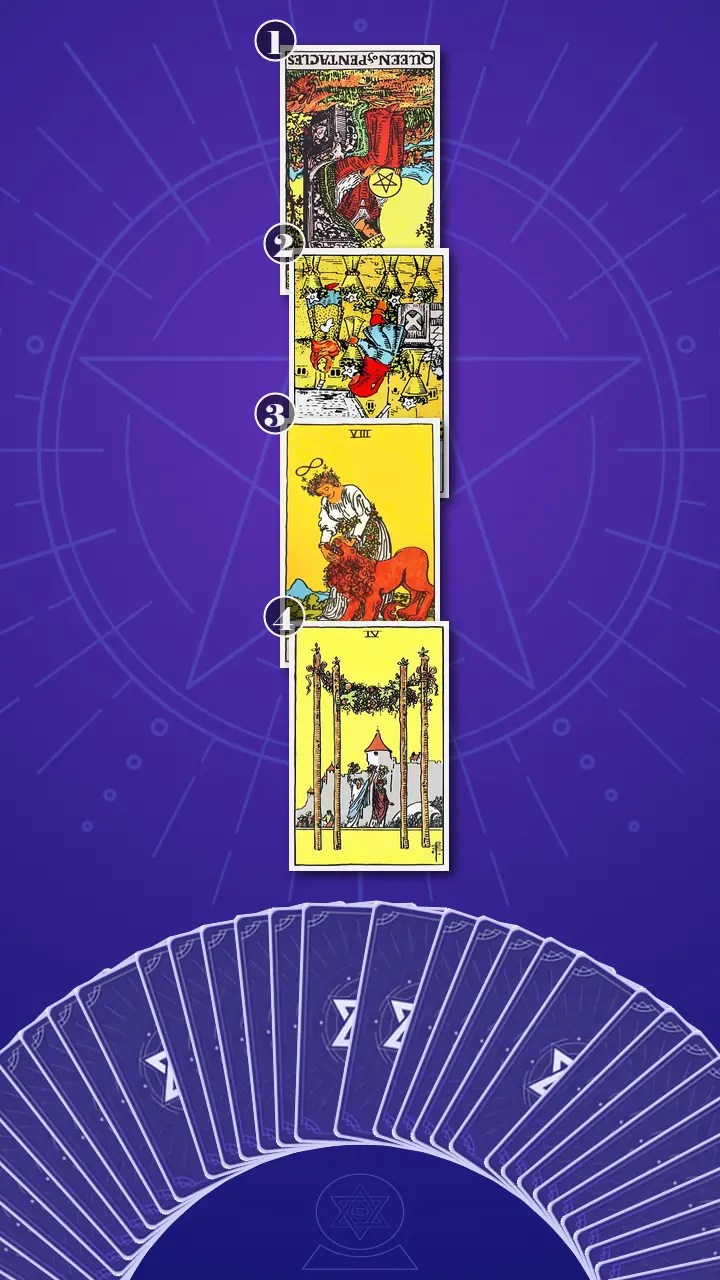
The Room That Became a Report Card
Position 1: The Apology That Tries to Get There First
I turned the first card and said, “This position presents the surface trigger and the concrete behavior around the apartment: what the apology is trying to manage in the moment.” The card was the Queen of Pentacles, reversed.
This was painfully accurate. In context, the Queen of Pentacles reversed is not about being bad at home life. It is about care turning against itself. Maya’s apartment had stopped being a normal, overused city space and started acting like evidence. The card translated directly into the modern scene she had described: the second the “on my way” text arrived, a casual visit turned into a self-worth emergency. She speed-wiped the counter, hid clutter in the bedroom, and apologized for the mess before her friend had even taken off her shoes. It was exactly like seeing her place through the imagined camera angle of a TikTok “clean girl apartment” tour and deciding she had already failed.
The energy here was blocked Earth. Too much meaning had been packed into material details. The dishes were not just dishes; the laundry chair was not just a doom pile; the cables by the sofa were not just life admin. They had become symbols in a private trial about whether she was competent, lovable, fully adult. In my own Social Pattern Analysis lens, the hidden interaction barrier was clear: the apology was making the room the main character before the friendship even got a line.
Maya let out a quick, bitter laugh. “That’s so accurate it’s almost rude,” she said. Her shoulders lifted, then dropped an inch. I smiled. “It’s not rude,” I told her. “It’s precise. You want easy friendship, but the pattern performs damage control instead. That’s why it feels so exhausting.”
Position 2: The Older Script Behind the Doorbell
I turned the next card. “This position reveals the older emotional script beneath the trigger, including the learned fear of judgment that makes a normal mess feel loaded.” The card was the Six of Cups, reversed.
This was the deeper layer. Six of Cups reversed told me the shame spike was older than the room. When someone was about to come over, Maya was not only reacting to dishes or laundry. She was reacting like a younger version of herself expected correction, comparison, or a silent downgrade. It was like an old browser tab opening by itself the second the doorbell rang. Present friend versus older rule. Now versus then. Apartment clutter versus belonging threat.
I have worked with scent for fifteen years, and one thing perfumery teaches me is how fast the body time-travels. A trace of dish soap, stale coffee, hallway air, or the metallic cold of a doorknob can pull a nervous system into an older room before the mind has caught up. That is what I felt in this card. The enclosed courtyard in the image, the childlike exchange, the figure waiting near the doorway: all of it spoke of home as an emotional atmosphere, not just an address. A lived-in room is not the same thing as a failed life, but an older part of Maya was still reading it that way.
Her reaction came in a quiet three-step sequence I have learned to watch for. First, her fingers froze around the water glass. Then her eyes lost focus for a second, as if some hallway memory had started replaying just behind them. Then the breath left her in a low, almost embarrassed exhale. “Why do I feel like I’m in trouble?” she asked. “Nobody’s actually doing anything. It just… hits.”
“Exactly,” I said. “This is not proof that the fear is true. It’s proof that it is old.”
When Strength Took the Door Handle
Position 3: The Medicine Card
When I turned the third card, the atmosphere shifted so noticeably that even the room seemed to cooperate; the small cedar note in the air felt steadier, and the city noise outside my window thinned into the background. “This position names the healing force that can interrupt shame and challenge the belief that worth must be earned through domestic perfection,” I said. The card was Strength, upright.
I could see exactly where Maya got caught. Her friend is downstairs. Her hand is on the cold handle. Her chest is tight, her face is hot, and her mind is already drafting a disclaimer. In that micro-second, she assumes the room needs to be managed before the person can be welcomed.
The Sentence That Changed the Sequence
You do not need to earn welcome through perfection; let the gentle hand of Strength calm the lion of shame and greet your friend from steadiness instead of apology.
I let that sit between us for a moment. Then I said, more softly, “The mess is not the part that needs to speak first. Calm warmth is stronger than shame.”
Maya did not melt into instant relief. Her reaction was more real than that. First, her jaw set. Then her brows pulled together, almost annoyed. Then she said, “But if I don’t say it first, it feels fake. Like I’m pretending I don’t see it.” That was the important resistance, and I was glad it showed up. “Not fake,” I said. “Sequenced. Person first, room second.”
This is where my background in perfumery becomes unexpectedly useful. In fragrance, I think a lot about first impression and sillage: the trace that reaches people before the full composition unfolds. In Maya’s case, the apology had become the accidental top note. It was announcing defense before connection had a chance to breathe. Strength asked for a different opening. One slower breath. Shoulders down. Warm voice on purpose. In my own terms, this was first impression calibration through sillage control: letting steadiness, not self-criticism, be the first thing that entered the room. The lion in the card did not need to be crushed. It needed a calm hand.
I watched the line land in her body in layers. The flush in her face softened. Her fingers unclenched from the glass. Her shoulders dropped with that odd, almost dizzy feeling people get when they set down something heavy they did not realize they had been carrying for years. I asked, “With this in mind, was there a moment last week when one breath and one real hello would have changed the feeling?” She gave a small, stunned laugh. “My friend literally just came in and asked if I wanted help opening the wine,” she said. “I was the only one acting like we were in court.”
That was the pivot. Not from mess to perfect order, but from anticipatory shame and self-erasure to steady welcome, warmer connection, and self-trust. Warmth lands harder than apology.
Threshold Over Showroom
Position 4: The Home That Lets Belonging In
I turned the final card. “This position grounds the insight into practice by showing how to host, connect, and stay present without self-erasure.” The card was the Four of Wands, upright.
I loved seeing this here. After the reversed Queen’s private domestic pressure and the reversed Six’s older emotional pull, this card opened the doorway. Four of Wands is not showroom energy. It is threshold energy. One clear seat. One warm lamp. One friend inside the frame. In modern terms, it was group-chat hangout energy instead of house-tour energy. The decorated threshold in the card mattered more than spotless floors. The room did not need to be polished; it needed to be enterable.
This was Fire settling into welcome. The practical shift was simple and radical at the same time: build enough structure for connection, not a full image rehab. When I said, “Don’t let the mess introduce you before you do,” Maya smiled for the first time without wincing. She could picture it. The apartment was no longer a verdict. It was becoming a place where someone she liked could actually arrive.
From Insight to Action: Warmth Before Polish
When I pulled the whole spread together for Maya, the story was clean. The Queen of Pentacles reversed showed the surface wobble: a home-based self-worth spiral where normal clutter got treated like proof of failing at adulthood. The Six of Cups reversed showed why it felt so intense: an older rule was still running in the background, making the present-day friend feel like an audience for an old fear. Strength changed the sequence by replacing self-attack with steadiness. Four of Wands turned the apartment back into what it was meant to be: a threshold for connection.
The cognitive blind spot was this: Maya had been treating imagined judgment as objective fact. She believed explanation created safety, when really it kept her in performance mode and taught her body that closeness must be earned through damage control. The transformation direction was much simpler than perfectionism likes to admit: greeting-first hosting. Not no awareness, not denial, not pretending the room was immaculate. Just person first, room second. The near-absence of Air in the spread mattered too. This loop was not going to be solved by better excuses, cleverer disclaimers, or more over-explaining. It needed an embodied shift.
- Doorway BreathBefore your next guest arrives, put one hand on the doorknob or kitchen counter, breathe out more slowly than you breathe in, open the door, and say your friend’s name first: “Hey, come in” or “I’m so glad you made it.” Offer water, a coat hook, or a seat before any room commentary.If your body likes sensory cues, use one light cedar or citrus spray by the entry. I suggested this to Maya not to disguise the apartment, but to help her nervous system register presence before defense. Minimum version: one breath and one genuine hello.
- One-Landing-Zone RuleSet a fifteen-minute timer before the visit and clear only one landing zone near the door plus one seat someone can actually use. Then turn on one warm lamp and stop. Let the rest of the room stay real on purpose.Scope creep is the trap. If fifteen minutes feels activating, do eight. If even that is too much, clear one chair. You can clear one chair without putting yourself on trial.
- Whose Voice CheckWhen the shame spike hits, open your Notes app and write the first judging sentence your mind predicts, like “She’s going to think I’m not coping.” Under it, add one line: “Whose voice is this—mine, social media’s, or an old house rule?” Then close the app after two minutes.This is interruption, not a full emotional excavation at the buzzer. Keep it factual, short, and private. The goal is to separate the present-day friend from the older script.
That was my practical takeaway for her: build welcome, not a showroom. If the pile on the chair is not a personality verdict, then the whole evening changes. Threshold over showroom. Warmth before polish.

A Week Later, the Quiet Proof
A week later, Maya texted me: “I did the one-chair thing, turned on the lamp, and said hi first. I still had the panic spike for like ten seconds. Then we ate noodles on the couch, and the apology never became the opening line.”
That is how a Journey to Clarity usually looks in real life. Not a perfect apartment. Not a personality transplant. Just a changed sequence, repeated until the body starts to trust it: from performance to welcome, from self-defense to connection, from shame to something steadier.
When someone you care about is five minutes away and your chest still goes tight because the room suddenly feels like proof against you, I know how easily belonging can get tangled up with looking completely together.
If you did not let the mess introduce you before you do, what would make your space feel one notch more welcoming tonight: one clear chair, one warm lamp, or one slower breath at the door?
Every reading at AceTarot is a Journey to connect with inner wisdom and empower next step.
Learn more about our Journey to Clarity.