Pressed Between Two Offers

Explore the pressure around backing out of an accepted offer, with related tarot cards and tarot reading insights from sessions.

Offer Reneging Pressure
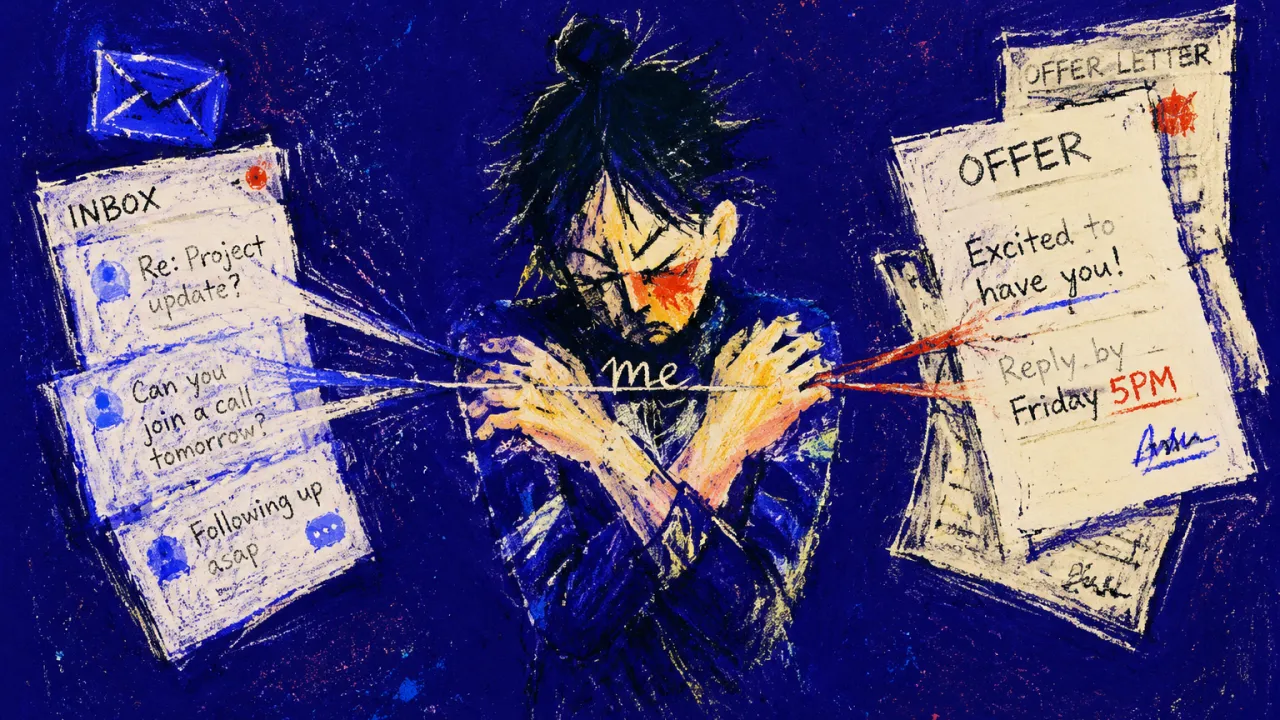
A solitary figure between two paths, offer letters and inbox threads pulling from both sides around their body

What is this situation?

Offer Reneging Pressure — you accept a job, internship, grad scheme, or contract because the deadline is tight, the email says they need your answer by Friday, and everyone around you treats a signed acceptance like the end of the decision. Then another company comes back, a recruiter reappears, a hiring manager asks if you can move fast, and suddenly your inbox becomes a stack of competing claims: one team welcoming you, another offering better pay or a cleaner path, a career adviser warning about reputation, a friend saying companies look after themselves, and an employer asking for onboarding forms as if nothing has shifted. The pressure does not come from a single dramatic moment; it comes from being copied into polished emails, calendar invites, offer letters, deadline extensions, and casual messages that all imply you should already know what the professional thing to do is. You keep rereading the first acceptance, checking the wording, comparing start dates, wondering how much damage a withdrawal could do, while the people with more power in the process speak in smooth phrases like “we just need clarity” or “we’re excited to have you on board.” Every reply feels like it might close one door publicly, and every silence feels like it might be read as disrespect. By the end, the choice is no longer just which role fits your life; it is the sensation of being pulled between two official-looking paths while other people’s timelines tighten around your name, much like the figure on the Two of Swords, seated between opposing forces with crossed blades held close to the body.

Why it's not you?

The problem is not that you are indecisive or unprofessional; the pressure is built into a hiring process that asks for commitment before all the information has arrived. Competing deadlines, reputation warnings, recruiter urgency, and polished employer language can turn a normal career choice into a public-feeling bind. This situation has a shape of its own, and it is bigger than your personal ability to “just decide.”

Offer Reneging Pressure in Tarot Cards

Offer Reneging Pressure turns a career decision into a narrow corridor of deadlines, signed emails, recruiter follow-ups, and reputation warnings. The tightness in your chest when another message lands is not floating in isolation; it belongs to an environmental, structural dynamic where institutions compress your options and make each reply feel loaded. The cards below do not decide which offer deserves your yes; they reflect the pressure lines, trade-offs, and competing claims surrounding the situation. Here are the Tarot Cards that tend to mirror this kind of offer reneging pressure.

The Hierophant
Upright
The robed authority sits between institutional pillars while two acolytes kneel below and crossed keys rest at his feet. The hierarchy mirrors career advisers, recruiters, managers, and professional conventions that present one approved definition of honourable conduct: acceptance should produce loyalty, even when the hiring market supplies relevant information late. The upright institution offers a recognisable code, but it also reveals who has the authority to define that code. You can see how reputation pressure gains force through repeated social rituals and polished language, not necessarily through a transparent assessment of the candidate's changing circumstances.
Reversed
The robed authority, crossed keys, and two kneeling acolytes place legitimate conduct inside an institution that defines the approved path. Reversed, the keys do not provide easy access to a self-authored professional standard; inherited rules such as “an acceptance is final” continue to control the frame even when the hiring process supplied incomplete information. The reversal exposes a blocked distinction between ethical communication and automatic obedience to convention. You may treat revision as a character failure because institutional language has fused professionalism with compliance, leaving little cognitive room to examine whose flexibility the rule protects.
The Lovers
Upright
The two figures stand in an open landscape beneath an angel, with different trees behind them and a mountain rising between their positions. The image places two distinct value environments inside one consequential field, echoing the choice between an already accepted role and a later opportunity that may offer better pay, culture, trajectory, or alignment. The upright openness keeps the decision connected to explicit values rather than secrecy or reflexive loyalty. You can see why a technically valid first acceptance may no longer represent the strongest overall fit once the second path becomes concrete.
The Chariot
Upright
The armoured driver stands above black and white sphinxes that face apart, with the city behind and no visible reins connecting his hands to their movement. The opposing figures resemble two employers pulling on different timelines, while the formal armour reflects the professional persona you are expected to maintain throughout the conflict. The upright chariot preserves a forward-facing position even when the forces underneath it are not naturally aligned. You can recognise that long-term direction depends on recovering authorship from recruiter urgency, onboarding momentum, and reputation warnings rather than allowing whichever institution moves fastest to steer the entire career route.
Reversed
The black and white sphinxes sit before an armoured charioteer who holds no visible reins, while the city and starry canopy establish an official, achievement-coded setting. Reversed, the vehicle retains status and potential power but lacks coordinated movement, closely matching two employers whose incompatible demands leave no shared mechanism for steering the career transition. The stalled chariot shows how external urgency can occupy the place where direction should be. You may feel pushed to preserve whichever path already has momentum, even when compensation, development, and long-term fit point elsewhere, because other people's deadlines are exerting more force than your own career horizon.
Justice
Upright
The level scales, upright sword, square crown, and formal pillars create a scene of documented accountability. That setting mirrors the offer letter, written acceptance, onboarding trail, and reputation calculations through which a career choice acquires the atmosphere of an official proceeding. The upright scales keep proportional evaluation available instead of allowing the first employer's preferred narrative to define the whole case. You can separate what was actually agreed, what each role materially offers, and what professional consequences are evidenced from the broader fear that withdrawing automatically makes you untrustworthy.
Reversed
The scales in one hand, raised sword in the other, and stone pillars frame a system that claims to measure commitments consistently. Reversed, that architecture cannot deliver procedural balance when an employer requires an early answer, another employer releases information later, and only the candidate is warned that changing position may damage a reputation. The inverted structure makes equal accountability unavailable even though the language of professionalism remains formal and polished. You carry the visible burden of correcting the mismatch while organizations retain broader discretion to delay, revise, or withdraw their own hiring decisions.
Two of Pentacles
Upright
The juggled pentacles make material trade-offs visible, while the looping cord prevents either option from being handled as a completely separate event. In career terms, compensation, development, start dates, onboarding, and reputation are being balanced inside one connected employment market rather than compared on a blank spreadsheet. The moving body shows the extra labour transferred to you when employers' processes overlap. You may already be completing forms for one team while protecting access to another, taking on the coordination burden without having equivalent control over when either organization releases information.
Two of Swords
Upright
The blindfold covers the figure's eyes while both arms remain occupied with holding the swords in equilibrium. That physical arrangement mirrors the mental workload of rereading an acceptance, rehearsing possible replies, and trying to predict reputational consequences without receiving any genuinely neutral information. The still water and guarded body show why the internal loop persists: the pressure is being held in suspension rather than resolved by the external system. You may experience every email as evidence for one side of the decision, while the deeper bottleneck is the demand to feel certain under conditions that do not support certainty.
Seven of Swords
Upright
The figure carries five swords away from an encampment while looking back at two left standing. His movement is available but exposed, making departure inseparable from awareness of how the people behind him may interpret it; this closely resembles withdrawing from an accepted role while anticipating accusations of disloyalty or evasiveness. The scene does not reduce the situation to dishonesty. It shows how asymmetric reputation power can turn a legitimate career revision into strategic movement, where you monitor wording, timing, references, and who might hear about the decision because a direct exit does not feel socially neutral.
Eight of Swords
Upright
The blindfolded figure stands bound within a loose enclosure of swords, with water at her feet and a castle visible beyond the barrier. The image captures the internal replay of professional restrictions: the signed email, the welcome message, the fear of blacklisting, and the assumption that every possible response violates a rule. The upright gap in the swords keeps the difference between pressure and total prohibition visible. You can audit which fears are supported by specific terms or credible career consequences and which have been enlarged by authority language, imagined public judgment, or the discomfort of disappointing an employer.
Nine of Swords
Upright
The figure sits upright in bed with hands covering the face while nine swords line the dark wall overhead. The repeated blades resemble every possible version of the withdrawal email, recruiter reaction, damaged reference, or future interview question being replayed after the workday has ended. The upright image makes the mental cost visible without turning every feared consequence into a fact. You can recognise that the inbox has been internalised as an overnight reputation tribunal, allowing the objective employment decision and the multiplying imagined audiences to be seen as different layers of the same pressure.
Knight of Swords
Reversed
The knight drives a white horse forward with a raised sword while clouds and trees are pushed by the same violent wind. Reversed, the scene makes acceleration outrun visibility: recruiter urgency, Friday deadlines, and demands for immediate clarity move faster than the candidate can verify terms or compare the two roles. The path is blocked not by a lack of possible action but by a process that treats speed as proof of professionalism. You are being asked to produce certainty at the tempo most useful to the employers, even though that tempo may prevent a coherent reading of the actual career tradeoff.
Two of Wands
Upright
One wand is secured to the battlement while the figure grips the other and studies a globe above the open land and sea. The fixed wand resembles the accepted job already attached to your professional identity, while the held wand represents the later offer that has become actionable but not yet secure. The upright viewpoint provides enough elevation to compare the options as different futures rather than different email threads. You can see the real choice between preserving a known position and accepting the exposure required to pursue a path with greater range or fit.
Three of Wands
Reversed
The robed figure watches ships moving across a distant sea while one hand rests on a planted wand. Reversed, those ships no longer provide a dependable arrival sequence: the candidate has already anchored one commitment when the expected response from another recruitment process finally reaches shore. The delayed arrival does not restore the earlier decision window; it creates an overlap with onboarding, start dates, and reputation concerns. You are forced to process late information as urgent information because separate employers' timelines have converged only after one path appeared settled.
Eight of Wands
Upright
Eight parallel wands fly diagonally across a clear sky above a river and distant buildings. Their shared velocity mirrors the sudden run of recruiter messages, offer emails, calendar invitations, and onboarding requests that turns a considered employment decision into a rapid-response environment. Nothing in the landscape slows the incoming movement, so speed begins to look like the only legitimate rhythm. You may feel that each hour of silence communicates disrespect, even though the urgency comes from several organizations accelerating around a decision whose consequences will last far longer than their email windows.
Ten of Wands
Upright
The figure bends beneath ten staffs and carries the whole bundle toward a town that is visible but not yet reached. The load resembles the accumulated offer letters, onboarding forms, comparison notes, adviser messages, and response deadlines that turn one career decision into a full layer of unpaid administrative work. The upright path still reaches the town, making the burden finite and observable rather than proof that you have failed to cope. You are carrying tasks generated by two employer systems at once, and the card makes the hidden lifestyle cost of that overlap visible: even minor replies become heavy when every message appears professionally consequential.

Offer Reneging Pressure in Tarot Card Reading Insights

When Offer Reneging Pressure shows up, people often bring the same crowded inbox, deadline squeeze, and competing professional expectations into a reading. The shift from cards to readings shows how this situation can appear when someone is trying to see the whole pattern before replying. Tarot Reading Insights from sessions involving this kind of pressure are gathered below.

Psychological Contexts Related to Offer Reneging Pressure