Always the Group Photographer? What Happens When You Stay in the Frame

The Carousel on Line 1
If your job rewards responsiveness and keeping chaos contained, and by the weekend you somehow become unpaid social admin for your friends, the ache that follows can feel embarrassingly small and weirdly sharp. That was the energy Maya (name changed for privacy) brought into my reading room: the part of her that could run a client timeline all week was still clocked in on her days off, as if Severance had leaked into brunch. This is how people-pleasing in friendships often hides in plain sight: always being the designated group photographer, never quite calling it loneliness.
She told me about 8:47 p.m. on Line 1 southbound from Bloor-Yonge. The fluorescent lights buzzed overhead, the train jolted at every stop, and her phone felt warm in her palm as she scrolled a birthday Instagram carousel from a night she had genuinely enjoyed. She was in the comments, not the pictures. Her throat tightened, her shoulders pulled inward, and that small drop in her chest landed again—the feeling of standing outside a window she had cleaned for everyone else.
“Why am I always the one taking the group photo?” she asked me. “Why do I feel left out even when I’m with my friends? At dinners, birthdays, even random park hangs, I just… do it. I line everyone up, make the moment happen, and later I feel weirdly excluded by something I helped create.”
I nodded. Sometimes the loneliest role in the room is the useful one. Maya was caught between wanting to belong and reflexively choosing the old part that kept her just outside the moment. “That isn’t vanity,” I told her gently. “It’s a real form of loneliness. Let’s give it a map and see what old role is still driving.”

Choosing the Compass: A Tarot Spread for Friendship Reciprocity
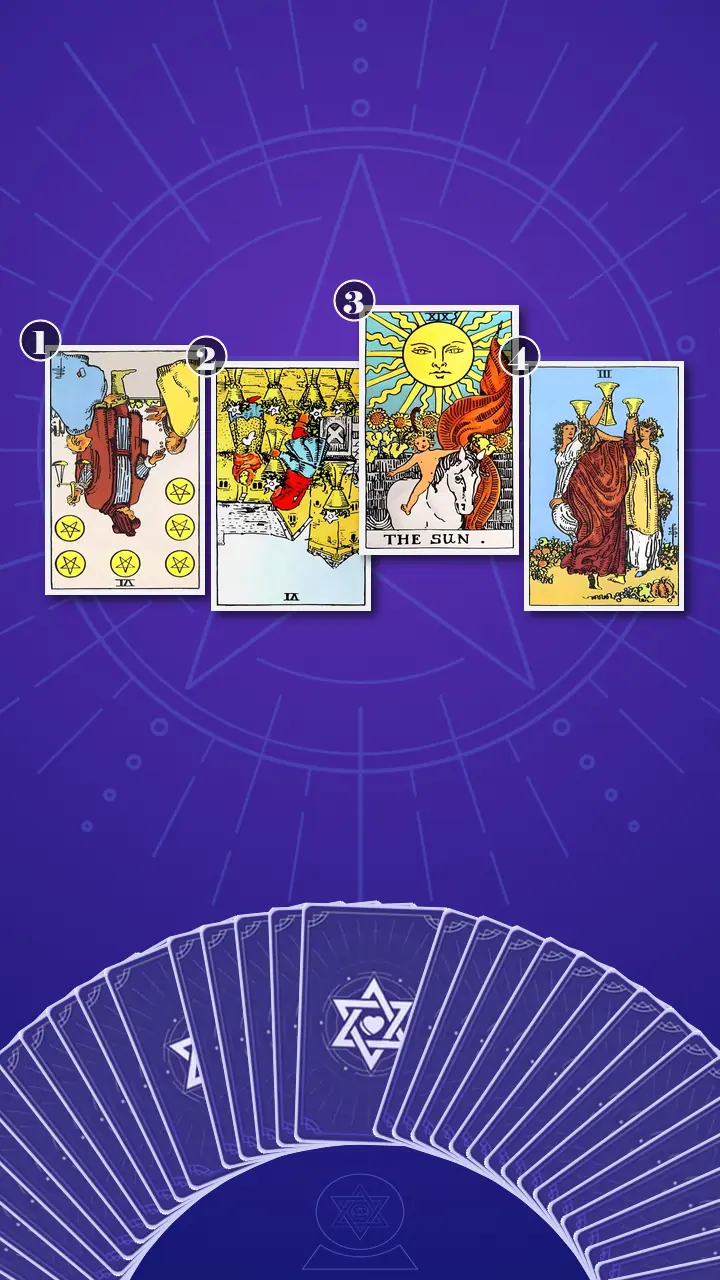
I asked Maya to take one slow breath and hold the question in her mind while I shuffled. Not for theatre; simply to bring the body and the problem into the same room. Then I laid out a four-card line I use often when someone is asking how tarot works in a practical way: the Situation-Challenge-Advice-Outcome · Context Edition spread.
I like this spread because it is compact, but not shallow. It is the smallest structure that still shows the visible symptom, the older script underneath it, the corrective energy that interrupts the pattern, and the lived alternative that becomes available after the shift. For a question about always being the designated group photographer, that matters. I did not want prediction; I wanted card meanings in context.
I told her what we would be looking for. The first card would show the habit her body grabs in social moments and the immediate emotional cost. The second would reveal the old belonging role that makes self-erasure feel familiar. The third—our turning point—would show the medicine. The fourth would show what friendship reciprocity could look like if she stopped earning belonging through usefulness.
What the Scales Remember
Position 1: The Useful Friend Who Vanishes From the Shot
Now I turned over the card that shows the observable social habit and its immediate emotional cost. It was the Six of Pentacles, in reversed position.
I pointed to the scales, the falling coins, the unequal body language in the image. “This is blocked earth,” I said. “Not a lack of care, but an imbalanced exchange. You send the Resy link, the ‘table under Maya’ text, track who is late, stack three phones in one hand, and stand up before anyone has fully decided what’s happening. Standing behind the camera gives you a role instantly. Asking, ‘Wait, can I be in one too?’ feels far more exposed.”
That is the friend-group version of getting stuck in producer mode instead of being part of the cast. The visible competence looks generous. The invisible cost is that belonging becomes a transaction: what I provide versus what I am allowed to receive. Helpful becomes a shield. Efficiency starts masquerading as intimacy.
Maya gave a short laugh that had no humour in it. First her mouth tightened, then her eyes dropped to the card, then one shoulder lifted in a tiny flinch. “Wow,” she said. “That’s accurate in a way I kind of hate.” I nodded. “Of course you do. You can feel the sting and still keep repeating the role. That’s how habits built around safety work.”
Position 2: The Old Script That Still Says, ‘Whatever Works’
Then I turned over the card that reveals the old belonging role and inherited script beneath the habit. The Six of Cups, in reversed position.
“This is blocked water,” I told her. “It usually appears when the present is still being routed through an older emotional map.” I asked her what came out of her mouth when friends said, What do you want? She smiled, already embarrassed. “Whatever works,” she said. “Or, ‘I’m easy.’”
Whenever I see this card, my mind flashes to an old Roman road I once studied—barely visible in places, yet still guiding footsteps because the ground remembers. I call that Ancient Reflection. The stone courtyard in this card feels exactly like that: an old route of closeness, learned early, still directing adult life. At some point, being sweet, useful, easy, or non-disruptive probably made connection feel predictable. Now the role launches automatically, like autofill using an old address long after you’ve moved.
“Being easy to include is not the same as feeling included,” I said. “This card doesn’t tell me you are weak. It tells me the pattern is inherited, familiar, and efficient. That’s why it feels safer to help than to have a preference.” Maya let out a long breath, her fingers uncurling from around her sleeve. “I never connected it to an old role,” she murmured. “But that lands.”
When The Sun Reached the Table
Position 3: The Antidote Hidden in Plain Daylight
When I turned the third card, the atmosphere changed. A stripe of late afternoon light slid across the table and caught the yellow field first, as if the room itself wanted to underline what we were about to discuss. The card was The Sun, upright—the key card in the spread, and the antidote to living behind the lens of her own life.
Using my Mythic Archetypes lens, I never read The Sun as a command to become louder or shinier. I read it as liberated visibility. In old Mediterranean courtyards—the sort I have spent years excavating—the daylight does not negotiate with the stone before it lands. It simply arrives. That is the medicine here: warm self-acceptance, playful visibility, uncomplicated self-trust. Not performance. Presence.
I told Maya that the hurt on the train home was rarely just about the photo. It was the aftershock of a role that keeps making the moment work for everyone else so she never has to test whether the group can hold her when she is not performing usefulness. The phone comes out, the body prepares to step aside, and the old command rushes in: don’t be needy, don’t make it weird, just keep the vibe moving.
You are not meant to live behind the lens; step into the light and let yourself be seen, like the child beneath The Sun who belongs without performing for it.
I let the sentence sit between us for a beat.
Her reaction came in layers. First her breath caught, and two fingers froze against the handle of her mug as if her body had hit pause. Then her gaze went slightly unfocused, replaying a whole archive of brunch tables, birthday dinners, Trinity Bellwoods blankets, and fluorescent TTC rides home. When she finally spoke, there was resistance in it, sharp and honest. “But if I ask for that, doesn’t it make me the one making it about me?”
“No,” I said. “It means you are finally gathering better data. If your place in the group disappears the second you stop managing it, that is not closeness. That is a role.”
Something in her face changed. The jaw unclenched first. Then the shoulders dropped. Then came that odd, almost dizzy stillness I have seen in students and clients alike when a long-carried idea is set down and the body has to remember what standing without it feels like. Her eyes brightened. Not dramatic tears—just the quick shine of recognition. “That feels… weirdly emotional,” she whispered.
“Because you are not only asking for a photo,” I told her. “You are interrupting an old survival script. And this card says you do not have to earn your place in the memory by making the moment work for everyone else. You can make the moment happen and still deserve to be in it.”
I leaned in slightly. “Now, with this new lens, think back to last week. Was there a moment when this insight would have changed how you felt?”
She nodded almost immediately. “Birthday drinks,” she said. “I grabbed the phone so fast nobody even had a chance to offer. If I’d stayed in the circle for one extra second, I think one of them would’ve taken it. I didn’t even test it.” That was the hinge of the reading: the move from useful-but-unseen loneliness toward reciprocal belonging and visible participation.
Position 4: Back Inside the Memory
Then I turned the final card, the one that shows the healthier social role available if the guidance is embodied. The Three of Cups, upright.
Three figures lifted their cups together in uncomplicated celebration. “This is flowing water,” I said. “Shared joy. Participation. The social pattern at the end of this reading is not that you stop contributing. It’s that your contribution stops being limited to backstage labour. You are in the photo dump, messy hair, half laugh, maybe mid-toast. Your warmth counts. Your presence counts. Your face counts.”
I traced the movement of the spread with my finger: from scales to cups, from being measured by what you give to being welcomed because you are there. “If you have to disappear to keep the vibe smooth, the role is working harder than the friendship,” I said. Maya smiled at that, soft and slightly sad, the kind of smile people give when hope and grief arrive together. “I want that,” she said. “I want to stop managing the memory and actually be inside it.”
Reciprocity Before Efficiency
The four cards told one coherent story. In the present, the reversed Six of Pentacles showed belonging by usefulness: the unpaid project manager in the group chat, the designated photographer, the person who holds everyone else’s tabs open until her own battery dies. Beneath that, the reversed Six of Cups showed the older road underneath it—the adapted, easy, low-maintenance role that once made closeness feel safe. The Sun interrupted the whole sequence by challenging the belief that visibility must be earned. The Three of Cups showed the replacement pattern: mutual belonging, shared laughter, and friendship reciprocity instead of quiet self-erasure.
I told Maya the blind spot was not that she helped too much. It was that she kept treating awkwardness as danger and efficiency as proof of love. Her transformation direction was simpler and braver than a personality overhaul: test whether her relationships could hold her unperformed presence. Not once forever. Just once at a time, in real life, with low stakes and clean data.
I gave her an Inscription Affirmation—the kind of sentence worth carving into memory before the next hang: You can make the moment happen and still deserve to be in it. Then I suggested three small experiments.
- First-in-the-Frame Ask At one low-stakes social plan this week—brunch, birthday drinks, a patio night—if someone says, ‘Let’s get a photo,’ say, ‘Can someone take one with me in it first?’ before you touch the phone. One sentence. About five seconds. Start with the safest group, not the hardest one. If your body shouts, ‘Don’t make it about you,’ treat that as old programming, not a command. Minimum version: text one trusted friend beforehand and ask them to help make sure you’re in the first shot.
- Celestial Tracking: North Star Before Logistics In one group chat this week, state one genuine preference before you offer any help: ‘I’d love the patio on Dundas,’ or ‘I don’t really want the loud sports bar, but I’m flexible after that.’ Let your own north star appear before you start navigating for everyone else. Do it by text if speaking live feels too exposed. Edit once, send it, and resist explaining why your preference is reasonable.
- The Handoff-the-Phone Experiment If you book the table or organize the plan, hand off one visible task—photos, playlist, rides, or the shared album—to somebody else, then let the first ten seconds of silence exist without rescuing the moment. Use this with a casual plan where nothing catastrophic happens if the group is slightly less efficient. Speed is not the goal; information is. You are learning whether the group can hold you too, not auditioning to be the least demanding person there.
None of this was about becoming difficult. It was about stopping the old default setting long enough to see whether adult friendship could offer something warmer than usefulness: visible participation, mutual care, and a place inside the circle.
A Week Later: The Quiet Proof
A week later, Maya sent me a message with a slightly crooked patio photo attached. She was in it—wind in her hair, glass raised mid-laugh, not polished, not curated, unmistakably present. “Used the line,” she wrote. “Felt cringe for literally two seconds. Then someone said, ‘Obviously,’ and took it.” A moment later, another message arrived: “Ride-home brain still asked if I was needy. But it sounded more like habit than truth.”
That is often what a real journey to clarity looks like in tarot. Not a transformed personality by next Tuesday. Just one small interruption of an old role, followed by better evidence. In this Situation-Challenge-Advice-Outcome · Context Edition spread, Maya did not become less generous; she became more visible to herself, and that made room for others to meet her there.
Sometimes the sharpest loneliness lands after a good night, when your throat tightens and the photos prove you were there for everyone else but barely let yourself be there too.
The next time the phone comes out and the old producer mode reaches for it, what might you learn if you stayed in the circle for one extra beat before slipping back behind the lens?