When a Small Argument Feels Like Home: Repair Without Disappearing
When One Small Argument Feels Unsafe on the Streetcar Home
When Jordan (name changed for privacy) sat down across from me, she gave me the kind of sentence I hear from thoughtful young professionals who can write clean copy all day and still spiral after one sharp tone at night: “I know it was small, so why does it feel this big in my body?” She was twenty-eight, a UX writer in Toronto, emotionally articulate, therapy-aware, and already tired of how searchable her problem had become. By the time she reached me, she had done the late-night rounds: why do small arguments make me panic in relationships, anxious after argument but everything is technically okay, why does conflict feel unsafe even when my partner is kind. None of it had loosened her chest.
Then she described the scene that mattered. It was 6:12 PM on the Queen streetcar after work, Notes app open, three apology drafts started and deleted before she had even decided what she actually felt. The fluorescent lights hummed overhead, winter air leaked in each time the doors sighed open, and her phone felt hot in her palm. She caught her own reflection in the dark window: shoulders braced, jaw tight, trying to look normal while internally the whole thing felt like a smoke alarm screaming over burnt toast.
It had been one small argument, but her body reacted like the room was not safe anymore. Fear sat on the surface; shame lived underneath it, quieter and meaner, asking why a shorter-than-usual text could make a grown woman feel as if something was ending. I told her what I often have to tell people at exactly this point: your body can call it danger before your mind has finished calling it small.
She nodded once. “The second the vibe changes, I want to fix it before it gets worse.”
“That makes sense,” I said. “And today, I don’t want to shame the pattern or romanticize it. I want to map it. Let’s see what from home still turns disagreement into danger, and how to find clarity without abandoning yourself inside the conversation.”

Choosing the Compass: A Simple Cross for Conflict Feels Unsafe
I asked her to place both feet on the floor, take one slower breath than her body wanted, and hold the question plainly: “We had one small argument—what from home makes conflict feel unsafe?” Then I shuffled. For me, that moment is not theatre. It is focus. A ritual can do what good field notes do in archaeology: mark the layer we are about to examine.
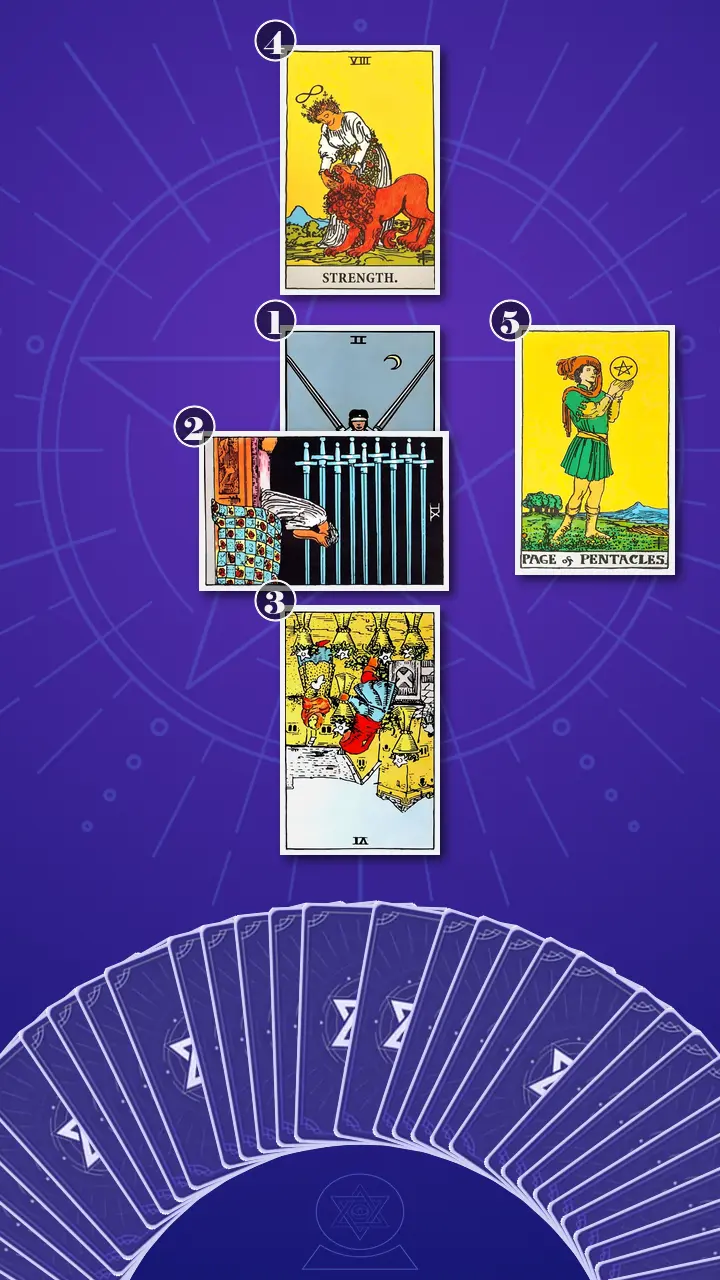
For this reading, I chose the Simple Cross, a five-card tarot spread for conflict anxiety and childhood patterns. I use it when someone needs clarity without ornamental noise. A larger spread would add clutter. A three-card line would miss the difference between the present-day trigger and the older home script beneath it. The cross shape is useful because it shows the whole chain at once: the symptom at the center, the fear crossing it, the root below, the regulating answer above, and the next walkable road to the right. That is how tarot works when it is useful: card meanings in context, not canned definitions.
I told her where we were going. The first card would show the post-argument shutdown itself. The crossing card would reveal what made one small disagreement feel mentally enormous. The lower card would uncover the older family conditioning still firing inside her body. The upper card—usually the hinge in a reading like this—would tell us what steadier inner stance could interrupt the old pattern. The last card would give us next steps simple enough to survive a real Tuesday night.
Reading the Crossed Wires After the Argument
The Quiet That Calls Itself “I Need to Think”
Now the card I turned over for the present conflict response—the specific shutdown, hesitation, and guarded behavior that appears after one small argument—was the Two of Swords, upright.
In older books, this card is often reduced to indecision. In Jordan’s life, it looked much more specific than that: phone in hand, chat thread open, honest follow-up delayed because saying less felt safer than risking one more wrong sentence. The blindfold and the crossed swords over the chest mapped almost too neatly onto her pattern of freezing, withholding, and protecting the bond by temporarily hiding her real experience. It had the emotional logic of typing a long message, selecting all, and deleting it because sending anything felt too exposing.
Upright here, the energy was not balance but blockage—Air turned rigid. She wanted closeness after conflict, yet she was trying to achieve it by becoming less visible, like putting the relationship on airplane mode to avoid one hard notification. The freeze bought short-term calm, but it also kept repair from beginning.
Jordan gave a small laugh with a bruise in it. “That is… uncomfortably exact.”
I smiled. “Exact is better than vague. Over-apologizing is sometimes fear wearing good manners.” Her fingers, which had been wrapped tightly around her mug, loosened just enough for me to see the line land.
The Mind That Makes One Text Feel Like a Forecast
Now the card I turned over for what was actively intensifying the reaction in the moment—the thinking pattern that made the disagreement feel bigger and less safe—was the Nine of Swords, upright.
This card always knows the blue light of 1:24 AM. The conversation has ended, but the nervous system has not. Here was Jordan rereading a short “okay” text, studying punctuation like forensic evidence, building an entire future story out of one ordinary relational bump. Hands over the face, swords lined on the wall: not danger itself, but the mind opening twelve browser tabs and calling it problem-solving.
The energy here was excess—Air in overdrive. The challenge was not that she lacked insight; it was that insight had been drafted into emergency service. Catastrophic meaning-making, tone monitoring, looping replay: maybe it is already colder, maybe I should have said less, maybe I should apologize first. That is how a minor disagreement becomes conflict hypervigilance.
As I said it, a streetcar bell drifted up from the road below my window, faint and metallic, and Jordan winced as if the sound had opened the same memory. Then she exhaled through her nose. “The replaying every line part got me,” she said. “That is exactly what happens on the commute, and then again in bed.”
The Older Room Hidden Inside the Present One
Now the card I turned over for the home-based emotional script beneath all this—the early conditioning that makes present-day conflict register as danger—was the Six of Cups, reversed.
Reversed, this card often tells me that time has folded in the wrong direction. A current disagreement activates an older household rule: when tension entered the room, someone had to smooth it out quickly. In modern terms, it is like the nervous system auto-filling a password from an old account into a new login. The partner in front of her may be kind, repair-capable, and present, but her body is reacting to older emotional weather.
This was the moment my archaeologist’s mind clicked into place. In a trench, if I confuse the fresh topsoil with the ash layer beneath it, I misread the entire site. So I told Jordan I wanted to borrow something from my own work—my Time Stratigraphy Method. Before we decide what this argument means, we separate the newest layer from the older one. This conversation is now. The alarm it triggered may not be.
The reversal showed a blockage in that separation. Jordan could say, intellectually, “This is probably old stuff,” yet the enclosed domestic atmosphere of the card—the younger figures, the inherited roles, the feeling that moods shape the whole room—told the deeper truth. Part of her still believed that a shift in tone was an emergency and that staying connected meant managing the atmosphere before she could even locate herself inside it.
She went very still. First her breath paused; then her eyes unfocused as if a different kitchen had briefly overlaid the one she lives in now; then her shoulders dropped a fraction. “I know this is now,” she said softly, “but I suddenly feel younger every time.” That was the card doing its work.
When Strength Placed a Hand on the Lion
The Card That Teaches Safety Without Disappearing
When I turned the fourth card, the room changed. A pale wash of late light moved across the table and caught the lion’s mane first, as if the card wanted to announce itself before I did. This was the position of guidance—the regulating truth that could interrupt the old pattern and create a safer way to stay present in conflict—and the card was Strength, upright.
Strength is often misread as control. I have never found that convincing. In this spread it was balance: gentle courage, embodied self-trust, calm emotional regulation. Not winning. Not pleasing. Not vanishing. Just the adult self keeping one hand on the body’s alarm and the other on the truth.
At moments like this, I use what I call Historical Case Matching. Civilizations do not endure because they avoid every internal clash. They endure because they learn which alarm signals a real invasion and which one is only the echo of an older siege. A city that slams every gate at the first sign of tension does not become safer; it becomes starved. Jordan had been governing her relationship like that—treating every difficult conversation as proof that the walls were about to fail.
I told her so gently. I reminded her of the streetcar, the apology drafts, the shoulders that had not unclenched even after the conversation was technically over. That was the giveaway: her body was not only in this argument.
Not every tense moment is a replay of home; let Strength place a steady hand on the lion so you can stay in the room with the truth instead of shutting the door from the inside.
I let the sentence sit between us.
First, she froze completely—breath held halfway in, fingertips hovering above the rim of her cup. Then the recognition moved through her face in stages: her eyes widened slightly, then drifted out of focus as if two timelines were briefly running side by side, then sharpened again with that unmistakable look people get when a sentence has reached the part of them that has been doing all the heavy lifting. Her jaw unclenched. The skin around her eyes brightened. “So I don’t actually need to make it disappear?” she asked, and there was resistance in it too, a small flash of grief at how long she had believed the opposite. “I just need to not leave myself while it’s happening?”
“Exactly,” I said. “The goal is not to become a person who never gets activated. The goal is to notice when old fear grabs the wheel, and answer from the present relationship without abandoning yourself.”
She looked down at the card again. “That makes me angry,” she said after a moment, quietly but honestly. “Not at my partner. Just… that I have been working this hard to keep the peace.”
“Of course it does,” I told her. “Strength is not a verdict. It is a new stance. You were using the map your body had.” I waited until her next breath came deeper. “Now, with this lens, was there a moment last week when this would have changed how it felt?”
“On the streetcar,” she said immediately. “If I’d known I could stay with the feeling instead of solving it, I wouldn’t have drafted the apology first.”
That was the hinge of the reading: not from fear to fearlessness, but from conflict hypervigilance and self-protection to steadier repair and safer closeness.
The Apprentice Card That Makes Change Believable
Now the card I turned over for the grounded next-step practice—the behavior that begins building a new conflict experience in real life—was the Page of Pentacles, upright.
I like this card precisely because it refuses drama. It is the apprentice, the beginner at the gym learning one clean movement before adding more weight. In Jordan’s life, this meant that the next win was not a flawless repair conversation. It was one small repeatable skill: asking for a pause, returning at a set time, or checking what was actually said before apologizing for meanings she had invented.
Upright, the Page brought balanced Earth into a spread that had begun in Air overdrive. Thought had been spiraling; now practice could land. Repair gets stronger when you stop treating calm as the only proof of love. The page studies the pentacle the way a person studies a new muscle pattern: one rep, one script, one return time.
Jordan nodded differently this time—less like someone trying to prove she understood, more like someone who could imagine actually trying it on a real Tuesday evening. That is usually when I know a reading has moved from insight to utility.
From Old Alarm to Walkable Ground
When I looked across the full spread, the story was remarkably clean. At the center, Jordan shut down because conflict felt unsafe. Crossing it, the mind inflated one tense moment into a forecast of criticism, shutdown, or disconnection. Beneath both lay the older home script: mood changes had once meant that the whole emotional climate of a room could turn, so her body learned to restore peace quickly. The blind spot was not that she cared too much. It was that she had quietly started using calm as the only trustworthy evidence of connection.
That is a fragile standard for love. It makes honesty wait outside until the weather improves. The transformation this reading asked of her was simpler and braver: treat disagreement as information, respond from the present relationship rather than the old household script, and build embodied self-trust through small repair reps. In elemental terms, the cards moved from Air lock and mental overdrive, through the waterlogged layer of memory, into the warm steadiness of Strength, and finally onto Earth. As an archaeologist, I have learned that sturdy structures are rarely restored in one dramatic act; they are stabilised course by course.
So I gave her three practices—not a personality transplant, just actionable advice she could use the next time the vibe changed.
- The 90-Second Steadying PauseThe next time the apology draft opens itself—on the streetcar, in the kitchen, or in the hallway after a tense moment—I asked Jordan to put both feet on the floor for 90 seconds and write three lines in Notes before replying: “What happened,” “What I fear it means,” and “What I know right now.”If 90 seconds feels impossible, do 30. The point is not perfect insight; it is interrupting fear’s first draft.
- The Then / Now Script SplitUsing my Time Stratigraphy Method, I asked her to make a two-column note after the next trigger. Under “Then,” list three things conflict meant in the home she grew up in. Under “Now,” list three facts about the current relationship before deciding what the disagreement means.Minimum version: one “Then” and one “Now.” Pattern recognition works even when the note is tiny.
- The Return-Time Voyage LogIf she needed space, I told her not to disappear into “later.” Say one grounding sentence—“I’m feeling activated, but I want to stay with this”—and name an exact return time such as “Can we come back to this at 8?”A pause is not punishment. Leave a clear route back, the way an old navigator marks harbour before nightfall.
“What if I can’t do all that in the moment?” she asked.
“Then do the smallest possible version,” I said. “One line. One sentence. One return time. We are not trying to prove you are healed. We are giving your body evidence that conflict can be survived without you disappearing.”

A Week Later, the Quiet Proof
A week later, Jordan sent me a message I could imagine many people saving as a tiny private milestone. She and her partner had another minor flare-up, this time about plans, nothing cinematic. She felt the old chest-tightening start, opened Notes, wrote the three lines, and sent one sentence instead of an apology spiral: “I’m activated, but I want to stay with this. Can we come back to it after dinner?” Her partner said yes.
The next morning she still had the first old thought—what if I got it wrong?—but she told me she noticed it, laughed softly, and made coffee instead of turning it into a verdict. Clearer was not the same as cured. It was simply the first piece of embodied proof of something I had told her at the table: you do not have to disappear to keep the connection intact.
I have spent enough of my life studying ruins to know that what survives is rarely the untouched structure. It is the structure that learned repair. That is why I still trust a Simple Cross tarot spread for uncovering home-based conflict triggers in relationships: it can show, with startling kindness, where an old alarm is still wired into a new home, and what next step begins to rewire it.
Sometimes the loneliest part is not the argument itself, but the moment your chest tightens, your shoulders brace, and you start shrinking just to keep closeness from slipping away. If tonight you recognize that reflex in yourself, then you are already closer to finding clarity than you were before. So when the next tense pause arrives, and you feel the old urge to make it disappear immediately, what is one small truth you might let yourself stay with for a few breaths longer?